
On This Day in Wembury – 19 September 1836
Fifty-one tubs of brandy on the Mewstone
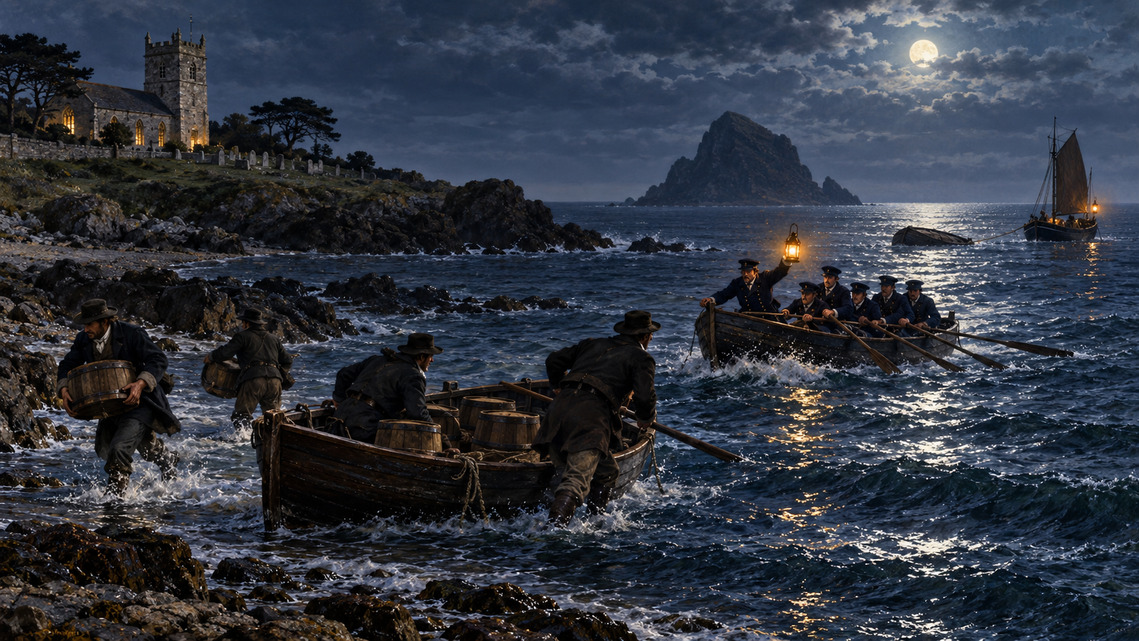
On 19 September 1836, the Morning Advertiser reported a dramatic night-time encounter between smugglers and Coastguard officers in Wembury Bay.
The incident had taken place on the previous Wednesday night, 14 September, when a party of smugglers attempted to “run a cargo” near Wembury Church. This meant bringing contraband ashore and moving it inland before the authorities could intervene.
The operation was spotted by the lookout maintained by Lieutenant John Somerville, who commanded the Coastguard station on the River Yealm. Somerville and his men set off in pursuit as the smugglers headed towards the Mewstone.
While following them, the Coastguard encountered a Cawsand seine boat floating upside down, with a Plymouth fishing boat attempting to tow it. The newspaper offered no explanation for its condition or whether it had any connection with the smugglers. In the darkness and confusion, it must nevertheless have added considerably to the drama.
A signal was made to the neighbouring Coastguard station, attracting the attention of its commander, Lieutenant Holman. He joined the operation and succeeded in capturing 51 tubs of brandy on the Mewstone.
Smugglers’ “tubs” were small wooden casks designed to be carried, concealed or moved quickly from a boat. Fifty-one of them represented a sizeable and valuable cargo. Whether the tubs had been deliberately hidden on the island or hastily abandoned as the Coastguard closed in is not explained.
Lieutenant Holman subsequently landed the captured brandy safely at the Custom House, almost certainly in Plymouth.
The Coastguard was still a comparatively new organisation in 1836. Established in 1822, its original purpose was largely to combat smuggling, although its members also assisted vessels and people in distress. Wembury’s Coastguard station, north of Warren Point, was already in existence by 1824.
The position of Wembury Church, overlooking a secluded beach with the Mewstone offshore, may appear picturesque today, but it also provided smugglers with an inviting landing place. A boat could approach under cover of darkness, unload its tubs and disappear back to sea while accomplices carried the cargo inland.
On this occasion, however, the lookouts were watching—and an attempted landing beside Wembury Church ended with 51 tubs of brandy in the hands of the Customs authorities.
Source: Morning Advertiser, 19 September 1836. Additional background: The Archaeology and Heritage of Wembury and the recorded history of the early Coastguard.
On This Day in Wembury — 19 September 1935
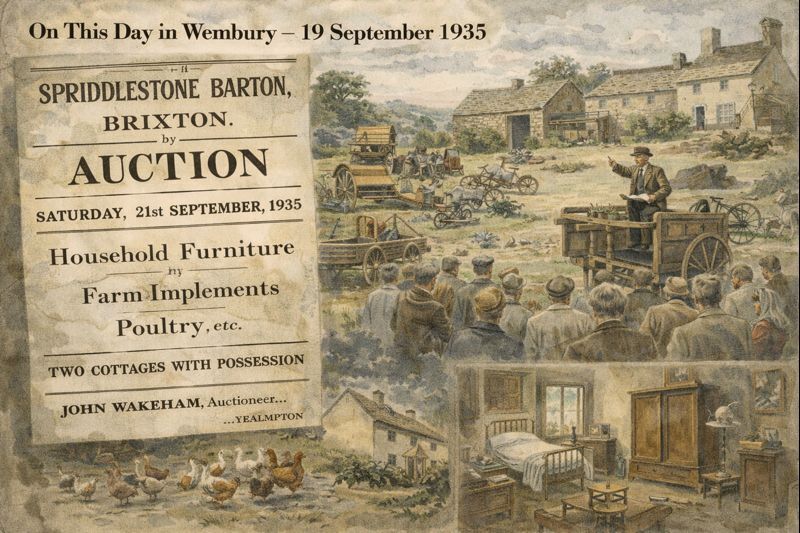
An advertisement in the Western Morning News announced that John Wakeham, auctioneer, had received instructions from the executors of the late Mr. J. N. Atwill to sell by auction the contents of Spriddlestone Barton, Brixton, just a short distance from Wembury.
The auction, scheduled for Saturday 21 September 1935, offered a full array of farm implements, household furniture, poultry, and effects. Farm items included wagons, carts, a self-binder, ploughs, harrows, a hay lift, root drill, sheep troughs, dipping apparatus, and cider pipes. Around forty young hens were also listed for sale. Inside the farmhouse, buyers could bid for oak tables and stools, iron bedsteads, wardrobes, carpets, linens, and a wide assortment of domestic furnishings.
Notably, two cottages with possession were also put up for sale, showing that the auction extended beyond the moveable contents of the farm.
Source: Western Morning News, 19 September 1935.
Reflection: Spriddlestone Barton’s dispersal fits into a long line of Wembury area estate and farm breakups recorded in the archive. From the grand sales of Wembury House and its landscaped gardens to the more modest but still significant clearances of farms and cottages, each notice charts the shifting shape of local landholding. By the 1930s, such auctions were as much a social event as a transaction — neighbours gathered not only to buy tools or furniture but also to mark the passing of one farming chapter and the start of another.
Entries are summaries and interpretations of historical newspaper reports.