
- Home
- On this day in Wembury
- 09-20
ChatGPT said:
On This Day in Wembury – 20 September 1843
A disastrous fire at Langdon Farm
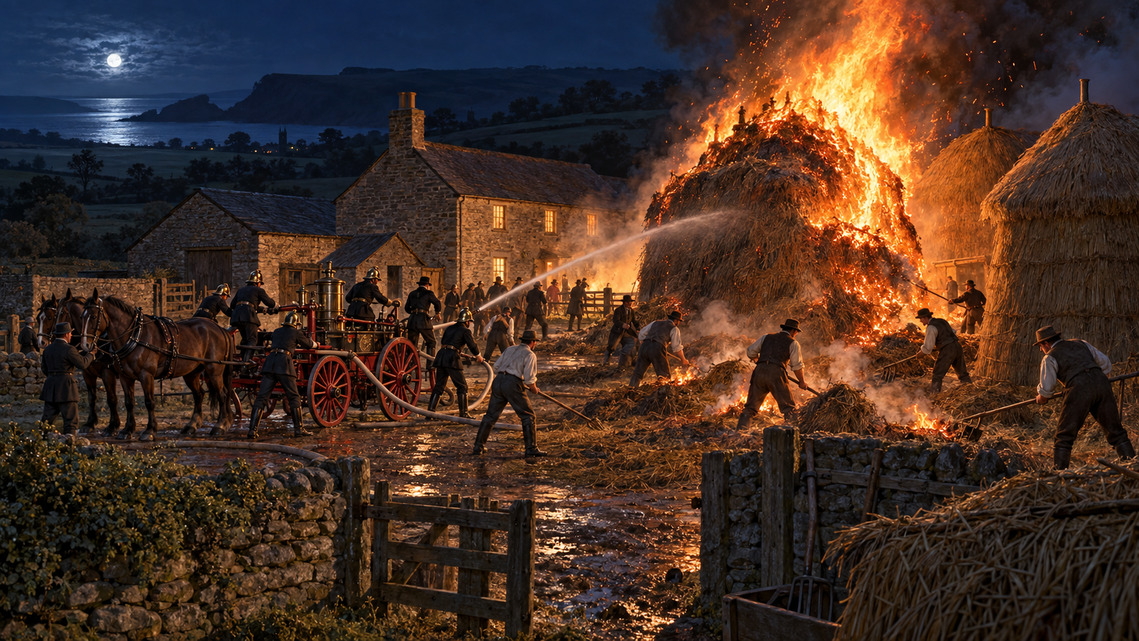
On 20 September 1843, the Western Courier, West of England Conservative, Plymouth and Devonport Advertiser reported a serious fire at Langdon Farm in Wembury.
The blaze had broken out on the previous Wednesday night, 13 September, at the farm then occupied by Mr Burrows. It was first discovered raging through a large hay mow standing close to the farmhouse and its outbuildings.
The flames soon spread to a second mow. Even more alarming was the danger to several neighbouring wheat ricks and barley mows, valued together at approximately £500. With dry straw, hay and timber clustered around a nineteenth-century farmyard, the entire property could very easily have been engulfed.
As soon as the fire was discovered, a messenger was sent to Plymouth to obtain help. Meanwhile, those at the farm began cutting away and removing the burning ricks in an attempt to prevent the flames from spreading.
At about half past one in the morning, the “powerful engine” of the West of England Fire Office arrived from Plymouth. It had been drawn all the way to Wembury by four horses and was accompanied by a large brigade of firefighters.
This was long before the modern publicly operated fire service. Fire insurance companies maintained their own engines and brigades, principally to protect insured property. The West of England Fire Office was one of the companies providing such a service in the region.
The combined efforts of the firefighters, farm workers and local helpers brought the flames under control remarkably quickly. By two o’clock in the morning—only about half an hour after the arrival of the engine—the fire was reported to have been completely extinguished.
Although the farmhouse, outbuildings and valuable corn stacks had apparently been saved, hay worth approximately £400 was destroyed. Fortunately, it was insured.
What would £400 be worth today?
Comparing money across more than 180 years can only provide a rough guide. Using changes in general prices and purchasing power:
- The £400 of hay destroyed would be equivalent to approximately £66,000 in 2026.
- The £500 of wheat and barley placed in danger would be worth approximately £82,000 today.
- Altogether, crops worth the equivalent of about £148,000 were either destroyed or seriously threatened.
Those figures compare the cost of goods and services then and now. Measured against wages or the economic importance of agricultural produce to a Victorian farming business, the loss could be regarded as considerably greater. The Bank of England cautions that comparisons over such long periods are necessarily approximate.
The newspaper added that the fire was not believed to have been started deliberately. Instead, it was thought to have resulted from spontaneous combustion.
Hay stored before it is sufficiently dry can continue to generate heat as microorganisms break down the damp plant material. In a large, tightly packed mow, that heat may become trapped until the hay eventually catches fire. It was a familiar and greatly feared danger on farms.
Langdon Farm had suffered a substantial loss, but the prompt efforts of those present—and the overnight dash of a horse-drawn fire engine from Plymouth—had prevented a much greater disaster.
Source: Western Courier, West of England Conservative, Plymouth and Devonport Advertiser, 20 September 1843.
On This Day in Wembury — 20 September 1935
Wembury Bird Sanctuary to be Opened
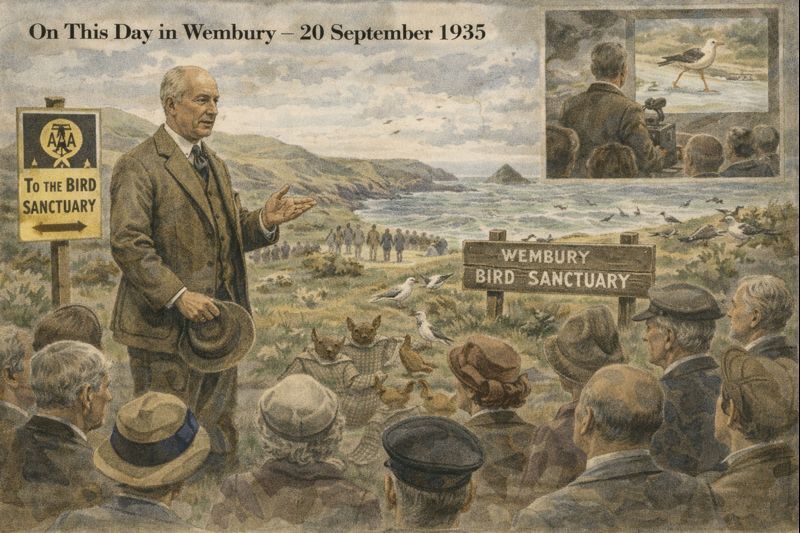
Major Anthony Buxton, D.S.O., D.L., was scheduled to open the new bird sanctuary at Wembury the following day, under the auspices of the Devon Bird Watching and Preservation Society. The ceremony was arranged for 3:30 p.m., with the Automobile Association co-operating by directing visitors from the Modbury and Kingsbridge main road to the church and on to the sanctuary. In the evening, Major Buxton was due to show his films of rare birds at Virginia House Settlement in Plymouth.
Reflection:
The formal creation of Wembury Bird Sanctuary in 1935 marked a milestone in the local conservation story. The Devon Bird Watching and Preservation Society’s efforts foreshadowed the later establishment of Wembury as part of a marine conservation area and National Trust coastline. What began with the safeguarding of birdlife against shooting and disturbance has grown into one of the South West’s best-known sites for education and environmental stewardship. It’s striking to see how early local action laid the foundation for the protection we take for granted today.
Source: Exeter and Plymouth Gazette, 20 September 1935
Entries are summaries and interpretations of historical newspaper reports.