
On This Day in Wembury – 22 September 1797
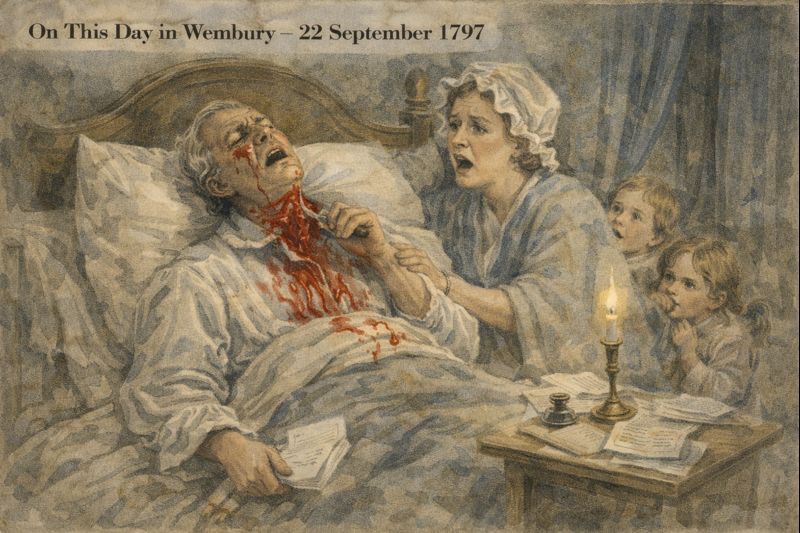
The Oxford Journal carried the report of the sudden death of the Rev. Mr. Love, Vicar of Wembury. While sitting up in bed at his Plymouth house during a long illness, he asked his wife for a penknife. In the course of a violent seizure — described at the time as “a rising of the lights and suffocation in the throat” — he tragically cut his own neck and died instantly, with his wife and children present.
The newspaper described it as an unhappy accident, and the dramatic account spread well beyond Devon, reflecting both the personal tragedy and the appetite of the late 18th-century press for sensational stories.
Source: Oxford Journal, 30 Sept 1797.
On This Day in Wembury – 22 September 1883
“You and I have not finished with this dog-case yet!”
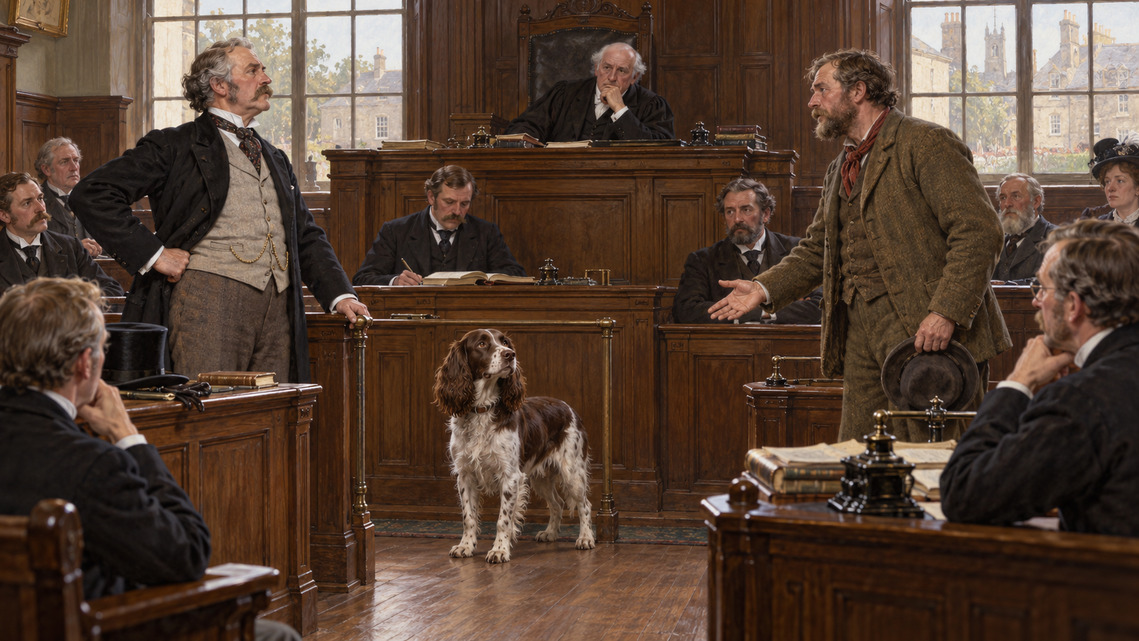
On 22 September 1883, the Western Morning News reported an unusually complicated dispute over the ownership of a spaniel named Sport.
The case was heard at Stonehouse County Court and involved Richard Cory of Langdon Hall—now known as Langdon Court—and Benjamin Bastin, a farmer from Wembury.
Mr Cory claimed that the dog had been given to him. His account began with a man named Beer, who had previously obtained Sport from Colonel Stirling. In March, Beer offered the spaniel to one of Cory’s keepers, a man named Sansom.
Sansom initially declined to buy him. Beer then reportedly asked:
“Will you have it as a gift?”
Sansom agreed and subsequently spoke to Mr Cory, asking him to give Beer a day’s rabbiting in return for the dog.
The situation became considerably more complicated when Beer later sold Sport to Benjamin Bastin. Cory therefore brought the court action to recover the spaniel—or receive payment for him.
Bastin disputed this version of events. He maintained that he had purchased the dog legitimately and said that, before buying him, he had visited the Sansoms. He had spoken to Frank Sansom, who apparently said nothing about Sport having ceased to belong to Beer.
There was also disagreement about what had been said by the elder and younger Sansom. The judge observed that the case contained a direct conflict of evidence and remarked that he wished it had been tried before a jury. Nevertheless, he believed it was reasonably clear on which side the weight of evidence lay.
Judgment was given in favour of Richard Cory for £10. However, that amount would be reduced to just £1 if Bastin returned Sport to Cory within seven days.
Allowing very approximately for changes in purchasing power, £10 in 1883 would be worth around £1,600 today. Bastin therefore had a fairly strong financial incentive to hand back the dog.
He did not receive the judgment quietly. The newspaper reported that he became “somewhat excited”, accused Cory of having obtained the verdict through lies and perjury, and announced as he left the court:
“You and I have not finished with this dog-case yet.”
Bastin also complained about the hearing and concluded that it would soon be unsafe to buy a duck in the market, in case it subsequently turned out to belong to somebody else.
Richard Cory had purchased Langdon Court in 1876. His family had made its fortune through coal shipping and bunkering, and he undertook extensive repairs and alterations to the house. In later years, Cory entertained his friend the Prince of Wales—the future King Edward VII—there.
Whether Benjamin Bastin carried out his threat to continue the dispute is not recorded in this report. Nor does it reveal whether Sport was returned to Langdon Hall. At the centre of all the contradictory evidence, accusations and courtroom indignation was one presumably rather bewildered spaniel, who had apparently been given away, exchanged for a day’s rabbiting and sold—all within the space of a few months.
Source: Western Morning News, 22 September 1883.
On This Day in Wembury – 22 September 1891
A major dispersal sale took place at Raneleigh Farm, Wembury, four miles from Plymouth. Auctioneers Endell & Symons sold 84 head of cattle, horses, colts, and a large collection of farm implements, the property of Mr. A. Tutoes.
Such farm sales were significant rural occasions, attracting neighbouring farmers, dealers, and townspeople, and often marked a turning point in the management or ownership of key Wembury holdings.
Source: Western Morning News, 5 Sept 1891.
On This Day in Wembury – 22 September 1943
A public inquiry was held into an appeal by Mr. A. S. Knight of Bournemouth, who sought permission to develop a field he owned at Wembury. Plympton Rural Council had refused the application, arguing that the land sat on a high ridge visible from sea and land, crossed by a public footpath, and any building there would spoil the rural skyline.
The Council’s clerk, Percy T. Loosemore, also criticised the way the land had been advertised for sale, warning buyers to check with planning authorities before assuming development rights.
On 11 November 1943, the Minister of Town and Country Planning dismissed the appeal, confirming the Council’s refusal and protecting the landscape from inappropriate development.
Source: Western Morning News, 1 Dec 1943.
Entries are summaries and interpretations of historical newspaper reports.