
On This Day in Wembury – 25 September 1861
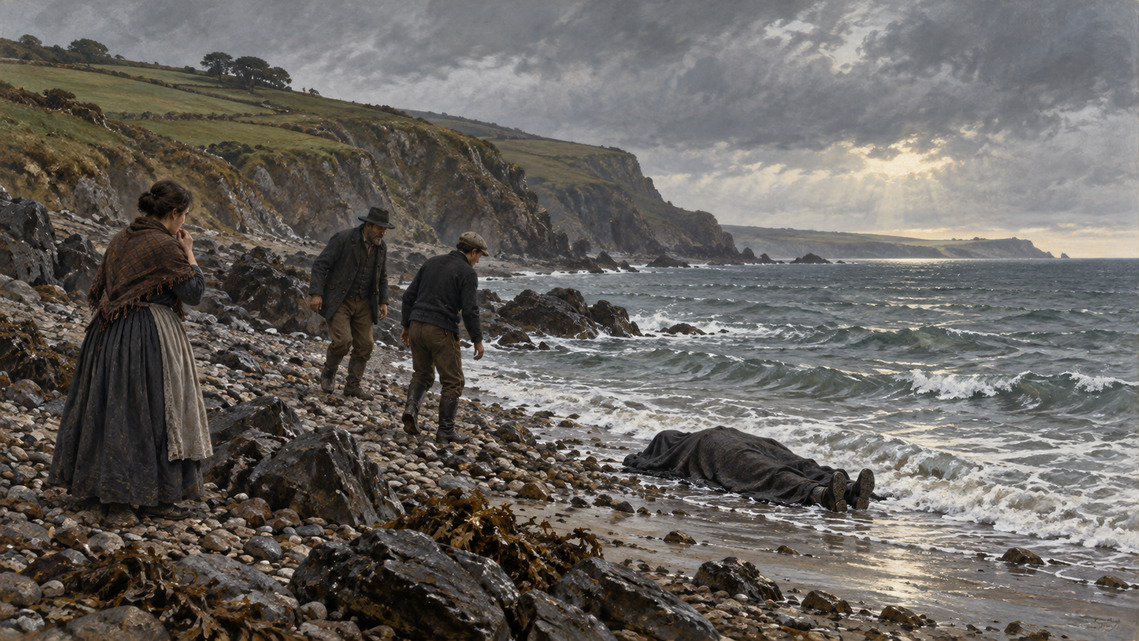
The sea returned another stranger
On 25 September 1861, the Morning Chronicle reported the discovery of an unidentified man on the coast at Wembury—a discovery which may have been connected to the unknown woman whose story inspired our song, “The Sea Never Told Us Her Name.”
The man’s body had been found on the previous Friday, 20 September, on the beach at Lentney Bay, near Langdon Barton. It was discovered by a Mrs Mole, whose husband was one of the men employed on the Plymouth Breakwater.
An inquest was held at Langdon Barton at three o’clock on the following Monday afternoon.
The condition of the remains showed that the man had been in the sea for a considerable time. There was nothing among his possessions to reveal who he was, but his clothing suggested that he was probably a sailor or someone accustomed to working at sea.
He was wearing sea-boots, black cloth trousers, a blue knitted frock, flannel drawers and a white flannel waistcoat.
On two of the flannel garments were the initials:
S. P.
Those two letters were the only apparent clue to his identity.
The newspaper then added a remarkable detail. It was thought that the man might have been the husband or a relative of the unidentified woman whose body had been found in a neighbouring bay on the same coast about a month earlier.
That surely must be the woman behind “The Sea Never Told Us Her Name.”
If so, this report changes her story. She may not have been travelling alone. Somewhere offshore, perhaps during the same accident or shipwreck, at least one man may have lost his life with her. The currents then carried their bodies into different bays and returned them to the shore several weeks apart.
It was only a theory. There was no name inside the man’s clothing, no surviving document in his pockets and no positive evidence linking the two deaths. Even the initials “S. P.” could not be connected with a known missing person.
Enquiries were made into the circumstances of his death, but without success. The jury returned the simple verdict that he had been “found dead.”
Immediately after the inquest, the unidentified man was buried.
The woman had been found first, without a name. About a month later the sea returned a possible companion, marked only by two initials. No one could establish who either of them was, where they had come from or what had happened to them.
The sea never told us her name.
And it never told us his.
Source: Morning Chronicle, 25 September 1861.
On This Day in Wembury — 25 September 1948
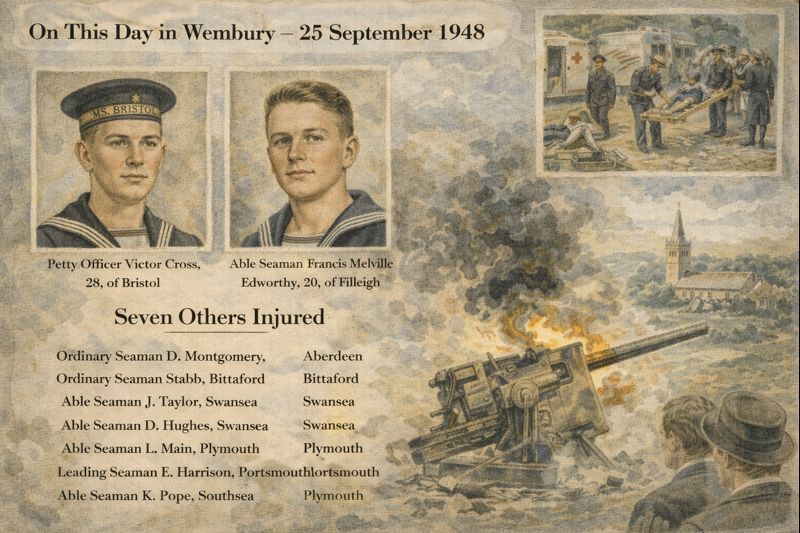
Two days after the tragic accident at the Royal Naval Gunnery Range on 23 September, the Western Morning News carried official details of the victims.
Those killed were Petty Officer Victor Cross, 28, of Bristol, and Able Seaman Francis Melville Edworthy, 20, of Filleigh, North Devon. Both died instantly when a cartridge jammed in a 4.5-inch gun exploded during training.
Seven others were seriously injured and taken to the Royal Naval Hospital, Stonehouse:
-
Ordinary Seaman D. Montgomery, Aberdeen
-
Ordinary Seaman Stabb, Bittaford
-
Able Seaman J. Taylor, Swansea
-
Able Seaman D. Hughes, Swansea
-
Able Seaman L. Main, Plymouth
-
Leading Seaman E. Harrison, Portsmouth
-
Able Seaman K. Pope, Southsea
The inquest later confirmed the cartridge was being rammed when it detonated, killing Cross and Edworthy instantly and scattering the crew.
The Wembury range and later HMS Cambridge always carried danger alongside their military role. Here the victims’ names and home towns remind us that the tragedy spread grief far beyond Devon, from Scotland to Southsea. In our archive of Wembury’s history, these entries stand not just as naval records, but as markers of ordinary young men caught in the hazards of service.
Source: Western Morning News, 25 September 1948.
Entries are summaries and interpretations of historical newspaper reports.