
On This Day in Wembury – 28 September 1946
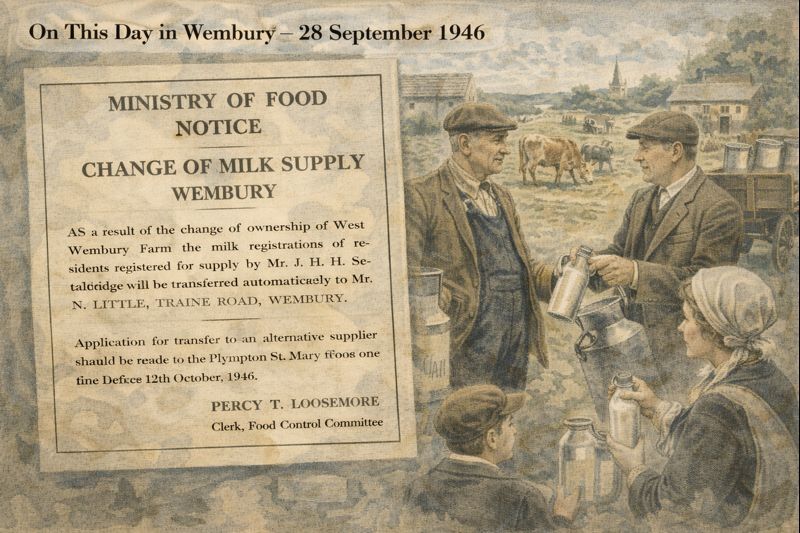
The Western Morning News carried a notice from the Ministry of Food regarding a change of milk supply in Wembury.
Residents who had been registered with Mr J. H. H. Smallridge of West Wembury Farm for their milk were informed that, due to a change of ownership, their registrations would be automatically transferred to the new proprietor, Mr N. Little of Traine Road, Wembury.
Anyone wishing to transfer their registration to a different supplier had to apply at the Plympton St. Mary Food Office before 12 October 1946. The notice was signed by Percy T. Loosemore, clerk of the Food Control Committee.
This reflects the wartime and immediate post-war system of rationing and controlled distribution, where milk and other essentials were supplied only through official registration with designated local traders.
On This Day in Wembury – 28 September 1944
At an auction held at the Law Chambers, Princess Square, Plymouth, the coastal residence “Moonstone” at Wembury Point was offered for sale.
The semi-detached property faced directly towards the Mewstone and included a large lounge, two bedrooms, kitchen, bathroom and w.c., oil-fired boiler, electricity, in-built garage, and a garden of around 6,000 square feet. The sale notice emphasised its striking location overlooking the bay and islands.
The auction was conducted by Woolland, Son & Manico (est. 1848), with local solicitors Foot & Bowden handling particulars. Telephone enquiries were directed to “Wembury 247,” one of the limited village lines of the period.
The sale of Moonstone reflects the mid-20th century wave of coastal properties around Wembury Point being marketed to buyers seeking scenic residences, even in wartime conditions.
Source: Western Morning News, 28 Sept 1944.
On This Day in Wembury — 28 September 1988
Whirlwind John!
The Western Morning News carried a cracking little piece of village cricket news on 28 September 1988, under the headline “Whirlwind John.”
The John in question was Wembury's John Weymouth, who had produced a devastating spell of bowling against Old Suttonians, taking seven wickets for just 31 runs.
Old Suttonians were skittled out for only 105, with Paul Blank providing almost the only serious resistance with 30. The newspaper reported that wickets were “tumbling around him” as Weymouth did the damage.
Wembury then had to bat — and things weren't entirely comfortable. They were reduced to 37 for 3, before recovering strongly. Colin Sly made an unbeaten 44, sharing stands with Wood and Fishlock, and Wembury eventually reached 126 for 4.
That gave the visitors a 21-run victory, with Weymouth's remarkable 7–31 very much the performance of the match.
Cricket in Wembury
Village cricket has a surprisingly long history in Wembury. A photograph preserved in the Wembury Memories collection shows the Wembury village cricket team in the 1970s, with names including David, Tony and Peter Boardman, Mike Jinks, Bill Harris, Colin Baines, Ted Wilcocks, Graham Gunby, John Montague and others — evidence of a thriving club well before this 1988 match.
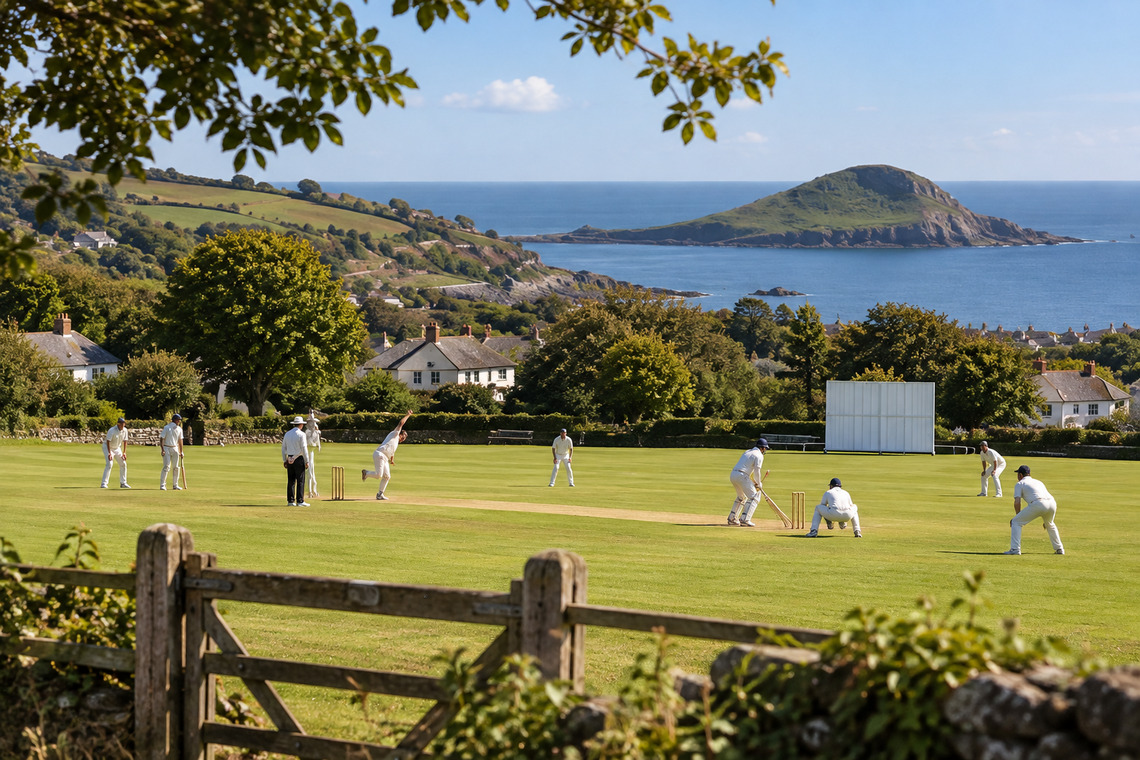
The tradition continues today at the ground beside Wembury House, now associated with Wembury Grasshoppers Cricket Club. And village cricket there still has much the same friendly character: recent reports describe Wembury matches involving players of different generations and local sides travelling around the South Hams to play one another.
But back in September 1988, there was really only one name worth putting in the headline.
Seven wickets for 31 runs. No wonder the paper called him “Whirlwind John.”
Source: Western Morning News, 28 September 1988.
Entries are summaries and interpretations of historical newspaper reports.