
On This Day in Wembury — 29 September 1803
French prisoners and the Wembury camp
On 29 September 1803, the Exeter Flying Post carried a small report which gives us a fascinating glimpse of Wembury during the Napoleonic Wars.
Britain and France had been at war again for only a few months. The short-lived Peace of Amiens had collapsed in May 1803 and, with fears of a French invasion, troops were being mobilised around the south coast.
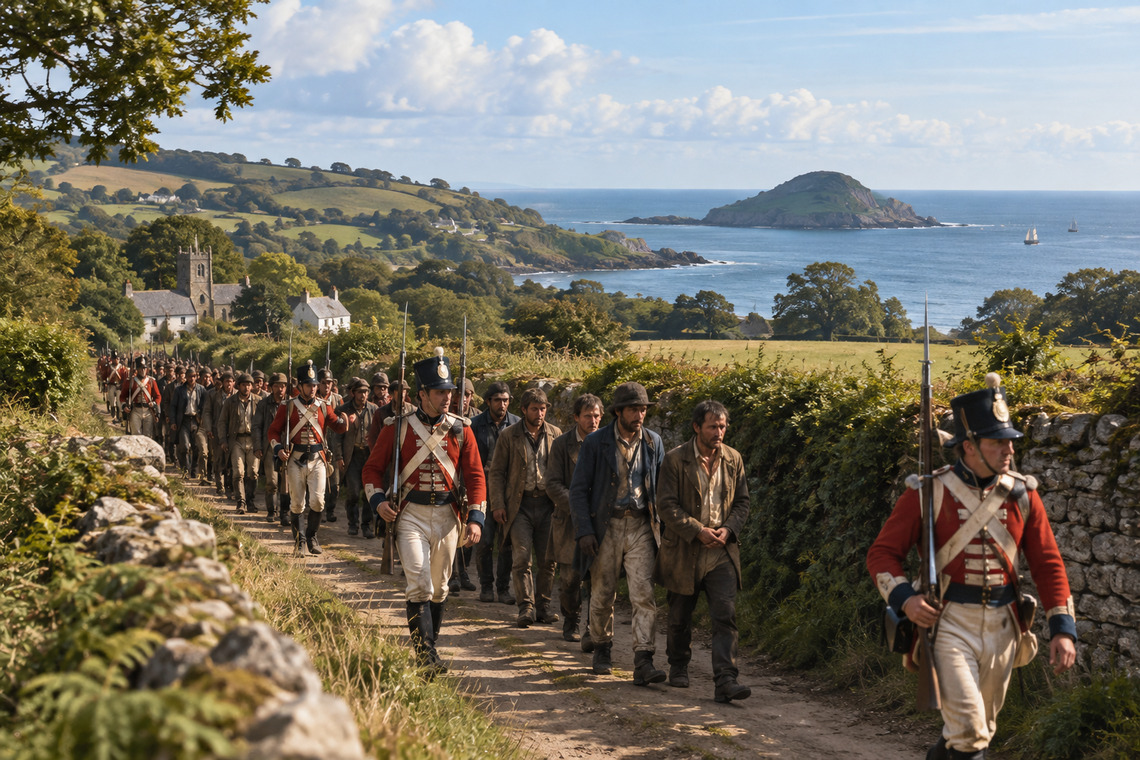
The newspaper reported that 200 French prisoners of war were being marched under military escort towards Stapleton Prison, near Bristol. When the column reached Ridgeway Cross, the soldiers guarding them were relieved by:
“a party of the First Devon militia, from Wembury camp.”
That little phrase is the Wembury connection — and it's a particularly interesting one.
Soldiers camped at Wembury
The 1st Devon Militia, also known as the East Devon Militia, had been embodied again in the spring of 1803. By May it had arrived in Plymouth as part of the area's defences, and during August the regiment established a camp at Wembury.
The troops weren't simply camping here waiting for Napoleon. They were involved in defending the approaches to Plymouth and the Yealm and helped construct a redoubt at the mouth of the River Yealm. The regiment remained at Wembury until November, when the camp was broken up and its companies dispersed to winter quarters.
So the men mentioned in our newspaper cutting were almost certainly soldiers temporarily leaving that Wembury encampment to take their turn escorting prisoners along the road.
And there were a lot of prisoners to move.
Plymouth was one of Britain's principal centres for French prisoners of war. Surviving Admiralty records contain entire registers devoted to French prisoners held at Plymouth in 1803–04, while Stapleton was also being brought back into use as a major prisoner-of-war depot.
The Flying Post report therefore captures something that would have been an extraordinary sight to us, but perhaps not quite so extraordinary to local people in 1803: two hundred French prisoners marching through the Devon countryside under armed guard, with soldiers from the camp at Wembury taking over part of their escort.
For a few months that year, Wembury wasn't simply a quiet farming and fishing parish on the edge of the sea. It was part of Britain's front line against Napoleon.
Source: Exeter Flying Post, 29 September 1803.
On This Day in Wembury – 29 September 1927
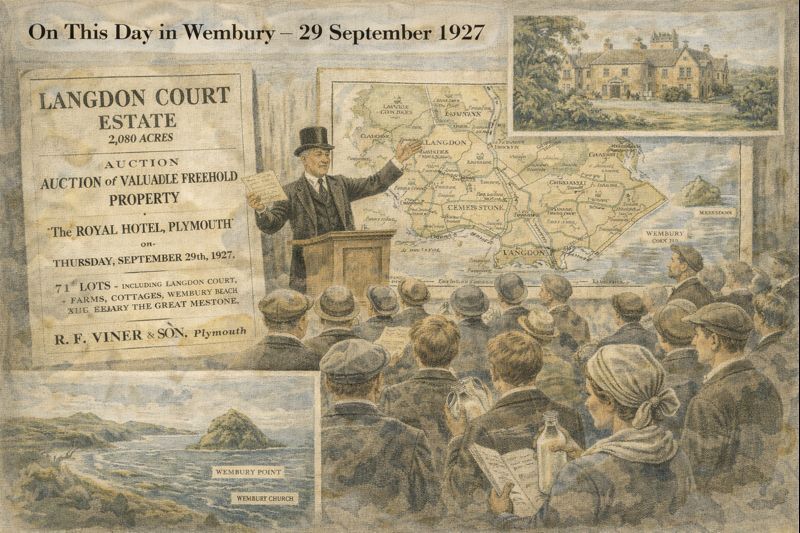
The Langdon Court Estate went under the hammer at the Royal Hotel in Plymouth. It was one of the most sweeping property sales South Devon had ever seen, covering some 2,080 acres. The estate stretched from Down Thomas in the northwest to Heybrook Bay in the southwest, Wembury Church and Mill in the southeast, and Hollacombe in the northeast.
Seventy-one lots were catalogued, including Langdon Court itself, numerous cottages, 14 working farms (among them Sherwell, Traine, Knighton, West Wembury, Higher Ford, Langdon Barton, Raneleigh, and Barton Taylor’s), plus both the New Inn at Down Thomas and the Jubilee Inn at Knighton. Even Wembury Beach and the Great Mewstone were listed.
The sale came in the shadow of the 1920s economic downturn, so many properties failed to reach their reserves. Those that did sell still seem almost unbelievable by modern standards. Knighton Farm fetched £3,700, while West Wembury Farm went for £4,700 (around £40 per acre). Langdon Barton Farm made £5,650, while Church Walk Wood (16 acres) reached £770.
Wembury Point, with 102 acres of coastal land, fetched £3,000, labelled in the brochure as “building land.” And the Great Mewstone itself sold for £500 — about the price of two Morris Cowleys or Austin Sevens in 1927. In today’s money that’s around £35,000 — still staggeringly cheap for an island that dominates the bay.
Auctioneer R. F. Viner’s firm handled the sale, and his son (writing decades later) remembered it as a landmark event in South Devon estate history.
Sources: Exeter & Plymouth Gazette, 9 Sept 1927; Western Evening Herald, 12 Nov 1991 (recollections of R. F. Viner, Chartered Surveyor).
Reflection
The sale marked a turning point in Wembury’s story. What had once been a single landed estate was broken up into dozens of lots, passing into many different hands. Farms that had been tenanted for generations were suddenly up for grabs, inns and cottages became investments, and even the Mewstone changed ownership. In a sense, the 1927 sale symbolises the shift from the old world of big estates to the more fragmented, suburban, and commuter-driven Wembury we know today. It reminds us how quickly the patterns of land and power can change, and how local communities live with the legacies of those sales for generations.
On This Day in Wembury – 29 September 1995
A piece of naval history arrived at Wembury Point when the great figurehead of Queen Victoria was moved from the Royal Naval Engineering College at Manadon to the gunnery school, HMS Cambridge.
The four-metre, four-ton carving was originally made in 1856 for the Navy’s gunnery training ship in the Hamoaze, later renamed HMS Cambridge. It had spent fifty years in the grounds at Manadon, rescued from the cruiser HMS Drake, but with the college closing down, the decision was taken to return it to the coast where the Cambridge name still lived on.
Hoisted onto a lorry, the monarch made the journey “in state” to Wembury. Once restored and cleaned — work carried out by Weapon Engineer Mechanic Stuart Dingley — the statue was placed on a plinth before the mainmast at the naval school, a striking reminder of Britain’s longest-serving sovereign keeping watch over the training ground.
Source: Western Morning News, 29 Sept 1995.
Entries are summaries and interpretations of historical newspaper reports.