
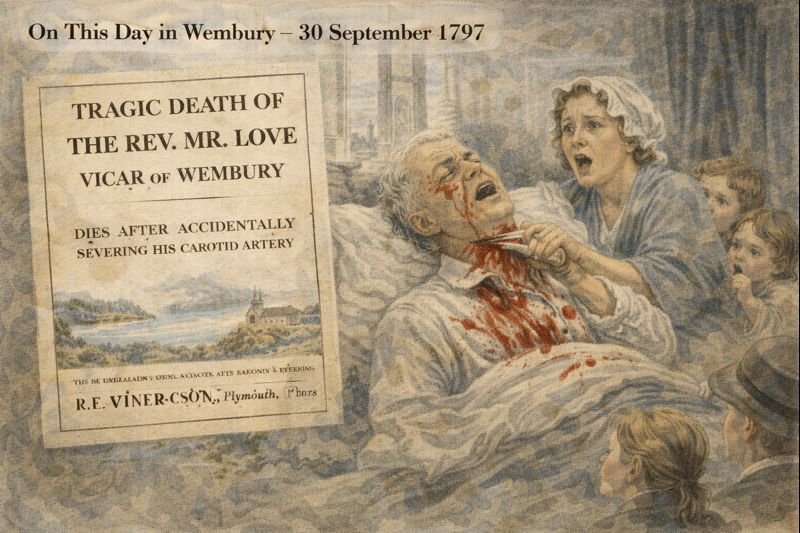
On This Day in Wembury — 30 September 1797
The Oxford Journal reported the sudden and tragic death of the Rev. Mr. Love, Vicar of Wembury. After a long illness, he was sitting up in bed at his Plymouth residence and asked his wife for a penknife to pare his nails. Seized suddenly by his recurring complaint—a choking rise in the throat—he forced his hands upward under his jaw in an attempt to relieve the spasm. In doing so, he accidentally drove part of the knife’s blade into his neck, severing the carotid artery.
He died instantly, in full view of his wife and children. The report described it as an “unhappy accident,” bringing to a close both his ministry at Wembury and a painful final illness.
The story is stark, even shocking by the standards of parish news. It reminds us how fragile life was before modern medicine, when an illness could leave someone so vulnerable that a small, everyday act turned fatal. In Wembury’s wider history, it also marks how a sudden vacancy in the living of St Werburgh’s might ripple through parish life, one more example of how the community’s stability often hinged on the fortunes of its clergy.
On This Day in Wembury — 30 September 1881
A grand wedding — and a familiar name
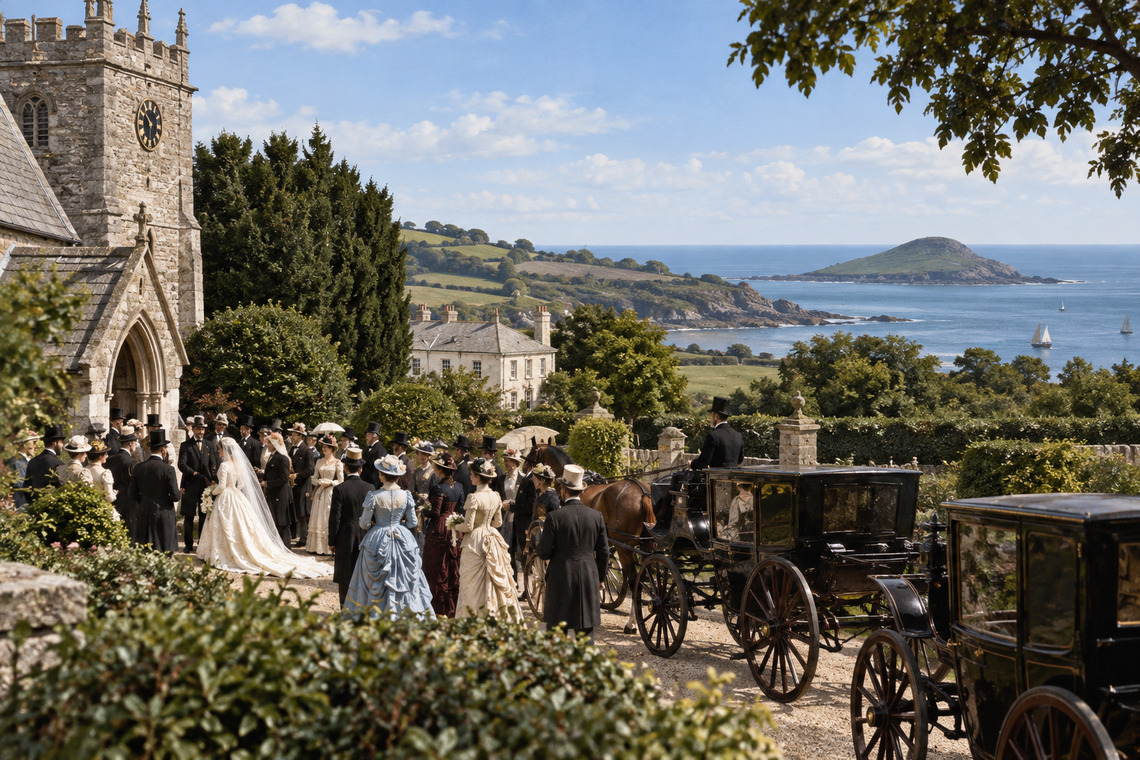
On 30 September 1881, the Western Morning News devoted a remarkably detailed column to a society wedding at Plymstock — the marriage of Bessie Frances Coulthard to Richard Cory of Langdon Hall, Wembury.
And Bessie's name should sound familiar. She is the very same woman who appeared in our On This Day item only four days ago, when we told of the death of Mrs Bessie Frances Gore in September 1924.
So, quite by chance, the newspapers have given us opposite ends of the same Wembury story: her wedding in 1881 and her death 43 years later.
Bessie was the eldest daughter of the Rev. Thomas Coulthard, vicar of Plymstock. The newspaper describes the wedding in wonderful Victorian detail. The weather was delightful, the bride arrived at church in a carriage drawn by a pair of grey horses with postilions in scarlet and blue, and the churchyard gate was decorated with a floral arch.
The bride wore cream satin and brocaded silk, trimmed with lace, with a long tulle veil. Her bridesmaids included her sisters Emily, Ellen and Edith Coulthard, and Miss S. Bulteel. They wore white surah dresses trimmed with lace, each carrying a handsome bouquet.
After the ceremony, the wedding party returned to the vicarage for breakfast. The Western Morning News even listed some of the gifts — including silver, jewellery and china — before recording that the newly married couple left later that day for their honeymoon at Torquay.
From Plymstock to Langdon
For Bessie, the marriage meant becoming mistress of one of Wembury's great houses.
Richard Cory was a wealthy businessman whose fortune came from the coal-shipping concern established by his father. He had acquired the Langdon estate in 1876, and during his ownership Langdon Hall was extensively altered and became the centre of a large country estate.
The Wembury Local History Society archive contains something particularly special: photographs of Richard and Bessie taken in 1881, the very year of their marriage. One shows Richard on horseback outside Langdon; another shows Bessie Frances Cory with her stepdaughter Bessie Buchan in a dog cart.
In the years that followed, Langdon became known for some decidedly grand entertaining. Among the Corys' guests were the Prince of Wales, later Edward VII, and his brother Prince Alfred, Duke of Edinburgh. A surviving photograph of a shooting party from about 1891 actually shows Bessie standing beside the future king.
Richard died in 1904. Bessie subsequently married Colonel George Anthony Ellard Gore in 1905 — another familiar figure at Langdon, who appears in that same 1890s shooting-party photograph.
And that brings our story full circle.
On 26 September 1924, we read the newspaper's account of Bessie's death. On 30 September 1881, we find her again — more than four decades earlier — a young bride setting off from Plymstock for a new life at Langdon.
It's one of those lovely coincidences that makes doing these daily newspaper snippets worthwhile. Two apparently unrelated cuttings, four days apart in our calendar, turn out to tell the beginning and the end of the same woman's Wembury story.
Source: Western Morning News, 30 September 1881.
Entries are summaries and interpretations of historical newspaper reports.