
On This Day in Wembury — 6 October 1896
The body of Mr Cooke found on Wembury Beach
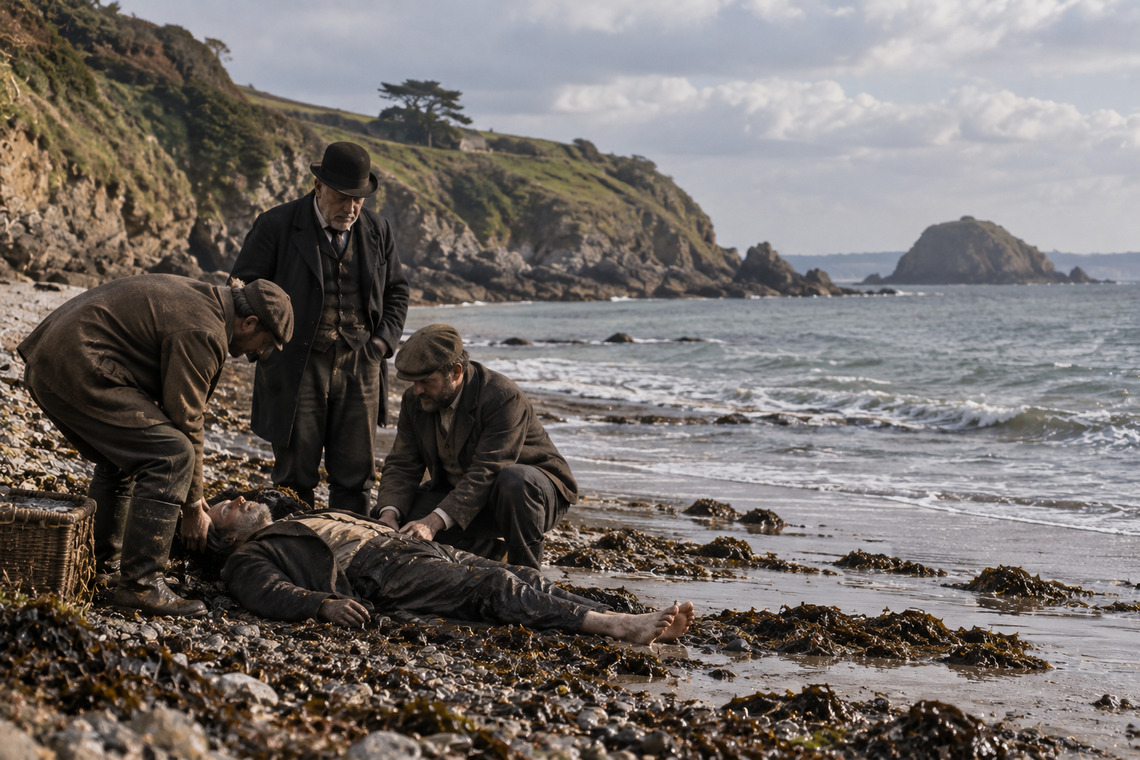
On 6 October 1896, the Western Evening Herald reported a grim discovery made on Wembury Beach the previous afternoon.
The body of a man named Cooke, thought to have been about 50 years old, had been found by men employed by Mr Pearce of Langdon Barton.
There was already a possible explanation for his identity. The newspaper reported that Cooke was “supposed to have been drowned from H.M.S. Thalia”. If correct, this suggests that news of a missing man from the ship had reached the authorities before the body was discovered at Wembury.
The condition of the body showed that it had probably been in the sea for some time. Cooke had no boots on his feet and no hat, and the report rather starkly noted that the hair had disappeared from the top of his head.
Police Constable Payne was called and removed the body from the beach. It was taken to Wembury Mill, close to St Werburgh’s Church, where it was kept to await an inquest.
That detail gives us a particularly vivid glimpse of Wembury in the 1890s. The old mill was still standing beside the beach beneath the church, and a surviving photograph from around 1890 shows the church, mill and nearby cottages much as they would have appeared on that October day.
The reference to H.M.S. Thalia makes the story more than simply another unidentified body washed ashore. Somewhere there may be a naval record or subsequent report of the inquest which establishes exactly who Cooke was, what his role aboard the ship had been, and when he disappeared.
For the moment, the little newspaper report leaves us at Wembury Mill in October 1896, with the body of a man recovered from the sea and an inquest still to come.
It is another reminder of how frequently the sea enters Wembury's history — sometimes as livelihood and recreation, but occasionally in much sadder circumstances.
Source: Western Evening Herald, Tuesday 6 October 1896.
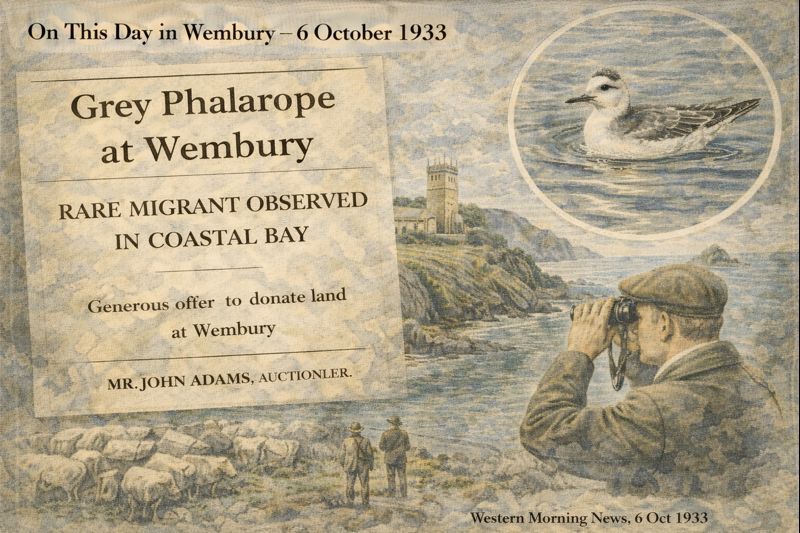
6 October — 1933: Grey Phalarope at Wembury
Western Morning News, 6 Oct 1933
A Plymouth observer reported a grey phalarope at Wembury, noting its tameness and light swimming style, “very like a small gull.” Most local records of this scarce migrant occur in autumn, when birds are blown off course from their Arctic breeding grounds (Greenland, Iceland, etc.) on their way south, sometimes as far as the Falklands and New Zealand.
This early record highlights Wembury’s position on a key migration corridor. The bay and headland funnel seabirds and waders moving along the Channel, and unusual visitors often appear after storms. The 1933 phalarope foreshadowed Wembury’s later reputation, cemented after the Marine Centre opened in 1981, as one of Devon’s most rewarding coastal birdwatching sites, with cirl buntings, whimbrel, ring ouzel, peregrine, and occasional rarities still regularly recorded.
Entries are summaries and interpretations of historical newspaper reports.