
Wembury On This Day — 12 October 1839
A report in the Plymouth Herald and Devonshire Freeholder celebrated a remarkable sight at South Wembury House, now known as Thorn.
Thomas Lockyer’s lemon tree, growing in a sheltered south-facing garden, had produced an extraordinary crop. The account records 380 lemons, including 135 fully grown fruit, with more than 300 still remaining on the tree. One lemon shown to the reporter measured eight and a half inches across.
The tree had been planted by Thomas Lockyer about fifteen years earlier, around 1824. Its luxuriant growth was offered as proof of the “salubrity and warmth” of Wembury — a rather splendid nineteenth-century endorsement for the local climate.
The large, fruit-laden tree in the illustration imagines that sheltered garden at South Wembury House in the autumn of 1839.

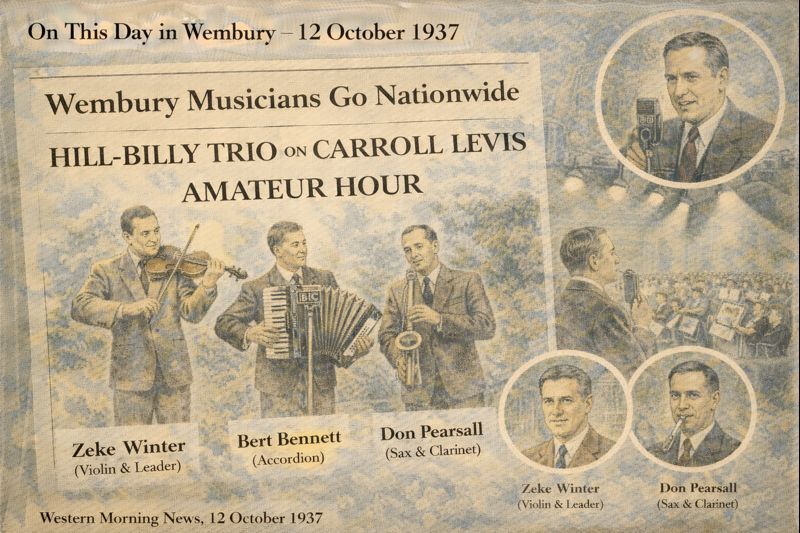
On This Day in Wembury — 12 October 1937
Wembury Musicians Go Nationwide
Three young men who had been amusing themselves by playing dance music at Wembury Point found themselves performing to hundreds of thousands of listeners when they appeared on the Carroll Levis Amateur Hour on the BBC Regional Programme.
The group, calling themselves the Hill-Billy Trio, consisted of Zeke Winter (leader and violinist), Bert Bennett (accordion), both from Wembury, and Don Pearsall (saxophone and clarinet), from Plymouth. They had been playing for fun when the manager of a Wembury holiday camp invited them to join the dance band. Carroll Levis heard them during a visit to Plymouth and quickly signed them up.
Their broadcast included "One, Two, Buckle My Shoe" and their own arrangement of "Tiger Rag." Though nervous at first, they said the warmth of the studio audience helped them perform with confidence.
The trio were soon contracted for a nationwide tour, with appearances in Portsmouth, Brighton, Newcastle, Scotland, and London, before returning home for Christmas.
This moment illustrates how Wembury’s social life in the interwar years was tied not only to its farms and fishing but also to its holiday camps and growing leisure industry. For Bennett and Winter, village evenings spent making music by the sea suddenly led to national attention—a reminder that even small, rural communities could be touched by the new power of radio and popular entertainment.
Source: Western Morning News, 12 October 1937
Entries are summaries and interpretations of historical newspaper reports.