
Wembury On This Day — 15 October 1896
The mysterious disappearance from the Talbot
A sombre naval mystery with a very local ending was reported on this day in 1896, when the Naval & Military Record and Royal Dockyards Gazette carried the findings of an inquest held at Wembury into the death of Henry C. Cook, formerly a steward aboard the Royal Navy cruiser HMS Talbot.
Cook had disappeared at the end of September. Evidence at the inquest showed that he had last been seen alive aboard HMS Vivid on Saturday 26 September. One of the witnesses, an ordinary seaman serving in Vivid, recalled working with Cook that day and said that he had seemed unusually low in spirits. By the morning of the 28th Cook was missing, and nothing further was heard of him until his body was discovered on the coast at Wembury.
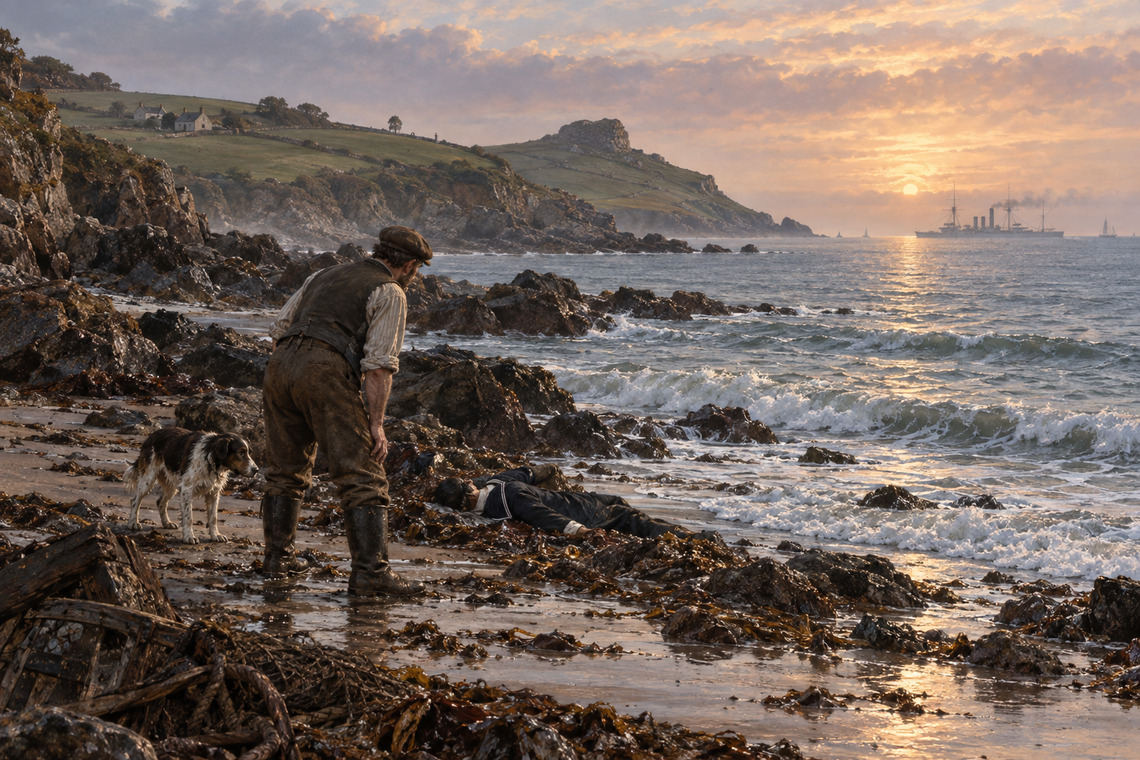
The discovery was made by William Watts, a labourer at Langdon Barton, who was on the beach at about five o’clock in the morning when he came across the body. Watts conveyed it away from the shore, and a post-mortem examination was subsequently carried out. The doctor found no signs suggesting violence and concluded that death had been caused by drowning. The jury returned the simple verdict: “Found drowned.”
The report is only a few paragraphs long, but it connects Wembury directly with the enormous naval world centred on Plymouth and Devonport. HMS Vivid was the name given to the Royal Naval Barracks at Devonport from 1890, after hundreds of sailors had been moved ashore into the newly built barracks the previous year. Men serving in and around Devonport could therefore appear in records as belonging to Vivid even though it was not, in the ordinary sense, a ship cruising at sea.
HMS Talbot, meanwhile, was extraordinarily new. The Eclipse-class protected cruiser had been built at Devonport Dockyard, launched in April 1895 and officially completed on 15 September 1896 — barely two weeks before Cook disappeared. That makes the newspaper description of him as a former steward of the Talbot particularly interesting: his death occurred almost at the very moment the cruiser was entering Royal Navy service.
For Wembury, the most striking detail is William Watts’s connection with Langdon Barton. The farmhouse remains an important survival of the old agricultural landscape of the parish; Historic England describes the present building as an eighteenth-century rendered stone farmhouse. In 1896 Langdon was still very much a working farming community, and a labourer setting out early enough to be on the shore at five in the morning would have known these fields, tracks and coves intimately.
There is also something particularly haunting about the contrast. Cook belonged to the intensely busy naval world of Devonport, with a brand-new cruiser being prepared for service and thousands of men passing through the barracks. Yet his story ended several miles away on the quiet Wembury coast, where a farm labourer found him at first light.
The newspaper called it “The Mysterious Disappearance from the Talbot.” The inquest established how Henry Cook died, but it could not explain why he entered the water. Beyond the evidence that he had appeared depressed shortly before disappearing, the jury went no further. More than 130 years later, that is probably where the story must remain: a brief and sad episode preserved because the sea carried one Devonport sailor onto the shore at Wembury.
Source: Naval & Military Record and Royal Dockyards Gazette, 15 October 1896.
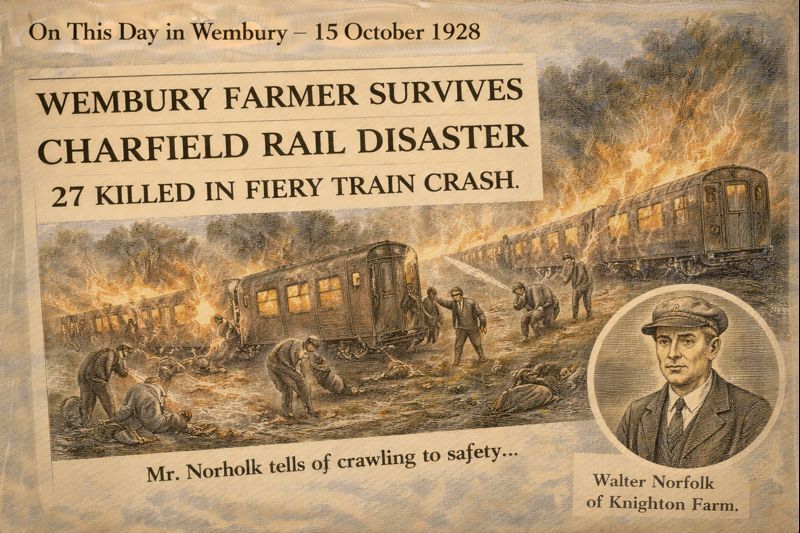
On This Day in Wembury – 15 October 1928
The Western Morning News reported on the Charfield rail disaster, one of Britain’s worst railway accidents, in which 27 lives were lost. Among the passengers was Mr Walter Norfolk of Knighton Farm, Wembury.
Norfolk described how he was dozing when a terrible crash hurled him across his carriage, leaving him concussed and with bruised legs. He recalled struggling to open the shattered door and crawling on hands and knees up the embankment, unable to walk because of his injuries. From there he saw his carriage engulfed in flames, knowing that some who had been seated just yards away could not have escaped.
Reflection
Wembury readers of the time would have recognised Norfolk as a local farm worker, suddenly caught up in a national calamity. His account reminds us how survival in such disasters often hinged on small details — his seat position, his ability to crawl free — and how the impact of events far away from home could leave their mark on village life.
Entries are summaries and interpretations of historical newspaper reports.