
On This Day in Wembury
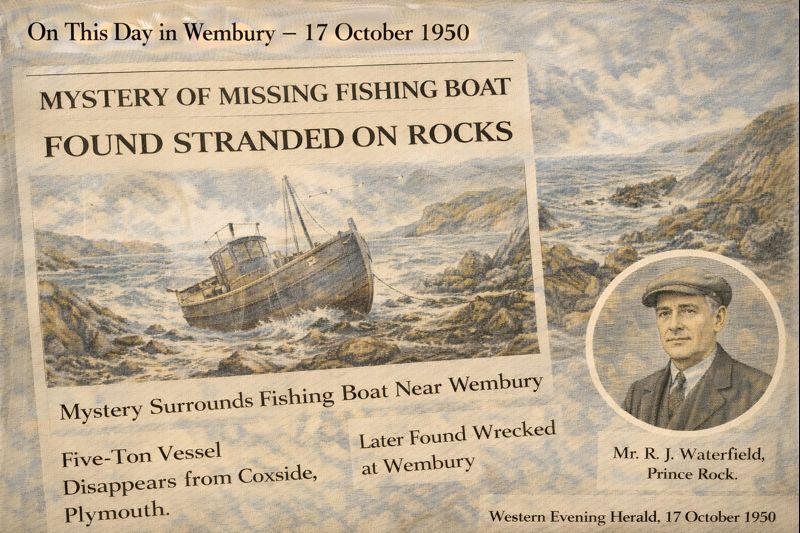
17 October 1950 — Fishing Boat Mystery Near Wembury
On this day the Western Evening Herald reported the strange disappearance of a five-ton fishing boat from her moorings at Coxside, Plymouth. The vessel, owned by Mr. R. J. Waterfield of Prince Rock, was later found stranded on the rocks between Wembury and Bovisand. Mr. Waterfield’s son suggested the boat may have been taken by someone trying to get home. The craft was undamaged, though south-westerly gales threatened to wreck her. Apart from missing fuel cans, the gear aboard was intact. Another boat, owned by his brother-in-law, Torquay United goalkeeper Derek Davis, had also shown signs of tampering in Sutton Pool. The family dismissed the idea that the vessels could have simply broken free from their moorings.
Reflection: The episode reads like a maritime whodunit: a vanished boat, suspicious tampering, and recovery on Wembury’s rocks. It reflects both the vulnerability of small craft in Plymouth waters and the ever-present drama of the sea along this coast.
Source: Western Evening Herald, 17 October 1950.
Wembury On This Day — 17 October 1952
“Houses damaged by heavy guns”
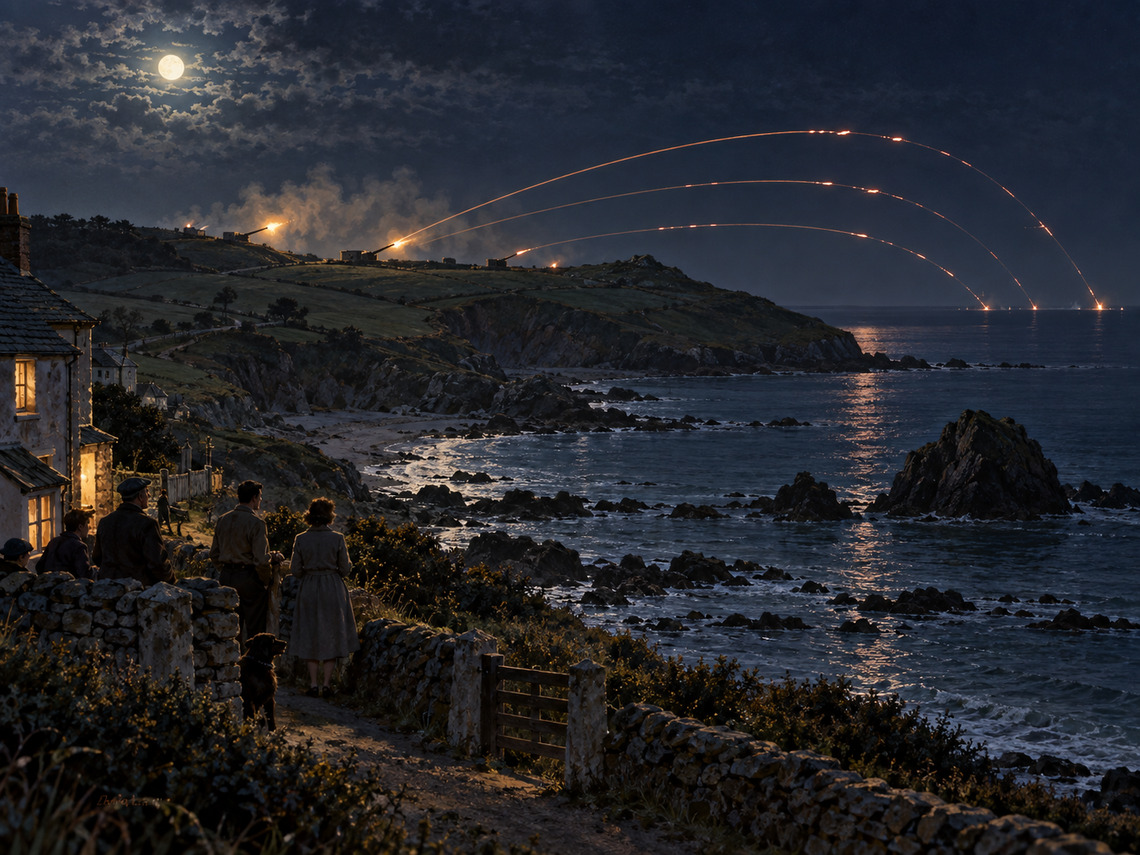
A very different sort of Wembury noise complaint appeared in the Western Morning News on this day in 1952, when residents of Heybrook Bay complained that the firing of heavy naval guns at the Wembury gunnery range was damaging their homes.
The headline was unusually direct: “HOUSES DAMAGED BY HEAVY GUNS”. Beneath it, the paper reported that people living at Heybrook Bay believed repeated firing from the naval range was doing more than rattling windows. Residents described cracks appearing in walls and plaster, and there were complaints that the repeated concussion of the guns was affecting houses in the bay.
This was not simply a case of villagers objecting to an unfamiliar military installation. By 1952 the range at Wembury Point had already been operating for more than a decade. A naval and army gunnery range had been established there during the Second World War on the site of the former holiday camp, and after the war the Navy decided to retain and expand it. The land was purchased in 1948 and, in 1950, approval was given for permanent development of the establishment.
So the complaints reported in October 1952 came at an important moment. What had begun as a wartime expedient was becoming a permanent feature of the Wembury landscape.
The guns were no small affair. The post-war establishment eventually included substantial naval weapons mounted close to the cliff edge, firing seaward across the approaches to Plymouth Sound. Later records describe six gun turrets on the site, while the firing danger area extended far out to sea. For anyone living at nearby Heybrook Bay, the blast would have been impossible to ignore.
The Western Morning News article records the residents’ frustration at what they believed was happening to their properties. The firing, they said, produced severe vibration, and some householders associated fresh cracking and other defects with the concussion from the guns. The underlying argument was straightforward: if a government establishment was damaging private homes, who was going to accept responsibility and pay for repairs?
That question was not easy to settle. Proving that a particular crack in a wall had been caused by gunfire rather than settlement, weather or ordinary movement in a building was difficult. The Navy, equally, had a powerful argument for keeping the range: Britain was still only seven years beyond the Second World War, the Korean War was under way, and training sailors in live naval gunnery remained an important defence requirement.
This tension between military necessity and village life became one of the defining features of western Wembury during the second half of the twentieth century.
From wartime range to HMS Cambridge
The site had first been developed in 1940, when part of the old Wembury Point holiday camp was taken over for live-firing training. In the years after the war the establishment grew steadily. In 1956, only four years after this newspaper report, the entire site was formally commissioned as HMS Cambridge, becoming the Royal Navy’s principal shore gunnery school.
For the next four decades, firing became part of everyday life around Wembury and Heybrook Bay. Guns fired out across the sea, paths were diverted during firing periods, and the Great Mewstone itself lay inside the danger area. The War Office acquired the island because it stood within the line of fire, restricting ordinary public access whenever the range was operating.
Later official evidence gives an idea of the intensity. HMS Cambridge was eventually used on five days a week, with live firing on three full days, and the Navy argued that no inland range could reproduce the conditions required for naval gunnery because the weapons had to engage targets on or above the sea.
Interestingly, that same later review stated that there had been no “complaints of substance” during the preceding eight years. That makes this 1952 report particularly valuable: it preserves evidence of an earlier period when nearby householders were plainly unhappy about the effect of the range and were prepared to say so publicly.
A village living beside the guns
It is easy now to walk across Wembury Point and forget just how industrial and military the landscape once was. The gun positions, accommodation blocks, control buildings and other structures have largely disappeared. After live firing ended in 2001, much of the establishment was demolished, and the National Trust later acquired the Point and began returning it to a more natural coastal landscape.
In 1952, however, the opposite process was happening. The military presence was expanding just as the surrounding area was also becoming increasingly residential.
That is what makes the Heybrook Bay complaints so revealing. They were not simply about noise. They were about two very different uses of the same coast colliding with one another: a beautiful place in which people increasingly wanted to live, and a strategically useful stretch of open sea where the Royal Navy needed to fire full-size guns.
For many later residents, the sound of HMS Cambridge became simply part of Wembury life, windows trembling, sudden bangs rolling across the parish and the occasional interruption to coastal walks while firing took place.
But this newspaper report reminds us that people did not always accept it quietly.
In October 1952, residents at Heybrook Bay were looking at cracks in their homes and asking whether the naval guns across the headland were responsible. Whether every instance of damage could ever have been proved is another matter, but their complaints capture a period when the modern Wembury Point military establishment was still taking shape and nobody yet knew that the guns would remain a feature of local life for almost another half-century.
Today the Point is quiet enough for it to be difficult to imagine. In 1952, apparently, you could sometimes feel the Navy firing as well as hear it.
Source: Western Morning News, 17 October 1952.
Entries are summaries and interpretations of historical newspaper reports.