
On This Day in Wembury — 20 October 1803
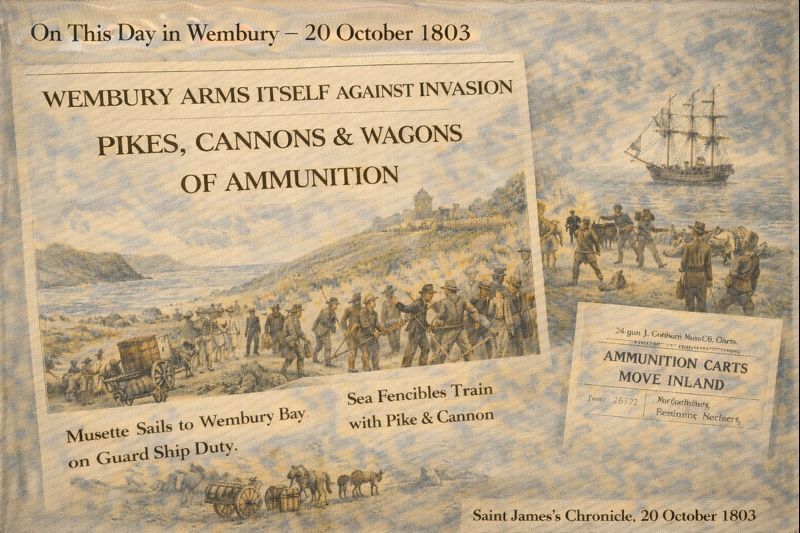
The Saint James’s Chronicle reported heightened military activity along the Devon coast during the wars with Napoleonic France. Orders had been sent down from the Transport Board to Lieutenant Clements, Agent for Transports, to provision six months’ salt stores for 600 tons of shipping. Speculative “politicians” wondered at the secrecy of the order.
That morning, the Musette, a 24-gun ship, sailed from her station at the entrance to the Yealm River to be floated as a guardship under jury-masts. Meanwhile, ammunition wagons carried pikes into the interior — Exeter among the destinations — for corps that could not be supplied with muskets and bayonets. Pikes and half-pikes were also issued to the Sea Fencibles at Plymouth and neighbouring ports. These local defence volunteers were reported to be making progress in their pike and great-gun drills, eager to excel with such “terrible instruments of war.”
A number of artillery wagons, with their drivers, were also seen carrying flint, powder, wadding, rammers, sponges, and handspikes from the arsenal to Wembury, for the use of the two batteries established there.
It’s striking how the paper spoke of pikes with the same awe as heavy artillery. For all the talk of “terrible instruments of war,” what you really see here is a community arming itself with whatever came to hand , a musket, a cannon, or just a sharpened pole. And Wembury, quiet as it seems now, stood bristling with weapons at the cliff’s edge, ready for a French landing that never came.
Source: Saint James’s Chronicle, 20 Oct 1803
Wembury On This Day — 20 October 1933
Gabber Farm goes up for sale
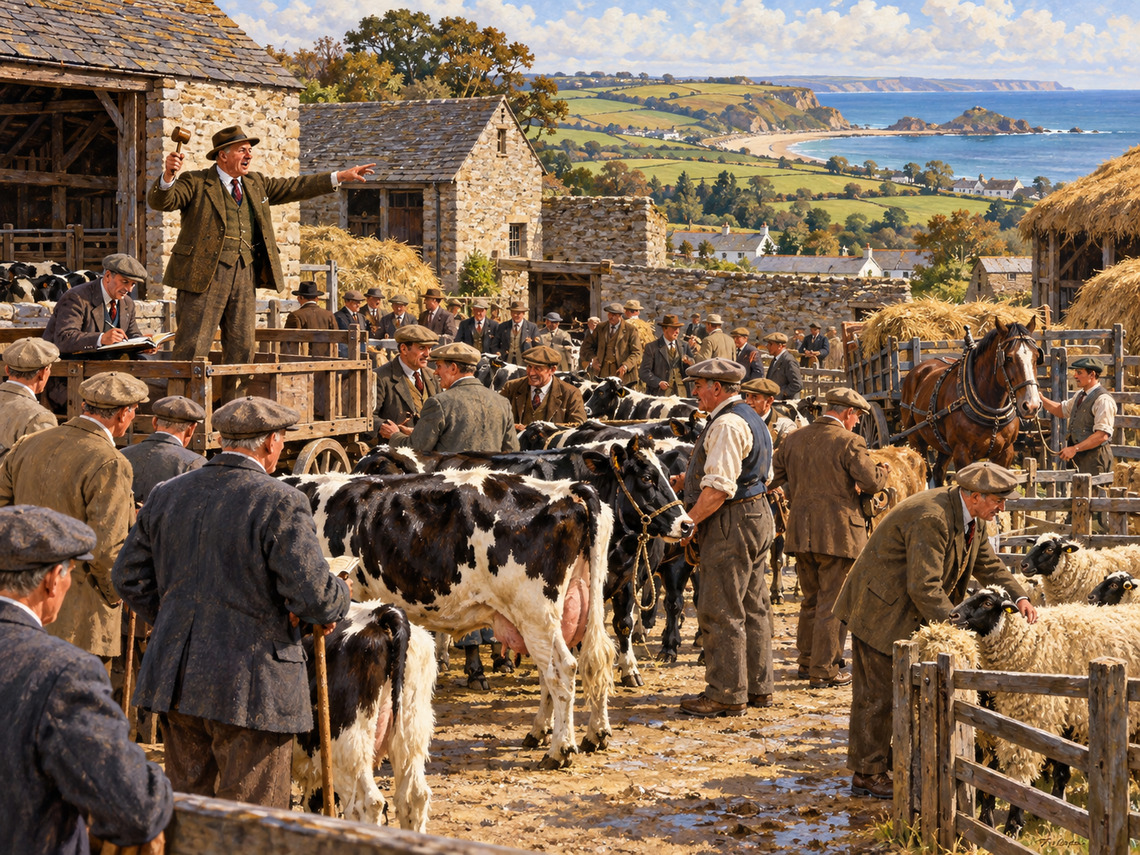
The Western Morning News carried a small but very useful piece of Wembury history on this day in 1933, when it advertised the forthcoming sale of Gabber Farm.
Under the heading “Farms and Farm Stock for Disposal”, the paper announced that Messrs. Viner, Carew and Co. would offer for sale at the Plymouth Law Chambers:
“the dairying, stock-rearing and corn farm known as Gabber, Wembury”
The farm was not being offered alone. The notice also referred to accommodation land, woodland adjoining the River Yealm, two cottages, and other associated property.
That immediately gives us a much clearer picture than the rather anonymous phrase “a farm at Wembury” would suggest. This was a named and substantial mixed holding, combining dairy farming, livestock rearing and cereal production, with additional land and buildings forming part of the estate.
A working farm, not just a landscape
Gabber is one of those names which helps reconnect modern Wembury with its agricultural past.
Today it is very easy to look at the parish primarily in terms of the coast, residential areas, footpaths and views. In 1933, however, much of Wembury was still organised around farms like Gabber, where fields, barns, livestock, labourers and cottages formed the economic structure of the countryside.
The description “dairying, stock-rearing and corn” is especially useful.
It tells us Gabber was a mixed farm, rather than a highly specialised enterprise. Cattle could provide milk and breeding stock, while cereals were grown alongside pasture. That pattern was common before the much greater specialisation and mechanisation of British farming after the Second World War.
The reference to woodland adjoining the River Yealm is also interesting because it shows how varied the holding was. A farm could include productive fields, grazing land, woods, cottages and outlying pieces of ground that might not sit neatly together on a map.
Why sell a farm in 1933?
The advertisement does not tell us why Gabber was being sold.
A farm might come onto the market because of retirement, death, changes in ownership, tenancy arrangements, financial pressure or the break-up of a larger estate. All were common enough possibilities.
What we can say is that the timing came during a difficult period for British agriculture.
Farmers had endured falling prices and intense competition from imported food during the inter-war years. The agricultural depression which followed the First World War had not simply disappeared, and many farms were under pressure to remain profitable.
At the same time, places close to Plymouth were beginning to acquire a second value.
Land around Wembury was not only farmland anymore. Its proximity to the sea and to Plymouth increasingly made it attractive for housing, recreation and development. That shift would become far more obvious later, but the 1920s and 1930s were already a period in which the old agricultural pattern was beginning to loosen.
Gabber and the changing parish
That is what makes the Gabber sale more interesting than an ordinary property notice.
The advert catches Wembury at a transitional moment.
On one hand, Gabber was still being advertised entirely as a working agricultural unit. Its value lay in dairy cattle, stock rearing, corn-growing, associated land and cottages.
On the other, the parish around it was beginning to change.
Motor transport was making Wembury more accessible. Plymouth’s population was expanding. Coastal recreation was becoming increasingly popular. Houses were appearing in areas that had previously been almost entirely agricultural.
The farm auction therefore belongs to a period when the old farming landscape was still dominant but was no longer guaranteed to remain unchanged.
The cottages matter too
One easily overlooked detail is the inclusion of two cottages.
Farm cottages were an important part of the rural economy. They could house labourers or other workers connected with the holding, and their inclusion in the sale reminds us that a farm was not merely acreage and buildings.
It was also a small community.
People lived and worked within these holdings, often for generations. Farm sales could therefore have consequences not just for the owner or tenant, but for labourers and families whose homes and employment were tied to the land.
The 20 October 1933 notice is brief, but once Gabber is named it becomes a much more valuable record.
It gives us a specific place, a specific type of farming and a glimpse of the way land around Wembury was organised before the major changes of the later twentieth century.
Gabber was being offered not as a picturesque coastal property but as a dairying, stock-rearing and corn farm — a business whose value lay in its fields, animals, crops, cottages and woodland.
That is worth remembering.
Much of what we now think of simply as “the Wembury landscape” was once intensely productive countryside, shaped day by day by farming families and labourers.
On 20 October 1933, one sizeable piece of that old agricultural Wembury was quite literally up for sale.
Source: Western Morning News, 20 October 1933.
Entries are summaries and interpretations of historical newspaper reports.