
On This Day in Wembury — 21 October 1859
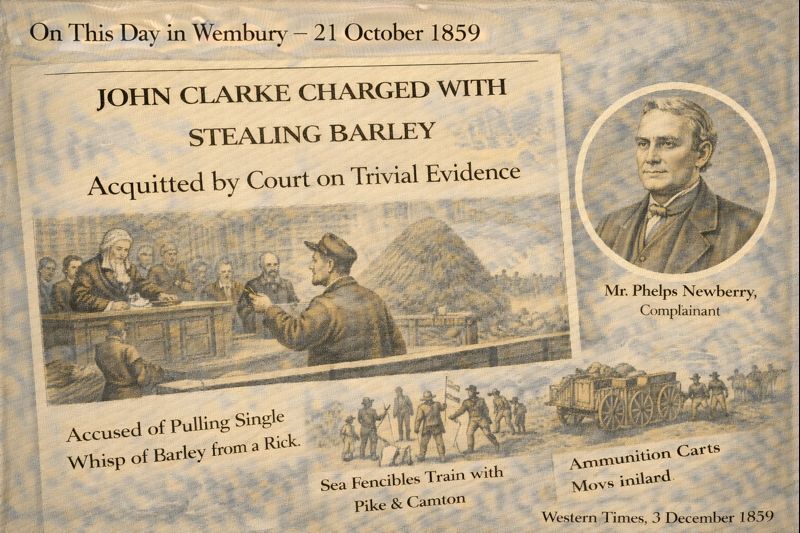
John Clarke of Wembury was brought before the Second Court at Exeter on a charge of stealing barley belonging to Mr Phelps Newberry. The case rested on the fact that Clarke had pulled a single whisp of barley from a rick. When the evidence was heard, the court quickly acquitted him.
That such a case reached the Assizes shows how jealously farm produce was protected in mid-Victorian Devon. A rick of barley represented both money and winter fodder, and even the smallest interference was often treated as theft. Landowners and tenant farmers like Phelps Newberry were the aggrieved parties, for they relied on the courts to defend their property against trespass or pilfering. The case also illustrates the gulf between strict interpretations of property law and the commonsense view of the court, which dismissed the charge once its trivial nature was clear.
Source Western Times, 3 December 1859
Wembury On This Day — 21 October 1916
“Surely they can have their Christmas pudding?”
A wonderfully human letter from Wembury appeared in the Walsall Observer on this day in 1916, written by M. Quigley of Bay Cottage, Wembury.
Quigley had read, with some astonishment, that the guardians of Walsall Poor Law Union had decided, apparently by a majority of just one vote, not to give the workhouse inmates their customary Christmas pudding that year.
The reason was economy.
Instead, the residents were apparently to receive suet pudding with treacle.
Quigley was having none of it.
The letter began:
“I read with surprise … that it was decided by one vote not to give the poor inmates of Walsall Union their usual Christmas pudding this year, by way of economising.”
What followed was both compassionate and gloriously pointed.
Quigley argued that the ratepayers of any town surely could not wish to deprive people who were probably in the workhouse “through no fault of their own” of the Christmas meal they looked forward to from one year to the next.
And then came the sting.
Those councillors who had voted for suet pudding and treacle, Quigley suggested, ought to make the same economy at their own Christmas tables.
Or, better still, perhaps they could economise a little further and have:
“only the pudding minus the treacle.”
The sarcasm sharpened further:
“Surely if they ate plum pudding it would give them indigestion.”
It is difficult not to imagine a smile behind that sentence.
Christmas in the workhouse
Behind the humour, however, was a serious issue.
The “Union” referred to the Poor Law Union, the organisation responsible for administering poor relief and the workhouse. By 1916 workhouses contained a wide mixture of people: elderly men and women, people with disabilities or illness, children, the destitute and those who simply had nowhere else to go.
Life inside was deliberately austere. The nineteenth-century Poor Law system had been built around the idea that conditions should not be more attractive than life outside. Even by the First World War, the institution carried a considerable stigma.
Christmas was one of the rare occasions when normal workhouse routine might be relaxed.
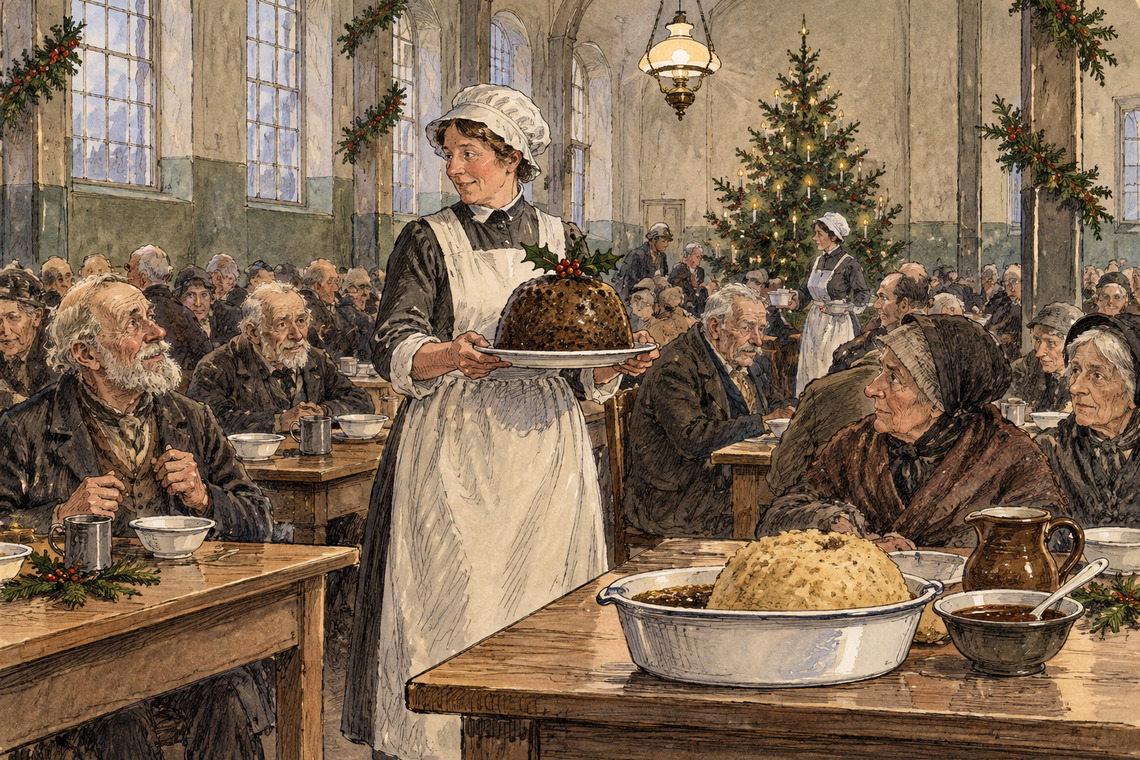
Special dinners, decorations and small gifts had become established traditions in many institutions. Accounts from workhouses describe local people and businesses donating food and money, with Christmas pudding commonly forming part of the meal.
So removing the pudding was not simply changing a dessert.
For residents whose lives were tightly regulated and offered relatively few pleasures, Christmas dinner was something genuinely anticipated.
Quigley understood that.
Why economise in 1916?
The date matters enormously.
Britain was more than two years into the First World War. Food prices had risen and imported supplies were increasingly vulnerable, particularly as submarine warfare threatened merchant shipping.
But Britain was not yet under compulsory national food rationing when Quigley wrote from Wembury in October 1916.
Formal rationing came considerably later. Sugar rationing began in January 1918, with meat and other foods following during that year.
So the Walsall decision appears to have been a local economy measure rather than part of a national rationing scheme.
That distinction helps explain Quigley’s annoyance. Everyone understood that wartime economies were necessary, but the question was who should be expected to make them.
Why, the letter effectively asked, should one of the smallest savings be made by taking the Christmas pudding away from people who possessed almost nothing?
“If it cannot come out of the rates…”
Quigley then turned from criticism to something practical.
There were still roughly ten weeks until Christmas. If the Observer printed the letter, perhaps somebody able to change the decision would see it.
And if the normal Christmas dinner genuinely could not be paid for from local rates, Quigley proposed another solution:
start a public subscription.
A fund could be raised so that Walsall’s workhouse residents could have what Quigley described as something expected in:
“every English home”
— a Christmas pudding.
And, Quigley added, it was “after all, not so terribly expensive.”
That final point makes the letter particularly effective. It was not demanding luxury. It was arguing for one modest annual treat.
But why was somebody in Wembury writing to Walsall?
That is perhaps the intriguing unanswered question.
The letter is signed:
M. Quigley
Bay Cottage, Wembury, Plymouth
13 October 1916
Yet it was published more than 200 miles away in a Walsall newspaper.
That strongly suggests some connection with Walsall — perhaps family, former residence, business or simply continued readership of the local paper — although the clipping itself gives us no explanation.
It is exactly the sort of small biographical trail that might repay further investigation.
What we do know is that someone sitting at Bay Cottage in Wembury cared enough about a decision taken in a Midlands workhouse to write publicly about it.
A little piece of social history
There is another reason the letter is interesting.
Quigley’s phrase “through no fault of their own” pushes gently against one of the assumptions underpinning the old Poor Law: that poverty could be divided neatly into the deserving and undeserving.
By 1916 those ideas were increasingly being challenged.
Quigley did not describe the inmates as paupers who should be grateful for whatever they were given. They were simply “poor people” who deserved the same small Christmas pleasure enjoyed elsewhere.
That is a subtle but significant difference.
This is one of those newspaper snippets in which Wembury appears almost accidentally, yet it tells us something rather appealing about one of its residents.
M. Quigley was not campaigning about an issue in Wembury at all.
The subject was a workhouse hundreds of miles away and a proposed saving involving nothing grander than Christmas pudding.
Yet the argument was a powerful one.
If economies had to be made during wartime, Quigley suggested, perhaps those making the decisions should first try them at their own dinner tables.
And if the authorities really could not find the money, ordinary people could surely club together and provide it themselves.
More than a century later, the humour still works — but so does the underlying principle:
economy is easy to demand when someone else is the person going without.
Source: Walsall Observer, 21 October 1916; letter dated 13 October 1916 from M. Quigley, Bay Cottage, Wembury.
21 October — 1920: Thorn Estate farms advertised for sale
By direction of William Arkwright Esq portions of the Thorn Estate in Wembury parish were advertised for public auction at Plymouth on 11 November 1920. The sale comprised New Barton Farm 199 acres Old Barton Farm 116 acres and 38 acres of accommodation land a total of 353 acres. Mortgages could be arranged and particulars were available from London solicitors Traherne Higgins & Co the Sutton Estate Office land agent A O Walker and Plymouth auctioneer C B Holditch.
This marked the beginning of the break up of the Thorn Estate under William Arkwright who still held Wembury House and other properties until his death in 1923 after which further parts of the estate were sold including the eventual purchase by Mrs Sebag Montefiore.
Source: West Briton and Cornwall Advertiser, 21 Oct 1920
Entries are summaries and interpretations of historical newspaper reports.