
Wembury On This Day, 23 October 1891
South Wembury House to let, with room for six horses and 200 ton yachts
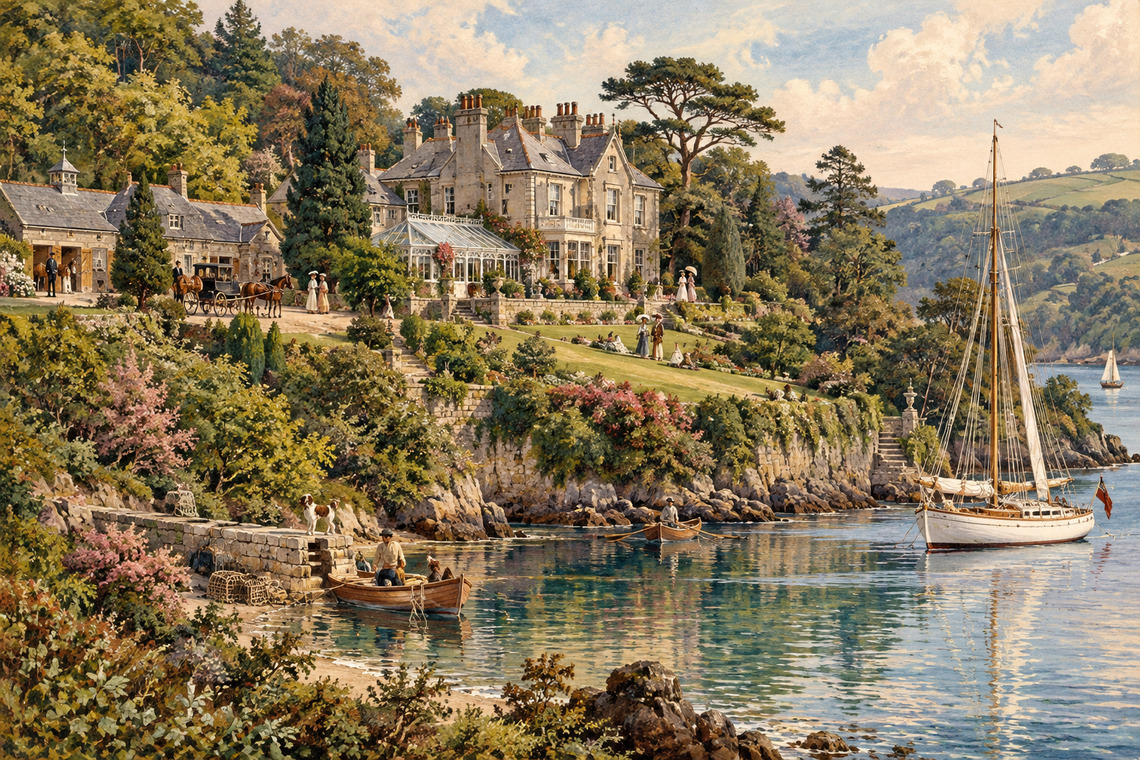
An advertisement in the Exeter and Plymouth Gazette on this day in 1891 offered one of Wembury’s grandest houses to let, and in doing so left us a remarkably detailed description of South Wembury House, the building we know today as Thorn House.
The property was being offered unfurnished, for a term to be agreed, with the option of about 40 acres of land. Its great selling point was immediately obvious. It stood on the banks of the River Yealm and harbour, about six miles from Plymouth, in its own grounds.
This was no modest country residence.
The advertisement listed stabling for six horses, coach houses and other offices, an entrance hall measuring 17 feet 6 inches by 15 feet 6 inches, and dining and drawing rooms each about 21 feet long. The drawing room opened directly into a conservatory.
Upstairs were no fewer than 15 bedrooms, together with a bathroom supplied with hot and cold water. Below stairs were extensive domestic offices and what the advertisement proudly called “fine large cellars.”
There were kitchen and flower gardens, a cottage, and a recently constructed range about 140 feet long, connecting the main house with a billiard room.
It is an extraordinary glimpse of the scale on which an affluent late Victorian household could operate.
South Wembury House was not simply a large family home. It required horses, carriages, servants, gardeners and considerable maintenance. Fifteen bedrooms suggest not only family accommodation but rooms for guests and probably domestic staff. The billiard room and conservatory belonged to the world of Victorian country house leisure, while the coach houses and stables remind us that transport depended upon an entire supporting infrastructure.
The setting was sold just as enthusiastically as the house itself.
The advertisement described the position as “delightful, well sheltered”, with extensive and picturesque views. The grounds occupied an eminence falling towards the Yealm, where, remarkably, the notice claimed that yachts of about 200 tons could anchor.
That statement tells us something important about South Wembury before roads and motor cars became dominant. The Yealm was not merely scenery outside the drawing room windows. It was a practical highway and anchorage.
The advertisement also made much of the local climate. It claimed that conditions were so mild that lemons could be grown abundantly without artificial heat.
That is a wonderful Victorian estate agent’s flourish, but it probably contains more than a grain of truth. The sheltered valleys around the Yealm have a notably mild maritime climate, and the house’s south facing, protected position would have created favourable conditions for tender plants.
Potential tenants were also promised excellent freshwater fishing nearby, good sea fishing, and access to country sport because the district was hunted by the Dartmoor Foxhounds.
In other words, South Wembury House was being marketed as something close to the perfect late Victorian gentleman’s residence. It combined privacy, scenery, fishing, hunting, boating and proximity to Plymouth.
The history of the house makes the advertisement even more interesting.
The site appears on the Wembury tithe map of about 1838 as “Lockyer’s Cottage.” During the nineteenth century it was greatly enlarged, and by the time of the first detailed Ordnance Survey mapping of the 1880s and 1890s it had become the substantial South Wembury House described in this advertisement. The building survives today as Thorn House.
Its development was connected with the Lockyer family. After the older Wembury estate was broken up during the early nineteenth century, Thomas Lockyer occupied South Wembury and the house became an important residence in its own right. By the 1851 census, Thomas Lockyer was recorded at South Wembury House, while Sir Edward Thornton occupied Wembury House itself.
This distinction is useful because Wembury House and South Wembury House were entirely separate residences. Wembury House stood farther west and was the successor to the great historic manor house. South Wembury House stood overlooking the Yealm and developed from the property once known as Lockyer’s Cottage. The latter is the house advertised here in 1891 and is the one later known as Thorn House.
The advertisement also tells us something broader about Victorian Wembury.
The parish population was still only around 560 in the later nineteenth century, and its society remained strongly shaped by a small number of major houses and estates above a much larger agricultural workforce. South Wembury House, Wembury House and Langdon Court stood at the top of that local hierarchy.
Yet South Wembury House feels different from the image we often have of an isolated country mansion. Its relationship with the Yealm was central to its appeal. Boats could lie almost below the house, fishing was on the doorstep, and Plymouth was near enough for the occupants to remain connected with the city while enjoying what the advertisement presented as a secluded country life.
The small detail about the lemons is perhaps the most memorable of all.
Estate agents have always known how to sell a lifestyle. In 1891 the attraction was not a fitted kitchen, broadband or sea views from the decking. It was fifteen bedrooms, six horses, a billiard room, yachts at the bottom of the garden and the promise that you could grow your own lemons outdoors in Wembury.
More than 130 years later, the house still stands above the Yealm. The advertisement lets us briefly see it not as a historic building, but as the Gazette’s readers saw it in October 1891, an exceptionally desirable country residence waiting for its next tenant.
Source: Exeter and Plymouth Gazette, 23 October 1891.
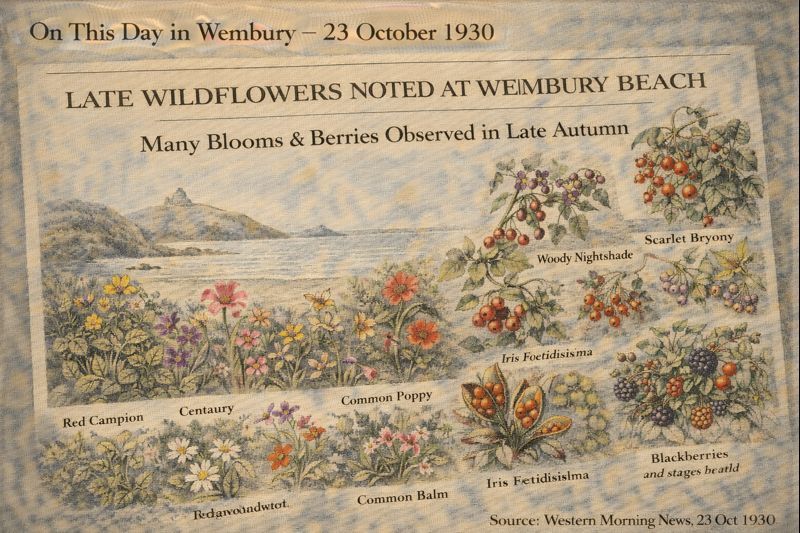
On This Day in Wembury — 23 October 1930: Late wildflowers noted at Wembury Beach
On this day the Western Morning News published a letter from E. Masson Phillips of Plymouth, who responded to an invitation for readers’ observations of late-flowering plants. Writing of a walk by Wembury Beach on 21 October, she listed hedge woundwort, centaury, yellow toadflax, common balm, red campion, honeysuckle, daisy, wood sage, ivy, sun spurge, dogwood, yarrow, knapweed, and common poppy all still in bloom.
She also remarked on the vivid fruits of the hedgerows, including scarlet bryony and woody nightshade, the bursting pods of iris foetidissima showing their red seeds, and blackberries in every stage from red to ripe black. The editor encouraged further notes from readers. The letter gives a vivid picture of Wembury’s late autumn flora, illustrating how closely the local landscape was watched and valued even in the inter-war years.
Source: Western Morning News, 23 Oct 1930
Entries are summaries and interpretations of historical newspaper reports.