
On This Day in Wembury
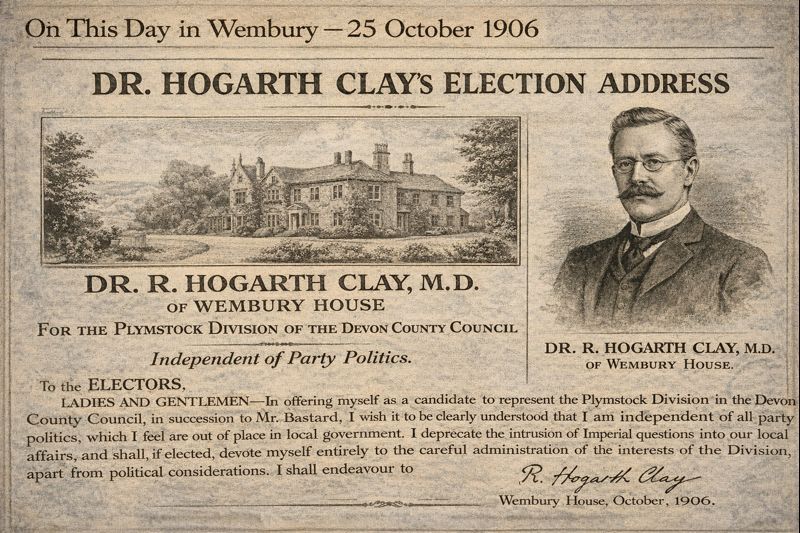
25 October 1906 — Dr. Hogarth Clay’s Election Address
On this day the Western Morning News carried the election address of Dr. R. Hogarth Clay, M.D., of Wembury House, who was standing for the Plymstock Division of the Devon County Council. His candidacy followed the retirement of Mr. Bastard, who had served the district for many years. Dr. Clay declared himself independent of party politics, stating that he deprecated the intrusion of imperial issues into local government. Instead, he stressed his medical knowledge and experience in sanitary matters as qualifications to serve the community. He pledged careful oversight of public spending and an earnest commitment to the welfare of all residents in the division.
Reflection: Dr. Clay’s address highlights how early 20th-century local elections were grounded in practical concerns—public health, sanitation, and fiscal responsibility—rather than party politics. His residence at Wembury House underlined his social standing and connection to one of the parish’s principal estates, reinforcing his role as a community leader.
Source: Western Morning News, 25 October 1906.
25 October — 1924: Bovisand Sands and Pier Co., Ltd. registered
Western Morning News, 29 Oct 1924
A new company, almost certainly the Bovisand Sands and Pier Co., Ltd. (mis-OCR’d in some sources as “Vis and Sands”), was registered with £12,000 capital to develop the beaches and cliffs between Bovisand Bay and Andurn Point in Wembury parish. Plans announced included a pier, theatre or concert hall, pavilions, tramways, restaurants and other amenities.
In practice, by the mid-1920s Saunders Bros. & Co. (the same directors) turned Bovisand into a holiday resort with a pier, café, holiday bungalows and camping grounds. By 1927 there was a half-hourly boat service linking Plymouth to the pier in partnership with the Oreston & Turnchapel Steamboat Co.
The more ambitious ideas (tramways and theatre) were never realised, but the scheme marked a significant phase of commercial seaside development within Wembury parish.
Wembury On This Day, 25 October 1995
Navy radar blamed for “blitzing” hearing aids
A rather unusual Wembury story made the Daily Star on this day in 1995, when residents living near HMS Cambridge at Wembury Point complained that a newly installed Royal Navy radar was interfering with hearing aids, televisions, radios and even security lights.
The paper's headline was typically dramatic:
“DEAF CHARGES”
and underneath:
“Navy radar spies launch hearing raid on old folk...”
Behind the tabloid language was a genuine technical problem.
The newspaper reported that elderly residents were hearing repeated electronic pings through their hearing aids, apparently every 4.2 seconds. One local resident compared the sound to being subjected to an incessant electronic nuisance, while another complained that his home security lights flashed on and off as the radar swept past.
The source of the disturbance was said to be the Navy's Watchman radar, which had recently been installed at HMS Cambridge.
The Watchman was a primary surveillance radar system originally developed by Plessey and widely used at British military and civil airfields. A contemporary technical history records that an upgraded Watchman was installed at HMS Cambridge in March 1995, only months before these complaints appeared in the press.
The radar at Wembury Point had an important job. HMS Cambridge was still the Royal Navy's principal shore gunnery school, and the radar helped monitor the airspace and sea area around the firing range. Former naval personnel have recalled the Watchman being used there for range safety, ensuring that aircraft did not stray into areas where live firing was taking place.
But a radar powerful enough to monitor a large area could also produce unwanted effects in badly shielded electronic equipment nearby.
The complaints were sufficiently serious for the Ministry of Defence to investigate.
The Royal National Institute for Deaf People was quoted as saying that interference of this kind from radar was highly unusual, although other electrical devices such as mobile phones were already known to produce audible interference in some hearing aids.
A Ministry of Defence spokeswoman said the Navy was treating the complaints seriously and would carry out a full technical and medical investigation.
The story did not disappear after the tabloid report. A few weeks later, The Independent also reported the problem, naming Ernie Trethowan, a former Second World War radar instructor, who said his hearing aid produced a bleep every 4.2 seconds. The same report noted complaints about telephones, security lights and television reception and said that a Royal Navy team was being sent to investigate.
That independent follow up is useful because it shows that this was not simply a sensational newspaper invention. There really was a cluster of complaints in villages around Wembury Bay, and the Navy really did investigate them.
The timing is interesting too.
By 1995 HMS Cambridge was approaching the final years of its life as a gunnery establishment. The site had formally opened as HMS Cambridge in 1956 and remained in Royal Navy use until it was decommissioned in March 2001. Much of the military infrastructure was demolished soon afterwards.
The radar, however, had a rather longer afterlife.
When HMS Cambridge closed, the Watchman system remained because it was still required for naval training and range safety. Heritage records note that, while most of the military buildings were removed during the large scale demolition of 2002, the Watchman radar station was among the structures left standing.
So the equipment causing such irritation in 1995 actually outlived HMS Cambridge itself.
There is something particularly characteristic of Wembury in the story.
For decades, residents lived alongside the bangs and flashes of naval gunnery. By the 1990s the guns were approaching the end of their life, but military technology was still finding new ways of making itself noticed.
Instead of windows rattling from gunfire, this time it was hearing aids bleeping, televisions misbehaving and security lights apparently switching themselves on.
The story also captures a very specific moment in technological history. The mid 1990s were a period when increasingly sophisticated electronic equipment was entering ordinary homes, while military radar systems were becoming more powerful and more heavily relied upon. Electromagnetic compatibility, something most people had never heard of, suddenly became a very practical problem when someone's hearing aid started chirping every few seconds.
And perhaps that is the most interesting part of the episode.
HMS Cambridge had been part of Wembury life for nearly forty years by 1995. People were accustomed to the Navy being there. What they had not expected was for a new radar on the headland to begin announcing itself inside their own electronic equipment.
It was an odd final chapter in the long relationship between Wembury and HMS Cambridge, and one that could hardly be more 1990s.
Source: Daily Star, 25 October 1995, with contemporary follow up reporting and later historical records.

Entries are summaries and interpretations of historical newspaper reports.