
Wembury On This Day, 26 October 1916
A sailor’s body washed ashore at Wembury
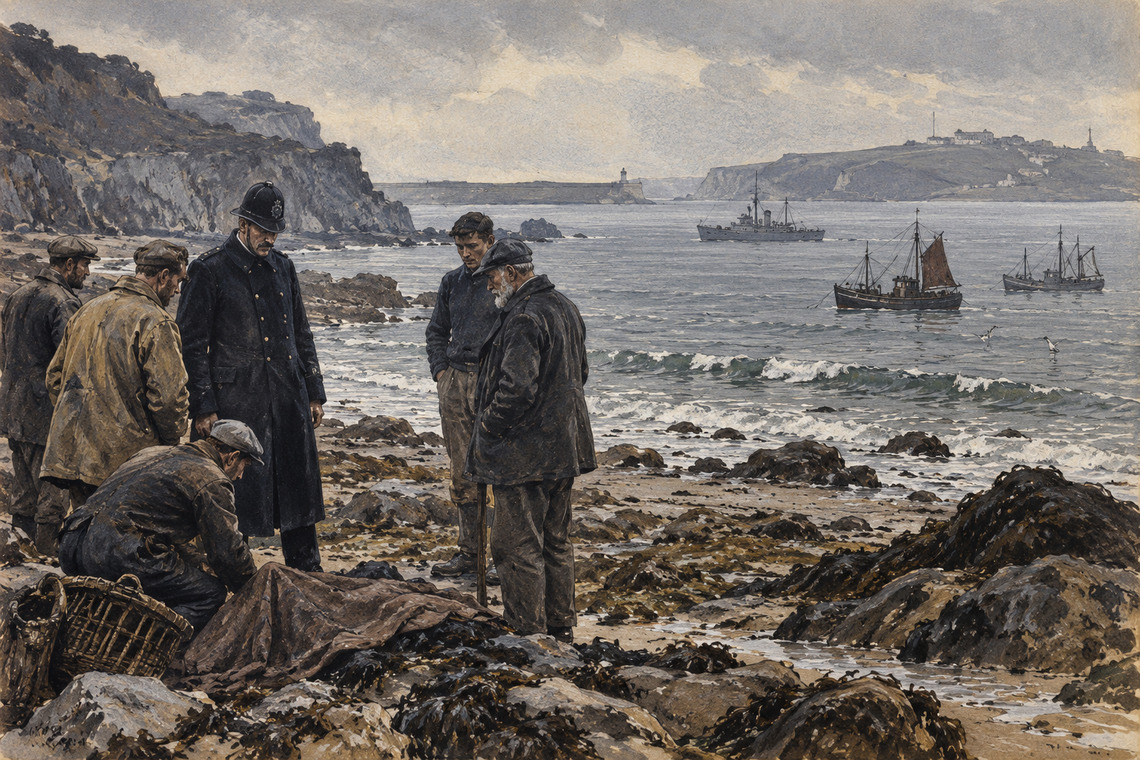
A brief but sombre report in the Western Daily Press on this day in 1916 recorded the discovery of a drowned sailor on the Wembury coast.
The newspaper reported that an inquest had been held at Mount Batten, Plymouth, into the death of a sailor whose body had been found ashore at Wembury, near the entrance to Plymouth Sound.
The verdict was simply:
“Found drowned.”
No name was given in the short report, and there was no suggestion that the circumstances of his death were known.
The same item noted that another body, that of a marine engineer, had been recovered from Jenny Cliff Bay in Plymouth, while four other bodies had been landed by trawlers at Devonport.
Taken together, those few lines give the article a rather different weight. This was not just an isolated drowning. It was part of a grim sequence of recoveries around Plymouth Sound during the First World War.
By October 1916, Plymouth was one of Britain’s most important naval centres. Devonport was crowded with warships, merchant vessels, patrol craft, trawlers and support ships. The sea approaches were heavily defended, and vessels moved constantly through the Sound.
Wembury sat on the eastern side of this busy maritime gateway.
The body described in the report was found close to the entrance to Plymouth Sound, an area shaped by the breakwater and by the great volume of naval traffic moving in and out of the port.
The clipping does not tell us whether the sailor had fallen overboard, been lost from a vessel, or died as a result of some wartime incident. It would be tempting to connect the death with enemy action, but there is no evidence in this report to support that.
What we can say is that bodies washing ashore around Plymouth Sound were one of the grim realities of a naval port operating at extraordinary wartime intensity.
The four additional bodies brought into Devonport by trawlers are especially striking. Trawlers were heavily used during the war for patrol, minesweeping and escort work as well as ordinary fishing, so they were frequently among the first vessels to encounter wreckage or casualties at sea.
For residents of Wembury, the war was therefore never entirely distant.
Even when the fighting itself was taking place elsewhere, the consequences could arrive quite literally on the beach.
There is something particularly stark about the newspaper’s wording.
No biography.
No account of family waiting at home.
Not even a name.
Simply a sailor, washed ashore at Wembury, followed by the coroner’s formal conclusion that he had been found drowned.
That anonymity is perhaps the most affecting part of the story. During a war in which casualties were counted in thousands, individual deaths could sometimes be reduced to a few lines in the press.
Yet for somebody, somewhere, this unnamed sailor was not simply another body recovered from the sea.
He was a son, husband, brother or friend who failed to return.
And for a short time in October 1916, one small part of the enormous human cost of the First World War came ashore at Wembury.
Source: Western Daily Press, 26 October 1916.
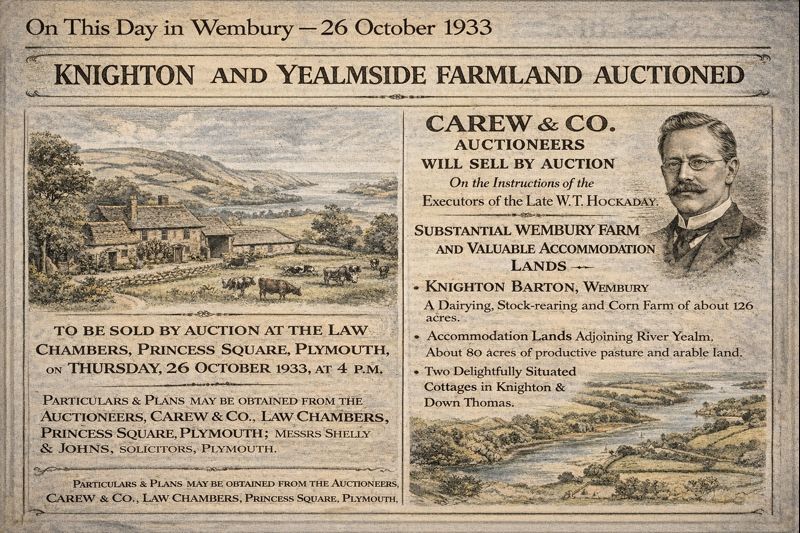
On This Day in Wembury — 26 October 1933: Knighton and Yealmside farmland auctioned
On this day Carew & Co. offered for sale by auction, on behalf of the executors of the late W. T. Hockaday, a substantial Wembury farm and associated lands. The property comprised a dairying, stock-rearing and corn farm known as Knighton Barton, together with accommodation lands adjoining the River Yealm, and two cottages in Knighton and Down Thomas. In all the holding covered about 216 acres.
The auction took place at the Law Chambers, Princess Square, Plymouth at 4 p.m. Printed particulars and plans were available from the auctioneers and from Messrs. Shelly and Johns, solicitors. This sale illustrates the continuing turnover of major farms in the parish during the inter-war years, with estates and holdings frequently broken up or restructured following the death of long-standing owners.
Source: Western Morning News, 7 Oct 1933 (advertisement; auction held 26 Oct 1933)
Entries are summaries and interpretations of historical newspaper reports.