
On This Day in Wembury, 28 October 1941
A rabbiting trip at New Barton Farm ends in tragedy
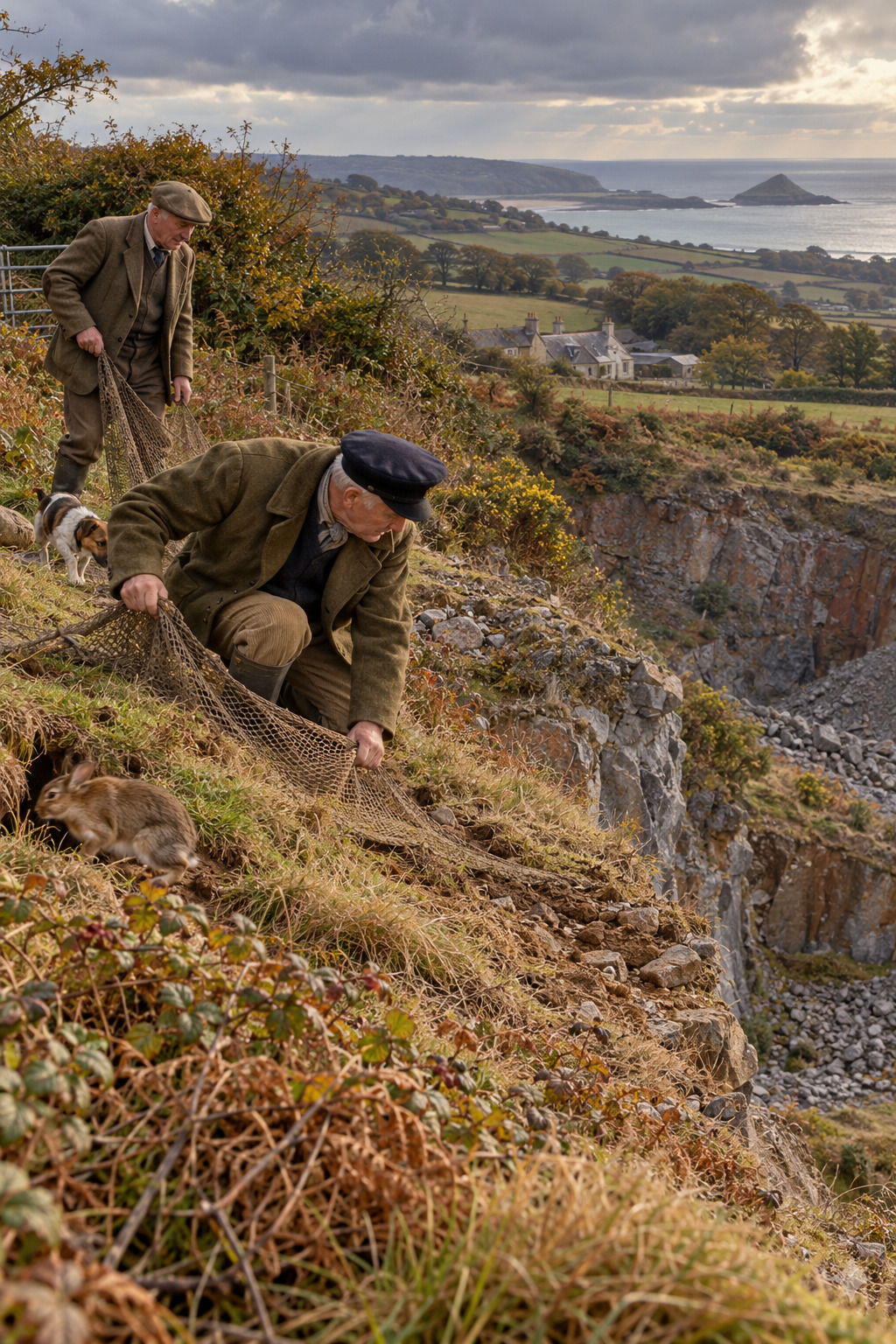
On 28 October 1941 the Western Morning News reported a fatal accident at Wembury involving 75 year old retired naval officer Lieutenant Commander William Alexander Herlihy. He had gone rabbiting at New Barton Farm on the previous Saturday when he fell into a disused quarry and suffered injuries from which he died.
Herlihy had been living at Thelma, Church Road, Wembury, since the Plymouth air raids. The newspaper described him as a familiar figure in Plymouth, where he had for many years been associated with St Paul’s Church in Stonehouse and with the city’s yachting and regatta circles. St Paul’s, in Durnford Street, is the substantial 1831 church designed by John Foulston that still stands today.
There is an especially nice little piece of local continuity in the address. Wembury memories record that Thelma was the name of No. 34 Church Road in the early 1950s, when the name could still be seen in gold lettering above the front door. Herlihy therefore appears to have been living in that same bungalow a decade earlier, having moved out to Wembury during the period of the Plymouth Blitz.
At the inquest, held at Wembury, Benjamin Brock of Harpenden described how he and Herlihy had been netting rabbit burrows close to the edge of the quarry. Brock was working about thirty yards away when he heard earth falling, followed by a thud. Looking over the edge, he saw Herlihy lying at the bottom. He scrambled down as quickly as he could, found him unconscious, and went to the farmhouse for help.
Dr H. W. Thomas told the inquest that death had been caused by a cerebral haemorrhage and that the injuries were consistent with such a fall. The District Coroner, A. K. G. Johnstone, returned a verdict of accidental death, recording that Herlihy had died from injuries sustained after falling into the quarry while rabbiting.
New Barton Farm itself belongs to one of the older strands of Wembury’s landscape. The historic Wembury Barton estate was divided into Old Barton and New Barton in the early nineteenth century, and the two farms became familiar landmarks in the countryside east of the village. Much later, land formerly worked by New Barton Farm would include the field in which the Wembury allotments were created.
The report is a small but unusually vivid wartime glimpse of Wembury life. Away from the bombing in Plymouth, the countryside could seem comparatively quiet, yet ordinary rural activities still carried their own dangers. The newspaper preserves one of those moments in remarkable detail, from the slipping earth at the quarry edge to the hurried scramble down to help a man who had spent much of his life connected with the Navy, Plymouth and the sea.
On This Day in Wembury
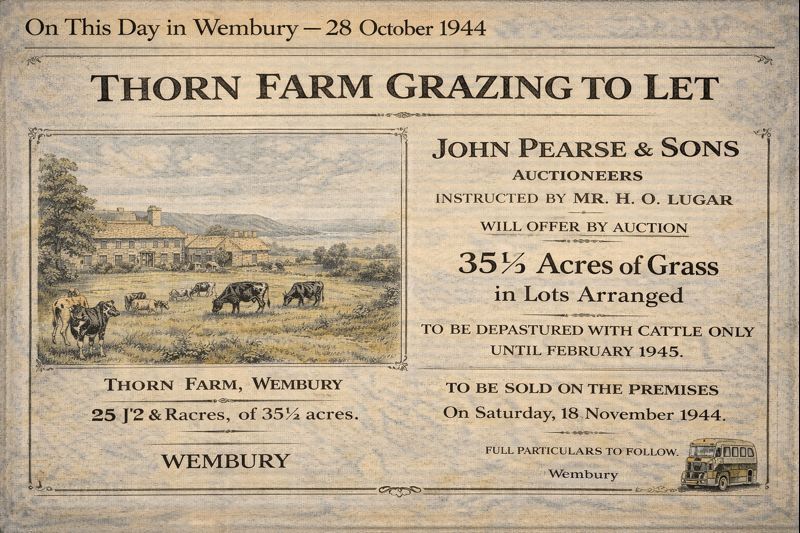
28 October 1944 — Thorn Farm Grazing to Let
On this day the Western Morning News advertised a forthcoming auction of grazing rights at Thorn Farm, Wembury, to be held on the premises on 18 November 1944. Auctioneers John Pearse & Sons, instructed by Mr. H. O. Lugar, announced that 35½ acres of grass would be offered in lots to be arranged, to be depastured with cattle only until February 1945. Detailed particulars were to follow.
Thorn Farm lay close to Knighton, just a few minutes’ walk from the village and on the Wembury–Plymouth bus route. It formed part of the wider Thorn estate (also known historically as South Wembury or South Wembury House), which by the 20th century included both the mansion and associated farmland. The vendor, Henry Osborne Lugar, was a member of the Lugar family, whose son Peter Lugar would later become the well-known local historian and author of the Wembury Memories series.
This wartime notice highlights how estate land was carefully managed for short-term use during periods of pressure on food supply. Letting out grass keep ensured productivity and supported local farmers, while also showing how Wembury’s estates adapted to the demands of the 1940s.
Source: Western Morning News, 28 October 1944 (advertisement for auction of grazing rights at Thorn Farm on 18 November).
Entries are summaries and interpretations of historical newspaper reports.