
On This Day in Wembury
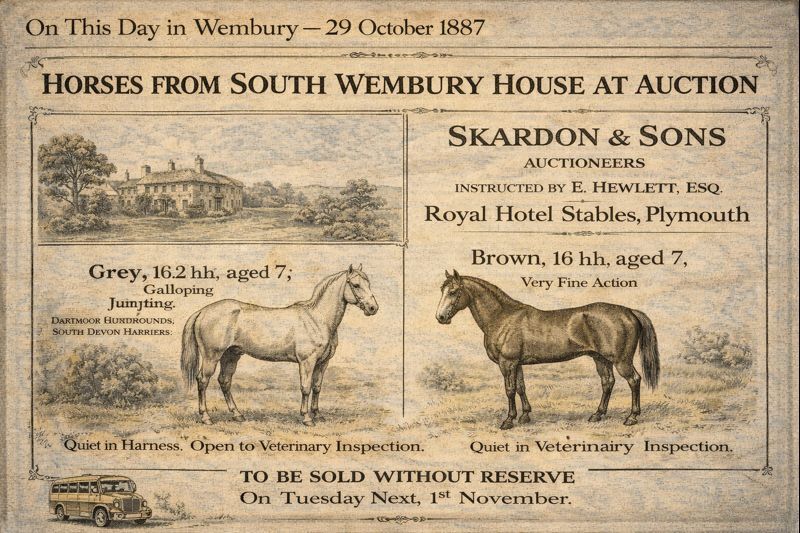
29 October 1887 — Horses from South Wembury House at Auction
On this day the Western Morning News reported that auctioneers Skardon & Sons were instructed by E. Hewlett Esq., of South Wembury House, to sell two valuable horses at the Royal Hotel Stables, Plymouth. One was a grey, 16.2 hands high, aged 7, known for galloping, jumping, and hunting with the Dartmoor hounds and South Devon harriers. The other was a brown horse, 16 hands, also 7 years old, praised for its fine action. Both were described as quiet in harness and offered for sale without reserve, open to full veterinary inspection in the days before the auction.
Reflection: The notice shows the role of South Wembury House, later renamed Thorn House, as an important local estate whose owners engaged in hunting and equestrian pursuits typical of Devon’s landed gentry. Sales like this give a glimpse of rural life, where horses were both status symbols and working companions, and the Royal Hotel in Plymouth acted as the commercial hub for such transactions.
Source: Western Morning News, 29 October 1887.
Sorry — you were right to call that out. I generated the picture and somehow failed to give you the actual OTD.
On This Day in Wembury — 29 October 1993
A remarkable legacy reported on this day in 1993 linked Wembury with one of the largest individual gifts then received by the National Trust in Devon.
The Torbay Express and South Devon Echo told the story of Muriel Stevenson Hornby, an elderly London widow who had died earlier that year and left £1,472,000 to the National Trust. Her instructions were unusually specific: the money was to be used for the maintenance of coastal land from Dartmouth to Wembury and for 15 miles inland from the high-water mark.
What made the story particularly intriguing was that National Trust staff apparently knew very little about their benefactor. Mrs Hornby had lived in a first-floor flat in Holland Park, London, and spent her final days in a residential home there. She was in her eighties and was believed to have had no close relatives. Her husband had died during the war.
The Trust could only speculate about the source of her affection for South Devon. A spokesman suggested that she may simply have visited the area on holiday, grown to love it, and decided that her fortune should help ensure that the landscape remained protected after her death.
It was an extraordinary expression of attachment to a place. Mrs Hornby also left £100,000 each to the National Art Collections Fund and the RNLI, but the great majority of her estate went towards the South Devon countryside.
For Wembury, the wording of the will is especially striking. Mrs Hornby did not merely mention South Devon in general: Wembury formed one of the two geographical end points of the landscape she wanted her money to preserve, with Dartmouth at the other.
By 1993 the National Trust already owned around 27 miles of coastline within that stretch, along with woodland, footpaths and other countryside. The Trust therefore interpreted Mrs Hornby's wishes as applying to its properties across the South Hams between Dartmouth and Wembury. The money could be used not simply to maintain paths and scenery but to protect the varied habitats along the coast.
That placed Wembury within a much bigger conservation story. The familiar cliffs, fields and coastal paths around the village form part of a virtually continuous protected landscape extending eastwards around the South Devon coast. Much of what now feels permanent about that scenery survives because successive landowners, conservation bodies and benefactors ensured that development did not gradually consume it.
There is something rather moving about Mrs Hornby's story because her connection with the area remains elusive. There was apparently no grand estate in South Devon, no obvious family seat and no well-known public association with Wembury. Somewhere during her life, however, this stretch of coast seems to have mattered to her enough that she decided that almost everything she possessed should help look after it.
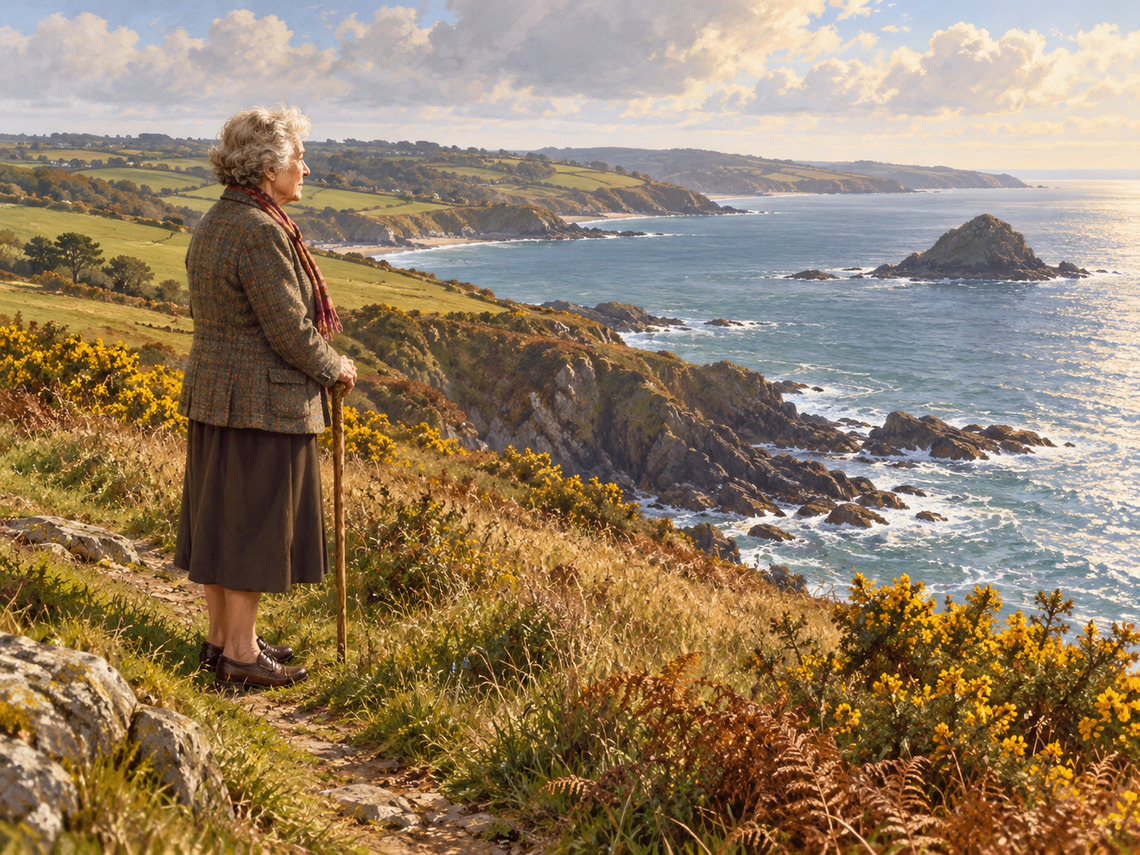
Thirty-three years later, anyone walking the coast path at Wembury, looking across the Mewstone or heading eastwards towards the Yealm and eventually along the South Devon coast, is enjoying precisely the kind of landscape that Muriel Stevenson Hornby wanted her fortune to help preserve.
What remains tantalisingly unclear is why this particular stretch of coast meant so much to Muriel Stevenson Hornby. Even the National Trust admitted in 1993 that it did not know. Yet a woman living hundreds of miles away in Holland Park chose Wembury as one boundary of an extraordinary £1.472 million legacy intended to preserve the South Devon landscape. Somewhere behind that decision there must have been a personal story, perhaps a holiday, a remembered place or a connection now lost. More than thirty years later, that part of the story is still waiting to be rediscovered.
Source: Torbay Express and South Devon Echo, 29 October 1993.
Entries are summaries and interpretations of historical newspaper reports.