
Yes — I gave you the illustration and somehow omitted the entire OTD article. Sorry. Here it is properly, with the reflection included but not labelled, as you asked.
On This Day – 1 November 1924
A doctor wanted for Wembury
On 1 November 1924, the Western Morning News carried a small advertisement which gives us an intriguing glimpse into healthcare in Wembury a century ago.
The Guardians of the Plympton St Mary Union were seeking applications for the post of District Medical Officer and Public Vaccinator for No. 5 District. The district consisted of the parishes of Plymstock and Wembury, covering around 5,930 acres and serving a combined population of 4,620 people.
The successful applicant would receive a salary of £78 a year as District Medical Officer, together with fees for carrying out vaccinations. A further £25 per year was allowed specifically for the duties of Public Vaccinator.
The doctor was required to possess the medical and surgical qualifications prescribed by the Ministry of Health, and the appointment itself remained subject to Ministry approval. Applicants had to provide two recent testimonials covering their professional ability as well as their personal character.
Although the advertisement looks rather like an ordinary job vacancy, the post was part of a system of public medicine that had its origins in the Poor Law.
Wembury at this time lay within the Plympton St Mary Poor Law Union, which covered a surprisingly large and varied area. It included growing districts close to Plymouth, such as Plymstock, but also distinctly rural communities including Wembury, Newton Ferrers and Ermington. Historical research into the Union describes it as retaining much of its rural and agricultural character even as Plymouth expanded towards its boundaries.
The District Medical Officer was therefore not quite the equivalent of today's family GP. His responsibilities were particularly concerned with people receiving Poor Law assistance. He could be called upon to visit sick paupers in their homes, certify illness, provide medical treatment and deal with cases which might otherwise have ended up in the Union infirmary or workhouse.
The Plympton St Mary Union still had its own workhouse at the time. Indeed, the 1921 Census records the Plympton St Mary Union Workhouse as a separate institution. Findmypast
The second half of the appointment, Public Vaccinator, is equally interesting. Vaccination against smallpox had been organised nationally since the nineteenth century and Poor Law Unions played an important role in administering it. Public vaccinators were paid fees for carrying out vaccinations and recording them, rather than simply receiving one fixed salary. Surviving Poor Law records elsewhere show separate payments routinely being made for vaccination work alongside medical duties. Kresen Kernow
It was quite normal for a country doctor to combine several such official responsibilities. A surviving account from neighbouring Ivybridge, for example, records that Dr Cooper was simultaneously a physician and surgeon, Medical Officer of Health and Public Vaccinator for the Second District of the Plympton St Mary Union. Ivybridge Heritage
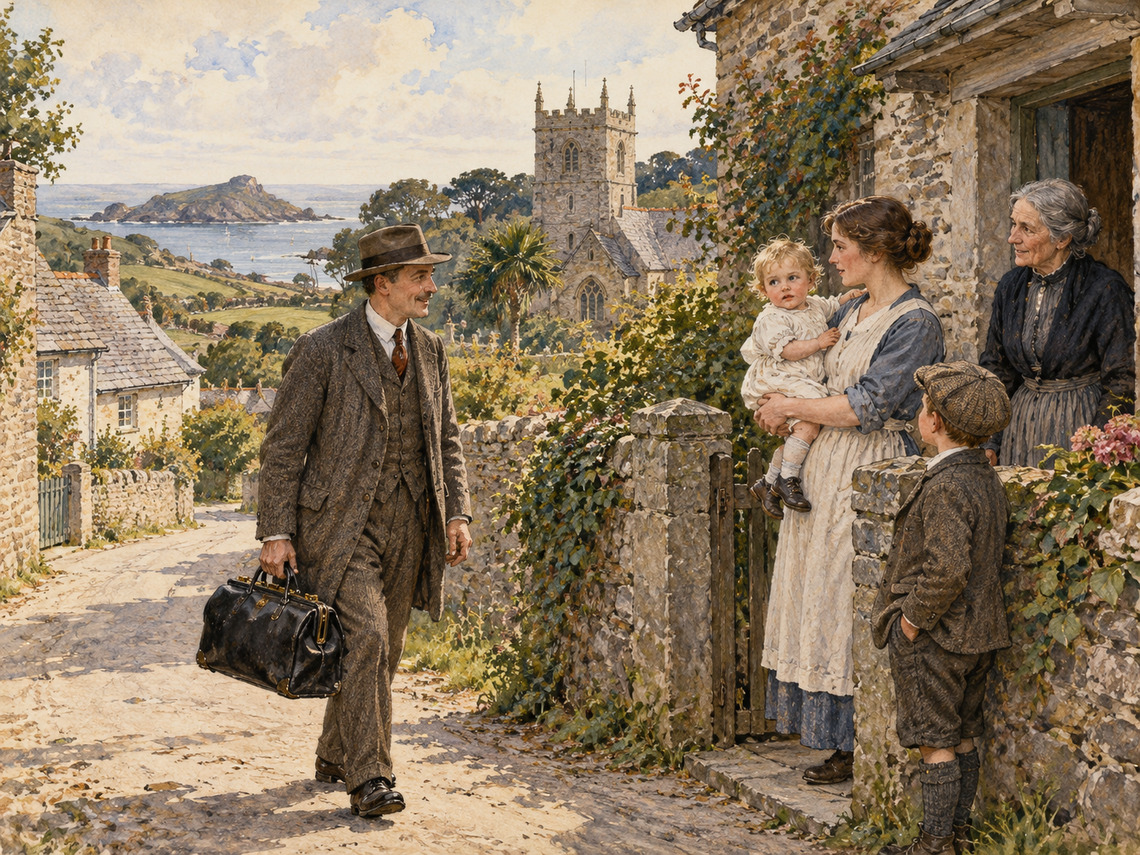
For Wembury families in 1924, a visit from the district doctor might therefore have looked very different from a visit to a modern surgery. Much of the parish was still scattered among farms, cottages and small groups of houses. A doctor might have travelled considerable distances by motor car, bicycle or on foot, carrying his instruments and medicines with him and treating patients in their own homes.
The notice also comes at an interesting moment in Wembury's history. The village had not yet experienced the substantial residential development which would follow during the interwar years. Official census records show Wembury still as a small rural civil parish in this period, quite unlike the much larger community it later became. Vision of Britain
And there is something rather striking in that figure of £78 a year. The person appointed was expected to be medically qualified, surgically qualified, available across nearly six thousand acres, responsible for some of the poorest and most vulnerable inhabitants of two parishes, and at the same time to act as their official vaccinator.
A century later we tend to think of organised public healthcare beginning with the NHS in 1948. This little advertisement is a useful reminder that long before the NHS there already existed a patchwork of district doctors, Poor Law medical officers, public vaccinators and voluntary hospitals trying to provide a form of healthcare for communities such as Wembury. It was far from universal and could be harshly divided according to a person's means, but it was nevertheless one of the foundations from which the modern system eventually grew.
Source: Western Morning News, Saturday 1 November 1924, together with historical records of the Plympton St Mary Union and 1921 Census material.
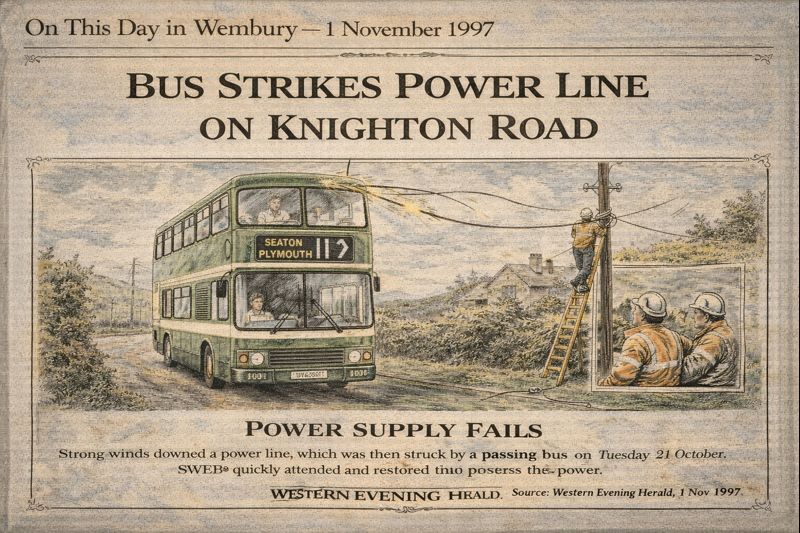
On This Day in Wembury
1 November 1997 — Bus Strikes Power Line on Knighton Road
On this day the Western Evening Herald reported that strong winds had blown an overhead electrical wire loose across Knighton Road, Wembury, on Tuesday 21 October. The situation escalated when the loose wire was struck by a passing bus, causing a local power failure and inconvenience to residents. South Western Electricity Board (SWEB) engineers quickly attended, making the area safe and restoring supplies.
The report appeared alongside notices of other parish life: the annual Christmas Pudding Stir at HMS Cambridge, where disabled pupils from Dame Hannah Rogers School in Ivybridge were once again guests; a talk to the Wembury Local History Society by Group Captain J. R. Goodman on “A Thousand Years of Sherford”; Wembury Grasshoppers Cricket Club’s autumn dance in the Village Hall; and a local bird feed delivery service run by Valerie Gray of Heybrook Bay.
The Knighton Road incident shows how vulnerable rural parishes were to sudden weather damage, and how everyday services—like buses—could suddenly become part of the drama. The accompanying local items also capture Wembury’s busy social calendar in the late 1990s, from cricket and history talks to community ties with HMS Cambridge.
Source: Western Evening Herald, 1 November 1997.
Entries are summaries and interpretations of historical newspaper reports.