
On This Day in Wembury – 3 November 1871
The Western Morning News carried a long letter promoting Wembury as a potential new watering place for Plymouth’s growing population. The writer, C. W. Dymond C.E., praised the natural beauty of Wembury’s coast, its healthy air, and the proximity to Plymouth, arguing it could rival Dawlish or Teignmouth if only a railway line or tramway were built through Plymstock and the Langdon Valley to Wembury Church. He described the fine stone, timber, and fresh water available locally, and urged that an hotel and villas would make Wembury a fashionable seaside resort, “the metropolis of the West.”
It is striking to think how close Wembury came to being transformed into a Victorian resort like Torquay. In the end, no railway came, and the cliffs and fields stayed much as they were. What some saw as a missed opportunity left us with something more precious: Wembury kept its quieter character, the kind of place where people come for rockpools and long walks, not promenades and piers.
On This Day in Wembury — 3 November 1916
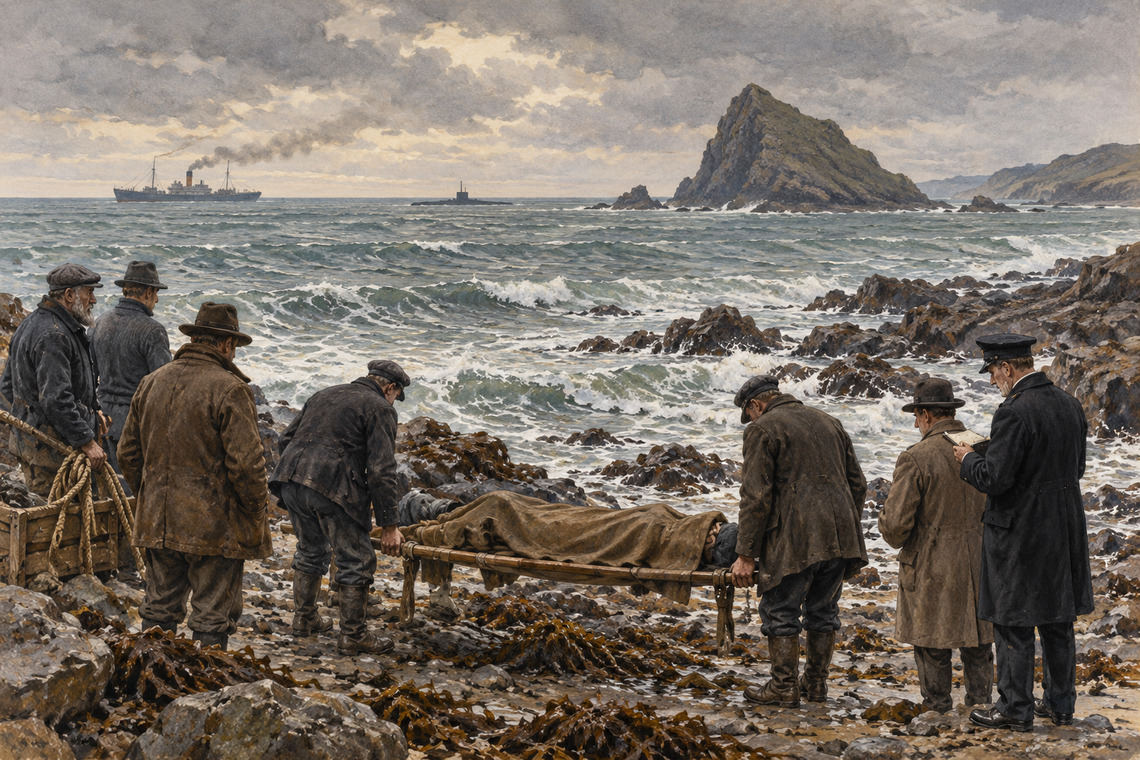
A Greek sailor washed ashore at Wembury
On 3 November 1916, the Cornish Times reported an inquest held at Mount Batten into the death of a Greek seaman whose body had been washed ashore at Wembury Beach.
The dead man was named as Bliziotis, a trimmer serving aboard the Greek steamship George M. Embiricos.
The newspaper reported that the captain of the vessel had given evidence at the inquest. The steamer had been torpedoed by a German submarine, and Bliziotis had been among those lost when the ship went down.
Modern shipping records allow the story to be filled out rather more fully.
The vessel was the George M. Embiricos, a Greek cargo steamer of 3,636 gross tons, built by Short Brothers of Sunderland in 1904 and owned by S. G. Embiricos of Andros. Surviving business records show that she had spent more than a decade trading widely between the Black Sea, Mediterranean and north-western Europe. Her final voyage was her fiftieth. Seal IT Project
On 22 October 1916, the George M. Embiricos was attacked and sunk by the German submarine UB-29, commanded by Herbert Pustkuchen. Contemporary U-boat records confirm both the date and the vessel involved. Uboat.net
Reports issued immediately after the sinking stated that twelve members of the crew were missing. RheinMain Library
The clipping from the Cornish Times makes clear what happened to at least one of them.
The captain told the inquest that, after the torpedoing, he flew the Greek flag, and that men aboard the submarine were able to see it. The coroner asked whether the submarine commander could therefore have been in any doubt about the ship's nationality. The captain replied that he could not.
That detail mattered because Greece was still officially neutral in October 1916. Greece did not formally enter the First World War on the Allied side until the following year, although the country was already deeply divided between supporters of King Constantine and those of the pro-Allied Eleftherios Venizelos.
Neutrality offered merchant ships little guarantee of safety. German submarines were increasingly attacking commercial shipping believed to be carrying goods useful to the Allied war effort, and neutral vessels were among those sunk.
The George M. Embiricos appears in surviving lists of Greek ships lost to U-boats during the war, and contemporary American government records likewise record her among Greek vessels sunk in October 1916. Uboat.net
There is another poignant connection with Plymouth. Men from the crew of the George M. Embiricos are buried in Efford Cemetery, where a number of First World War casualties from ships entering or passing Plymouth were also laid to rest. thebignote.com
For Wembury, however, the story arrived not through naval communiqués or casualty lists, but quite literally with the tide.
Some days after a ship had vanished beneath the Channel, the sea carried one of its crew ashore onto Wembury Beach. There, far from his home in Greece, Bliziotis became part of a local coroner's inquiry and a brief newspaper report.
The inquest returned the simple verdict that he had died as the result of the vessel being torpedoed by a submarine.
It is an unusually stark reminder that Wembury's coast during the First World War was not distant from the conflict. The fighting might have seemed far away in France or Flanders, but the sea immediately beyond the Mewstone was part of a wartime shipping route where submarines hunted merchant vessels and wreckage, lifeboats and sometimes bodies could be carried towards the Devon shore.
Bliziotis was one man among thousands lost in the submarine war, yet this small report gives him something casualty statistics rarely can: a name, a place and the final stages of his journey.
Source: Cornish Times, Friday 3 November 1916, with contemporary and modern maritime records concerning the George M. Embiricos.
Entries are summaries and interpretations of historical newspaper reports.