
On This Day in Wembury — 4 November 1938
£900 still needed to save Wembury Bay
On 4 November 1938, the Western Morning News reported that the long campaign to preserve Wembury Bay was approaching its conclusion, although another £900 was still required.
At a dinner in London, Mr R. C. Norman appealed for the remaining money needed to complete the preservation scheme.
The report makes clear just how highly Wembury was regarded. Norman described it as:
“a very beautiful bit of coast”
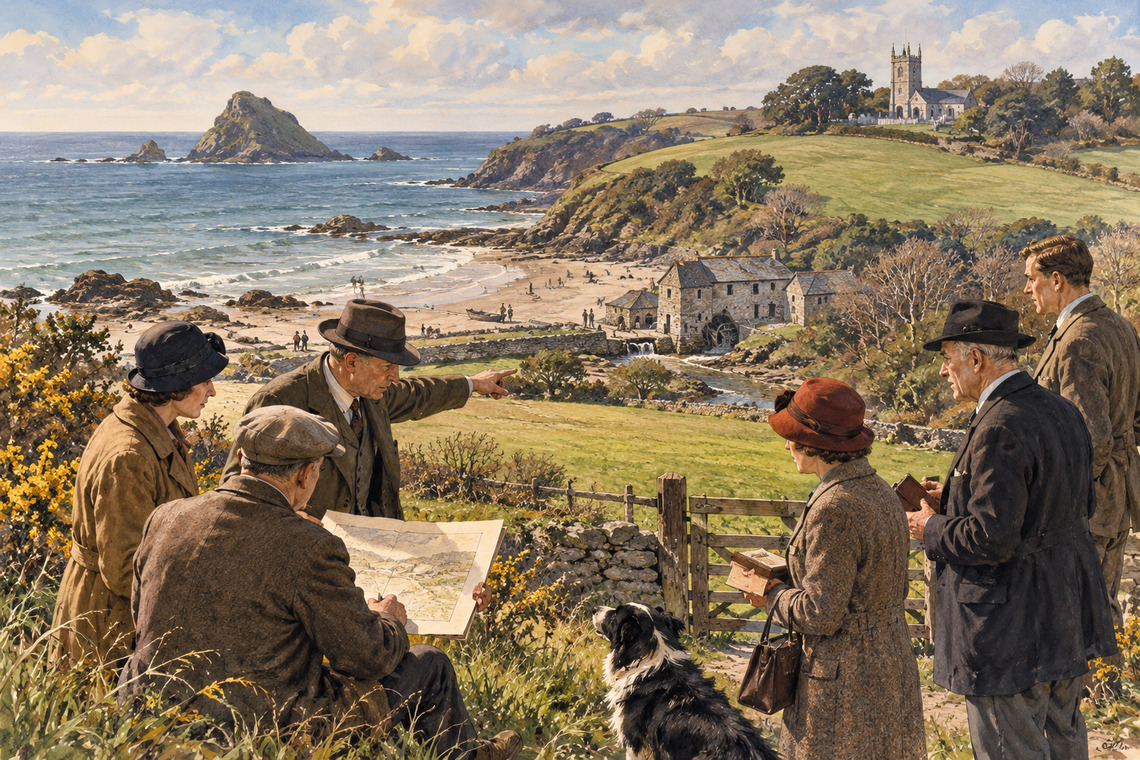
The land at risk included the landscape around Wembury Beach, the old mill and the fields close to St Werburgh’s Church. Development pressure was very real during the interwar years, when building was spreading through Wembury and proposals existed for much more extensive development along the coast.
A local preservation campaign had already succeeded in acquiring land around the church and beach, despite considerable difficulty and some opposition. That land would subsequently pass into National Trust protection.
At the same time, the Hon. Ida Sebag-Montefiore of Thorn had made an important contribution to the protection of the Wembury coastline.
In the 1930s she offered a substantial area of her cliff land to the National Trust, helping to secure a large part of the coast from future development. Her gift was one of the key steps in creating the protected landscape which today surrounds Wembury.
The £900 still being sought in November 1938 related to the separate preservation effort centred on Wembury Bay, the mill, church and surrounding land. The appeal was therefore part of a wider movement in which local campaigners, landowners, donors and the National Trust were all playing a part.
Two important strands of preservation were coming together at almost exactly the same time: Sebag-Montefiore’s gift of cliff land and the public campaign to secure the beach, mill and church fields.
Together they established the nucleus of the National Trust landscape at Wembury.
Today it is remarkably difficult to imagine the fields between the church and beach covered with houses, or the cliffs above the Yealm broken up for building plots. Yet neither landscape was automatically safe. The survival of the familiar Wembury coastline was the result of deliberate action by people who were prepared to give land, raise money and campaign to protect it.
By November 1938, the appeal was within £900 of its target.
That small figure in an old newspaper column represents something rather larger. The view across Wembury Beach towards the church and surrounding green fields did not survive simply because nobody happened to build there.
People made sure it survived.
Source: Western Morning News, Friday 4 November 1938; Wembury Local History Society and National Trust historical material.
On This Day in Wembury
4 November 1948 — “Sunningdale” on Church Road Offered for Sale
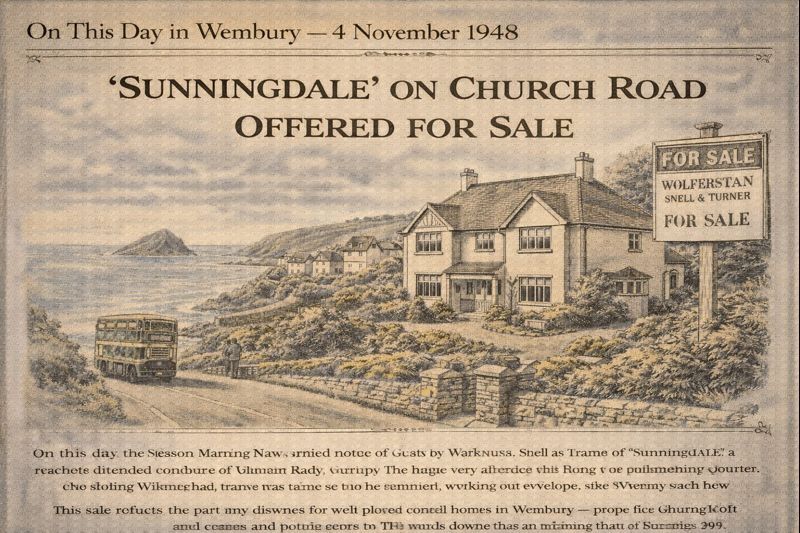
On this day the Western Morning News carried notice of a sale by Wolferstan, Snell & Turner of “Sunningdale,” a modern detached residence off Church Road, Wembury. The house was advertised as being in a commanding position overlooking Wembury Bay, within easy reach of the Plymouth bus route.
The name “Sunningdale” appears again in deed records of the late 1940s, confirming it remained a recognised property for some years after the sale. Church Road continues to be lined with detached houses with sea views, and while house names often change over time, it is very likely the original building still survives as a private residence.
This sale reflects the post-war demand for well-placed coastal homes in Wembury — properties offering both rural charm and quick access to Plymouth.
Source: Western Morning News, 4 November 1948.
Entries are summaries and interpretations of historical newspaper reports.