
On This Day in Wembury — 8 November 1900
A Hero’s Welcome Home from the Boer War
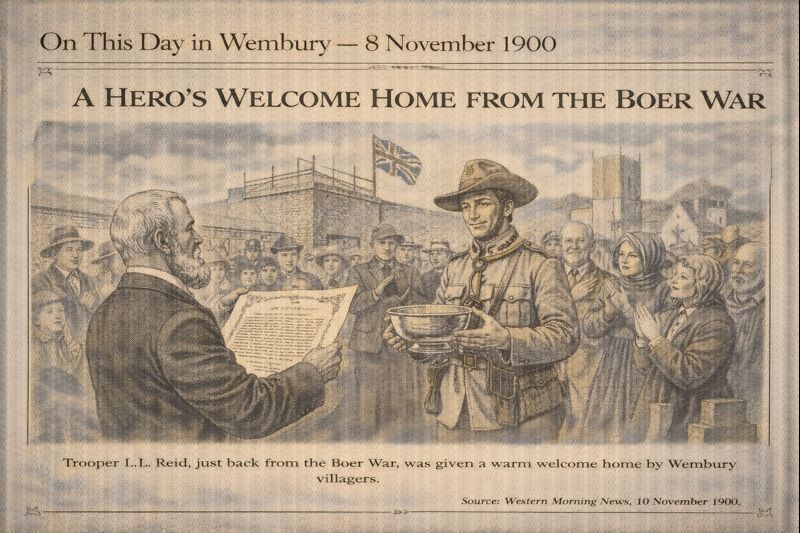
Wembury villagers gathered in force on Thursday evening to honour Trooper L. L. Reid, nephew of Mr. and Mrs. Nicholas Coleman of Spirewell Farm, who had just returned from the war in South Africa. Reid, who had volunteered ten months earlier, fought with Roberts’s Horse in some of the most famous actions of the campaign, including Reit River, Modder River, Dronfield, McFarlane’s Farm, Koodoo’s Drift and Paardeberg, where he witnessed Cronje’s surrender on Majuba Day.
His service was not without peril. On 31 March 1900, while escorting a convoy at Sanna’s Post, Reid’s troop rode into a Boer ambush. His horse was shot and he was thrown to the ground, narrowly escaping death. He and a companion crawled under heavy fire to shelter, only to be captured and sent to Waterval Prison in Pretoria. Believing him dead after his helmet was found near a fallen comrade, his family even received notice of his death in the Western Morning News. After two months’ imprisonment, he was freed when Lord Roberts entered Pretoria, only to fall dangerously ill with enteric fever before being invalided home.
At the Wembury meeting, chaired by Dr. Clay, Reid was presented with an illuminated parchment and a silver bowl subscribed for by 133 supporters. Overcome with gratitude, he thanked his neighbours warmly and was given an ovation.
The gathering was more than a simple homecoming — it was the village’s way of expressing pride and relief at seeing one of their own return from the Empire’s distant battlefields, alive against the odds.
Source: Western Morning News, 10 November 1900
On This Day in Wembury — 8 November 1944
The Western Morning News reported that at a recent Buckingham Palace investiture, King George VI decorated officers and men of the submarine Ultor for gallantry in the Mediterranean. Among those honoured was Frank Forrest of Knighton Hill, Wembury, who received the Distinguished Service Medal (D.S.M.).
The report highlighted the Ultor’s remarkable record of sinking 29 enemy ships and her role in the landings in Southern France. Nearly 290 officers and men were recognised that day, including many Westcountry names across the Army, Navy, and Royal Navy Volunteer Reserve.
Source: Western Morning News, 8 November 1944
Wembury’s own Frank Forrest stood among those decorated, a reminder that even the smallest villages had ties to world events. For readers in 1944, seeing a local name honoured in the King’s court must have brought a moment of pride amidst the strains of war.
On This Day in Wembury — 8 November 1986
Wembury Rovers face a tough cup test
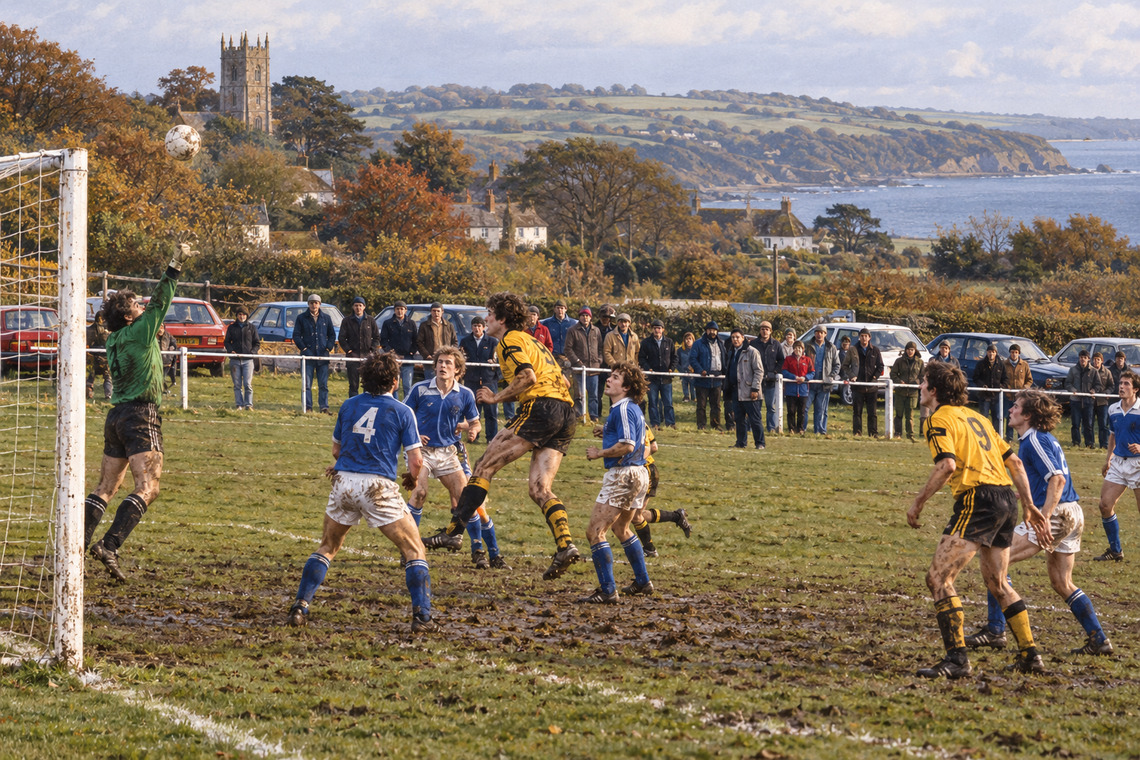
On 8 November 1986, the Western Evening Herald looked ahead to that weekend’s local football and picked out Wembury Rovers as one of the sides facing a particularly difficult tie.
Wembury were at home to Chasville, a club with a strong record in the competition. The paper was not especially optimistic about the village side’s chances, observing that Chasville had “a proud record in this competition” and that it was hard to see Rovers preventing them from making further progress.
For Wembury, though, simply appearing in the local football columns was part of a much longer village sporting tradition.
Wembury Rovers played their home matches at the Wembury Recreation Ground, later listed in league records as the Recreation Field at Barton Close. They were one of many amateur clubs forming the backbone of Saturday football in and around Plymouth, with players travelling across the city and surrounding villages for league and cup matches. Full-Time
The club survived long after this 1986 fixture. In 2012–13, Wembury Rovers were still competing in Division Two of the Plymouth and West Devon Combination, finishing sixth after a 20-match season. FCHD
By 2017, however, the future of the club had become uncertain. Wembury Parish Council minutes recorded that discussions were continuing between committee members and senior players about the future of Wembury Rovers. Wembury Parish Council
That later history gives this small 1986 cutting a little more weight. For many years, Wembury had its own adult football side, playing week after week on the village recreation ground and taking its place in the wider Plymouth football scene.
The opponents changed, the divisions changed and the kits changed, but for generations of local players and spectators, Saturday football at Wembury was simply part of village life.
And on this particular November weekend in 1986, Wembury Rovers had one fairly simple task ahead of them:
prove the Evening Herald wrong.
Source: Western Evening Herald, Saturday 8 November 1986.
Entries are summaries and interpretations of historical newspaper reports.