
On This Day in Wembury — 20 November 1895
Excursion to see the wreck on Wembury Beach
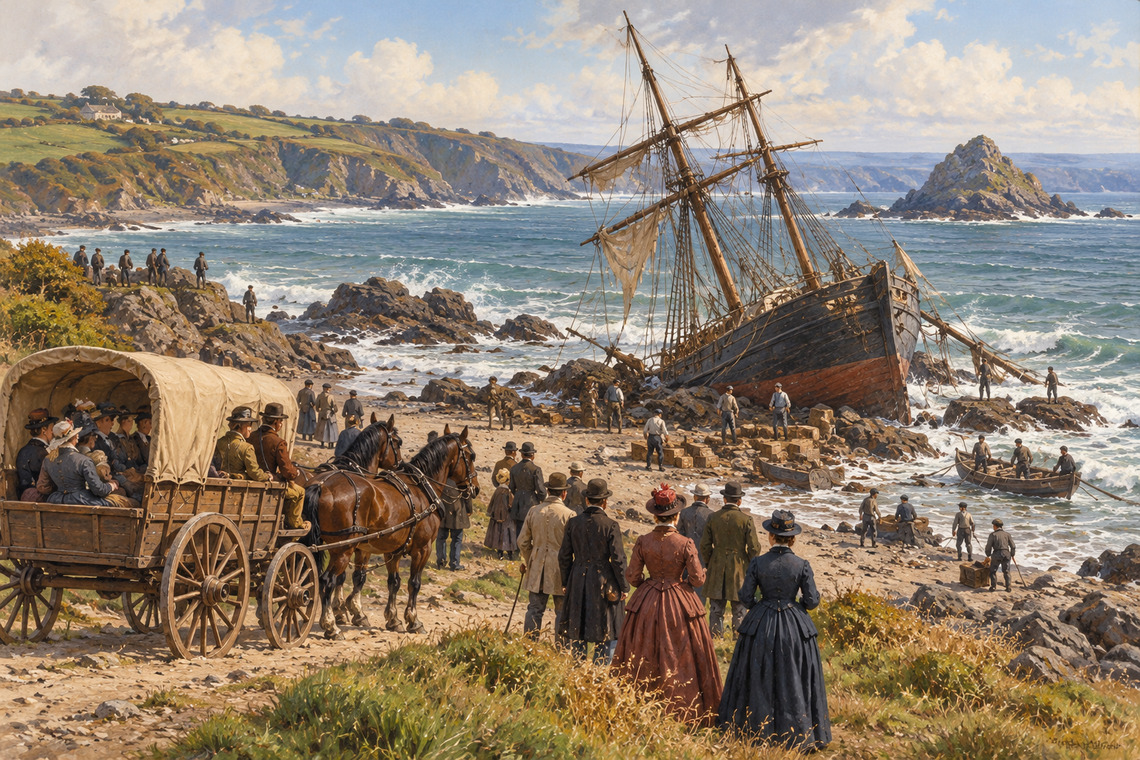
On 20 November 1895, the Western Morning News advertised a rather unusual outing from Plymouth: a trip by covered wagonette to see “The Wreck off Wembury Beach.”
The wreck was almost certainly the Norwegian barque August Smith, which had come ashore at Wembury only five days earlier, on 15 November 1895.
The August Smith was a wooden barque of about 600 tons, built in Norway in 1881. She had been travelling from Buenos Aires to Rotterdam with a cargo of quebracho or logwood when she was caught in severe weather off the South Devon coast.
In poor visibility, her captain became uncertain of his position and the vessel entered Wembury Bay. Two anchors were dropped in an attempt to hold her, but they dragged and the ship was driven ashore.
The crew of eleven all survived.
Once the tide fell, however, it became clear that the ship was badly damaged. Her back had been broken on the reef and there was no realistic prospect of getting her afloat again. Salvage began almost immediately, with cargo, fittings, spars and other material brought ashore.
Within days the wreck had become something of a local attraction.
The advertisement on 20 November offered Plymouth residents the chance to travel out and see it for themselves. Covered wagonettes were to leave Derry’s Clock at 2.30 p.m., with a return fare of 2 shillings and 6 pence, or three shillings for those wanting a separate arrangement.
That tells us something interesting about Victorian attitudes to shipwrecks. A wreck on the coast could be a disaster for the owner and crew, but it could also become a public spectacle. People were prepared to pay for transport simply to see the remains of a large sailing vessel stranded beneath the cliffs.
And the August Smith would have been an impressive sight. She was more than 150 feet long, with broken rigging and spars still standing above the beach while salvagers worked around her.
The wreck continued to attract attention for some time. On 6 December, the damaged hull itself, together with anchors, cables, boats and spars, was offered for sale by auction on Wembury Beach.
Today almost nothing visible remains of the vessel, although traces associated with the wreck site have survived around the shore.
For a few weeks in the autumn of 1895, though, Wembury Beach had something rather different from its usual visitors.
Instead of bathers and walkers, wagonettes arrived from Plymouth carrying sightseers who had paid to see a shipwreck.
Source: Western Morning News, Wednesday 20 November 1895.
Supporting identification: SHIPS Project records for the wreck of the August Smith and Lloyd’s casualty returns for 1895.
On This Day in Wembury
20 November 1999 — Bus Complaints, Traffic Calming, and Millennium Award
On this day the Western Evening Herald reported several key issues discussed by Wembury Parish Council. Residents had raised strong complaints about the deteriorating No. 48 Wembury bus service, citing lateness, unreliability, and even journeys withdrawn without notice. The council had taken the matter up with the Western Area Traffic Commissioners and First Western National, and correspondence was also to be sent to Devon County Council and Cllr. Keith Baldry. Members of the public at a September meeting had given valuable first-hand testimony.
The council also confirmed that a Traffic Calming Sub-Committee had been formed, chaired by vice-chairman Roger Newnham, with members from across the parish. Efforts continued to press Devon County Council for calming measures along the Down Thomas–Heybrook Bay road.
Finally, the council announced receipt of a £3,000 Millennium “Awards for All” grant, to fund a new edition of the Wembury Footpath Guidebook. This national lottery-supported scheme backed projects connected with heritage, sport, and community life.
Reflection: The issues of late buses and unsafe roads show how deeply transport has always affected village life, while the grant for the footpath guide reflects Wembury’s determination to celebrate and share its rich landscape at the turn of the millennium.
Source: Western Evening Herald, 20 November 1999.

Entries are summaries and interpretations of historical newspaper reports.