
On This Day in Wembury – 23 September 1937
A bicycle, black gloves and a bent buttonhook
On 23 September 1937, the Western Morning News reported that a young Plymouth seaman was to stand trial for breaking into houses at Wembury and Tamerton Foliot.
Christopher George Griffin, aged 21, was an unemployed merchant seaman living at 183 Mount Gold Road, Plymouth. Appearing before Crownhill magistrates, he was committed for trial at the next Quarter Sessions on two charges of housebreaking and theft.
Griffin told the court that he intended to plead guilty.
The Wembury charge concerned a house called Willowhays, occupied by Mrs Elizabeth Margaret Nicholas and her husband. Mrs Nicholas explained that they had left the house securely locked before going away on holiday.
When she returned, she found that a dining-room window had been broken. Several drawers inside the house had been forced open and jewellery worth £7 5s 6d was missing.
Detective Constable Jewell later showed Griffin some of the stolen articles, which had been found in his possession. Griffin initially claimed that he had no idea how they had come into his hands.
According to the officer, however, Griffin later admitted breaking into Willowhays and stealing the jewellery. In a written statement, he said that he had cycled out to Wembury intending to break into a house and steal because he was unemployed. He had subsequently sold some of the stolen articles.
A search of Griffin’s bedroom uncovered three files, a pair of black cotton gloves and a buttonhook which had been bent so that it could be used as a makeshift lock pick.
The second charge concerned a house at Tamerton Foliot belonging to Alfred Ernest Angus, an engineer. He and his wife had also been away on holiday, leaving their home secure. On their return, they discovered that a scullery window had been broken and jewellery worth £12 10s had disappeared.
Griffin was committed for trial on both charges.
The report gives us a glimpse of housebreaking before cars, electronic alarms or modern policing. Griffin apparently travelled from Plymouth to Wembury on an ordinary bicycle, carrying a few files, cotton gloves and a crudely adapted buttonhook.
It also demonstrates that leaving home unattended while away on holiday carried risks long before the age of social media announcements and overflowing letterboxes. For the Nicholas family, their return to Wembury brought the unpleasant discovery of a broken window, ransacked drawers and missing jewellery.
Source: Western Morning News, 23 September 1937.

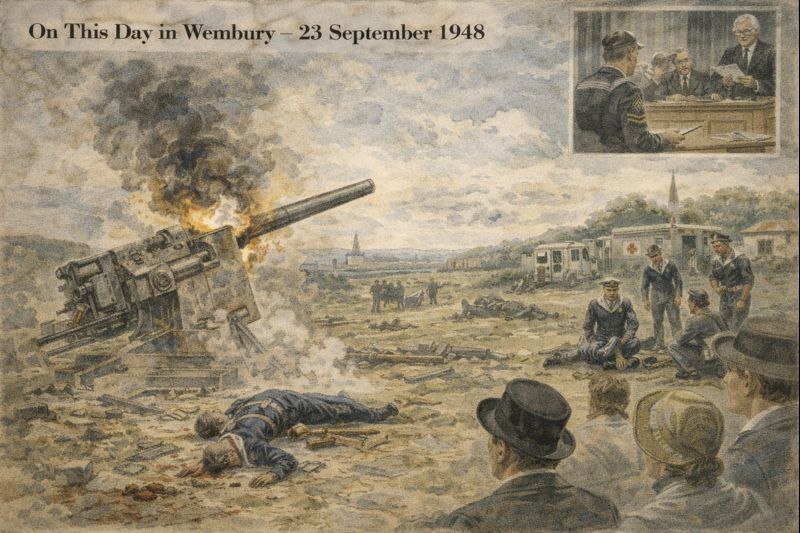
On This Day in Wembury — 23 September 1948
Tragedy struck the Royal Naval Gunnery Range at Wembury when a 4.5-inch gun exploded during routine practice, killing two men and injuring seven others. The blast occurred as a gun’s crew was undergoing training, and the injured were rushed to the Royal Naval Hospital.
At the inquest, it was revealed that the explosion was caused by a jammed cartridge during loading. Petty Officer Victor Cross, aged 28, of Bristol, was the instructor in charge of the gun, while Able Seaman Francis Melville Edworthy, aged 20, of Filleigh Lodge, North Devon, was serving as a member of the crew. Both men died from shock and multiple injuries after the cartridge detonated unexpectedly.
Chief Petty Officer Edwin Norman Hazeel, the supervising gunnery instructor, described how Cross was blown 20 feet from the weapon, while Edworthy was found lying nearby. Crew member A.B. David Hughes testified that he had tried to free the jammed cartridge with a hand rammer, following normal practice used on previous occasions. After repeated attempts, the round suddenly exploded.
The City Coroner, Mr. W. E. J. Major, recorded a verdict of accidental death but remarked that it was up to the naval authorities “to put their own house in order” to prevent a repetition of such an incident.
Source: Western Morning News, 24 September 1948; inquest report, later coverage
The accident was a grim reminder to the people of Wembury that the thunder of gunnery practice at the Point was not without risk. Even in peacetime, naval training carried dangers as sharp and sudden as war itself.
Entries are summaries and interpretations of historical newspaper reports.