
On This Day in Wembury – 24 September 1892
How should visitors get to Wembury?
On 24 September 1892, the Western Morning News published two letters inspired by an earlier description of a pleasure trip from Plymouth to Wembury.
The timing was significant. Plymstock railway station had opened to passengers only a few weeks earlier, on 5 September 1892. Although called Plymstock, it was situated at Pomphlett—a naming decision which had apparently already begun to cause some irritation.
The first correspondent, writing under the name “Pedestrian”, said that he had often travelled through the “charming region” described in the newspaper’s account. However, he questioned why the new station was called Plymstock when it was actually at Pomphlett and, according to his pedestrian map, was about a mile from Plymstock village.
He also thought that the route described by the newspaper was unnecessarily long. It would, he calculated, amount to well over six miles and could involve either crossing by ferry or making a considerable detour through Brixton.
Instead, he recommended leaving the main road and travelling through Staddiscombe before continuing towards Wembury:
“I am told it would be said to be a most enjoyable drive to leave the main road emerging through Staddiscombe, and thence on to Wembury, by the beautiful mansion and grounds of Langdon Court.”
The second letter, headed “South Hams Picnics”, came from somebody who had thoroughly enjoyed the newspaper’s account and believed that hundreds of readers might now want to see Wembury for themselves.
Unfortunately, the original excursion had taken place on a Wednesday, when many working people were unable to get away. The writer therefore appealed to an “enterprising coach proprietor” to organise similar outings on Fridays and Saturdays.
There was also a suggestion for the newspaper itself. The correspondent proposed that it should regularly publish short descriptions of afternoon and day trips around Plymouth and the South Hams.
Visitors arriving after a long railway journey, he argued, would be grateful if their newspaper offered a few suggestions for the best local walks and drives. One of his friends had apparently completed thirty different excursions during a single holiday.
The writer concluded by proposing that the routes should eventually be collected and published together in a cheap booklet. In effect, he was asking the Western Morning News to produce an early local tourist guide.
In September 1892, the new railway did not extend anywhere near Wembury. Plymstock was then the end of the passenger line from Plymouth Friary. The extension to Turnchapel did not open until 1897, while the separate branch towards Yealmpton followed in 1898.
Anyone wishing to explore Wembury therefore still faced a substantial walk or needed to find a horse-drawn coach. Yet these letters show that the village and its surrounding countryside were already being promoted as an attractive destination for visitors from Plymouth.
They also prove that arguments about misleading station names, inconvenient public transport and the best route into Wembury are by no means modern inventions.
Source: Western Morning News, 24 September 1892.

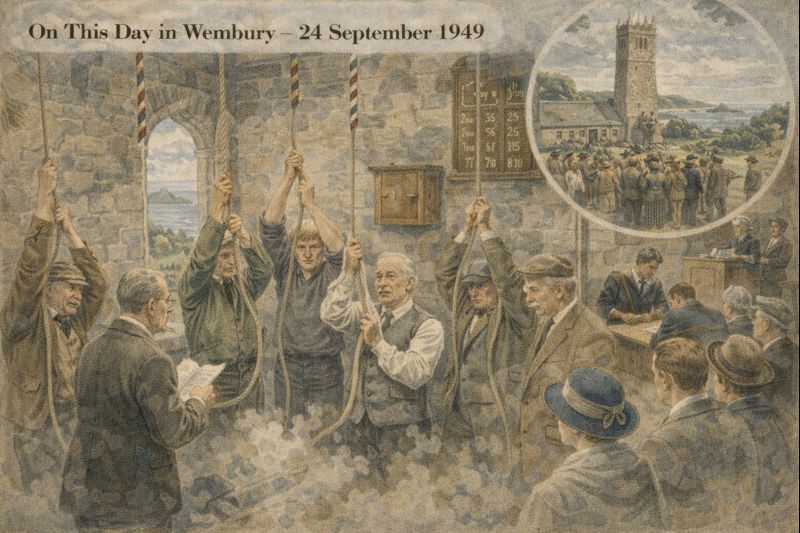
On This Day in Wembury – 24 September 1949
The South-West Branch of the Devon Guild of Ringers scheduled one of its 1949 meetings to be held at Wembury on this date (subject to permission). Earlier that year, at the annual branch meeting in Meavy, members from across Devon gathered to ring, attend service, and conduct business, with officers re-elected and reports showing healthy growth. Among the dates fixed for the year, Wembury was chosen as a host tower, placing the parish firmly within the county’s bell-ringing calendar.
Source: Western Morning News, 21 Jan 1949.
Entries are summaries and interpretations of historical newspaper reports.