
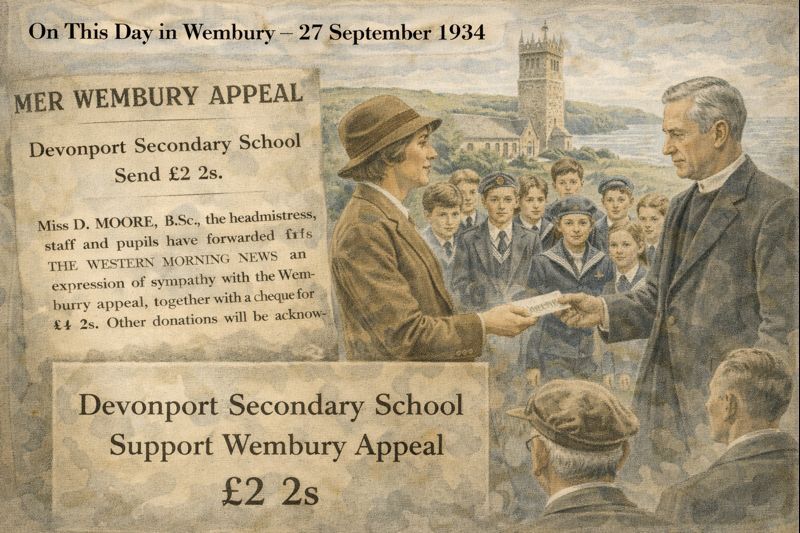
On This Day in Wembury — 27 September 1934
The Western Morning News carried an update on the Wembury appeal, noting a welcome gesture of solidarity from further afield. Staff and pupils of the Devonport Secondary School, led by their headmistress Miss D. Moore, B.Sc., sent a cheque for two guineas, along with greetings and good wishes for the success of the appeal. Other contributions were also acknowledged that day, with readers reminded that donations, however small, would be listed publicly and could be sent via the newspaper, the appeal secretary Rev. F. C. Butters, or the treasurer Mr. A. H. Lower of Exeter, representing the Devon Bird Watching and Preservation Society.
Reflection:
This snapshot from 1934 shows how deeply the Wembury cause resonated beyond the parish. The appeal—linked to conservation and the safeguarding of the cliffs and birdlife—was strengthened by contributions not just from wealthy donors but also from schoolchildren pooling their resources. That Devonport pupils felt moved to act underscores the wider regional recognition of Wembury’s natural heritage. In the long sweep of the village’s history, such moments illustrate how community and conservation have often gone hand in hand, uniting generations in the effort to preserve the coastline.
Source: Western Morning News, 27 September 1934.
On This Day in Wembury — 27 September 1949
“Keep West Wembury on Map” Plea
On 27 September 1949, the Western Morning News reported a rather revealing little dispute about the future of West Wembury.
At the previous night's meeting, Wembury Parish Council had refused permission for a proposed development at Brown's Hill Lane, Clifford, on the grounds that it was “crowd-loaded” — in other words, the councillors believed too much development was being squeezed onto the site.
But the decision prompted Councillor J. M. Brown to make a wider point. He argued that Wembury Parish Council ought to raise the whole question of West Wembury's future with Plymouth Rural District Council.
His concern was a very practical one. He told fellow councillors:
“We must allocate the mains.”
Without proper provision for services, particularly sewer mains, Brown feared that West Wembury would simply be left behind.
A village still taking shape
That concern makes considerably more sense when we look at what West Wembury had been like only a few years earlier.
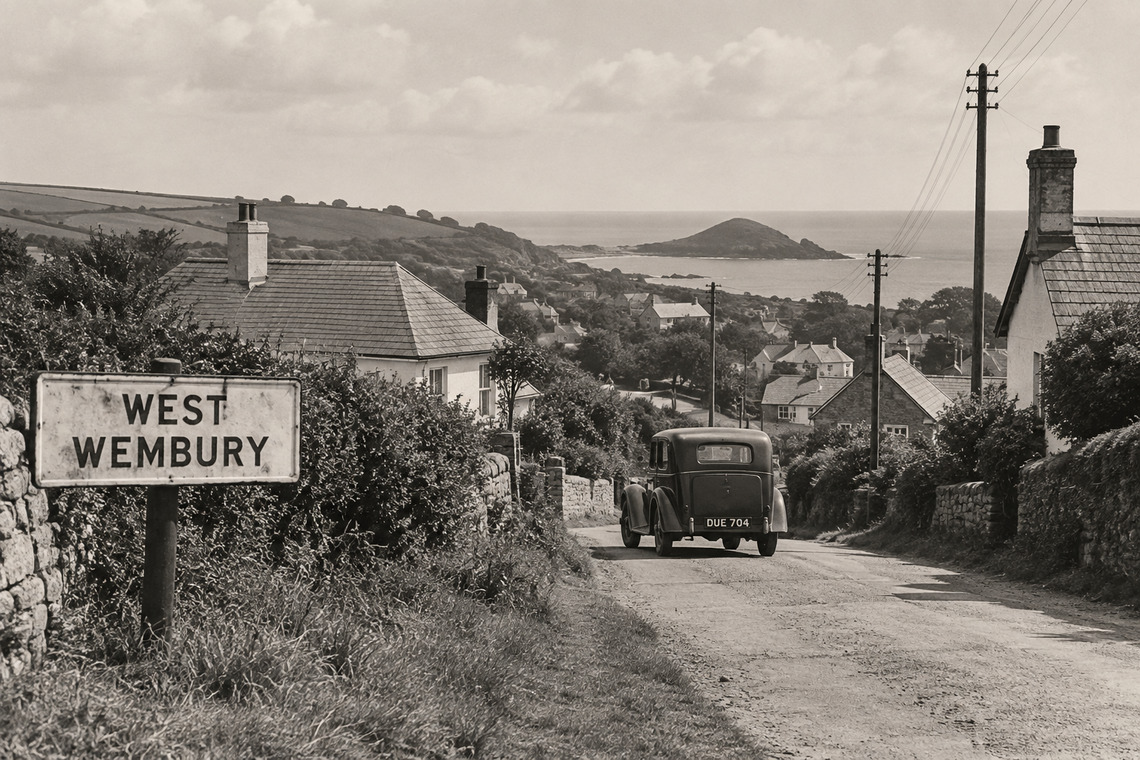
The development of modern Wembury was not a neat, planned expansion of the old village. Land had been divided into plots and sold for building, particularly during the inter-war period. A contemporary description of West Wembury was distinctly unflattering, complaining of converted buses, railway coaches and wooden huts being used as homes, with inadequate water supplies and drainage. It warned that, unless properly planned, the area could become a very poor extension of the old village.
Then came the Second World War, bringing normal civilian development virtually to a halt.
So by 1949, only four years after the war ended, Wembury was entering another period of change. There was enormous demand for housing, but new houses also meant roads, water, drainage and sewage disposal. Councillor Brown was effectively arguing that it was no good allowing West Wembury to grow without ensuring that the infrastructure grew with it.
It is interesting to read his remarks more than 75 years later. Sewage capacity and infrastructure remain very familiar subjects in the parish today; recent Parish Council discussions have again raised concerns about the local sewer network and its ability to cope with development.
The tiny newspaper report therefore captures an important moment in Wembury's transformation — from a scattered mixture of old village, farms, holiday plots and makeshift dwellings into the residential community we recognise today.
And Councillor Brown's plea in September 1949 was straightforward:
Don't forget West Wembury when you're planning its future.
Source: Western Morning News, 27 September 1949.
Entries are summaries and interpretations of historical newspaper reports.