
On This Day in Wembury — 7 October 1916
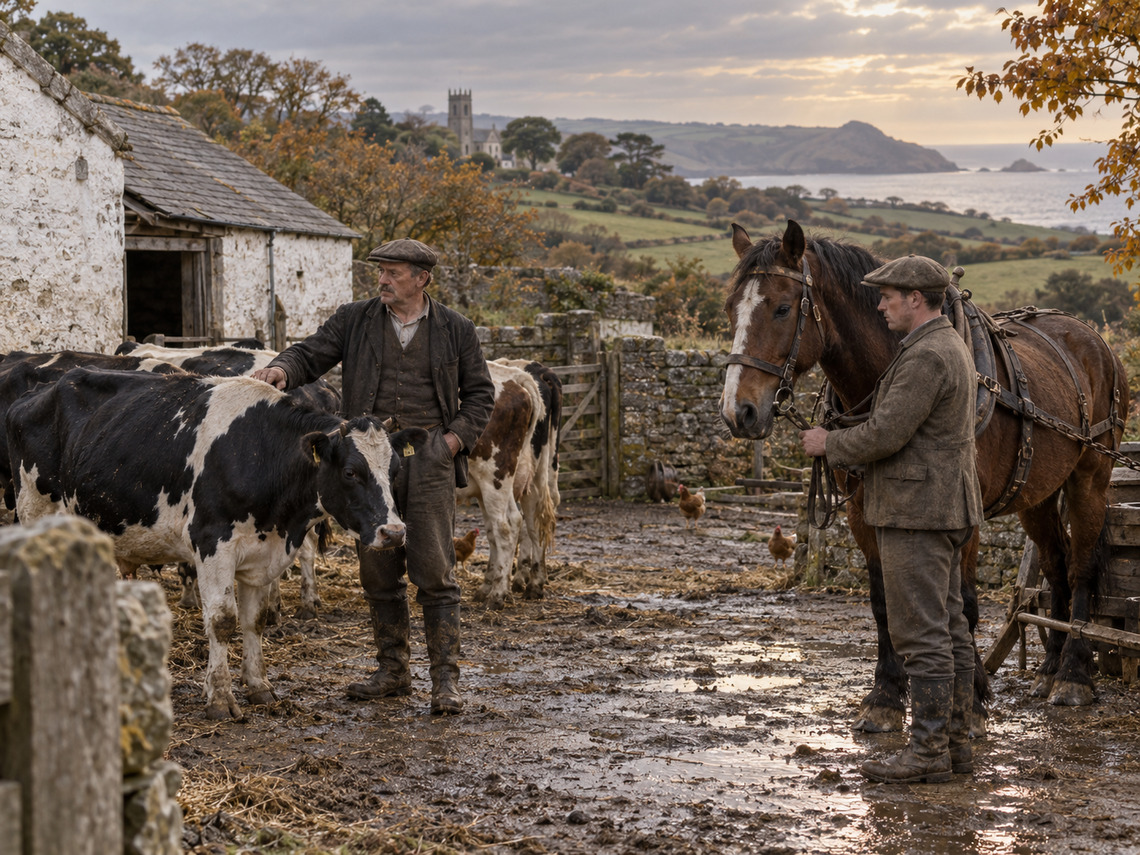
Two Wembury farm workers before the wartime tribunal
On 7 October 1916, the Western Morning News carried a list of cases heard by the military service tribunal, including two men from Wembury whose work was tied to the land at a time when both the Army and agriculture were desperate for manpower.
One was F. G. Walke, described as a cowman of Wembury. His case was decided with the brief but important note: “six months.” That meant he was granted a temporary exemption from military service for six months, allowing him to remain at work for the time being.
The other was R. Andrews of Langdon Farm, Wembury, who applied for exemption as a horseman. In a farming context, a horseman was not simply someone who rode horses, but a skilled agricultural worker responsible for working and managing farm horses, essential for ploughing, hauling and other heavy labour before tractors became common. In his case, the paper recorded the decision starkly: “claim disallowed.” In other words, his application for exemption was refused.
These two short entries open a small but telling window onto village life in the middle of the First World War. By 1916, Britain was trying to balance two urgent needs: sending men into military service, while also keeping enough labour on the land to maintain food production. Men like Walke and Andrews were caught right in the middle of that pressure.
The contrast between the two outcomes is striking. Walke, as a cowman, was considered valuable enough to be kept back for another six months. Andrews, despite his work at Langdon Farm, was not granted the same protection. We are not told here what happened next, but the implication is that his position was judged not sufficient to justify exemption.
So this tiny tribunal report preserves something rather human beneath the official wording: two local working men, both part of Wembury’s farming life, facing very different wartime decisions in the autumn of 1916.
Source: Western Morning News, Saturday 7 October 1916.
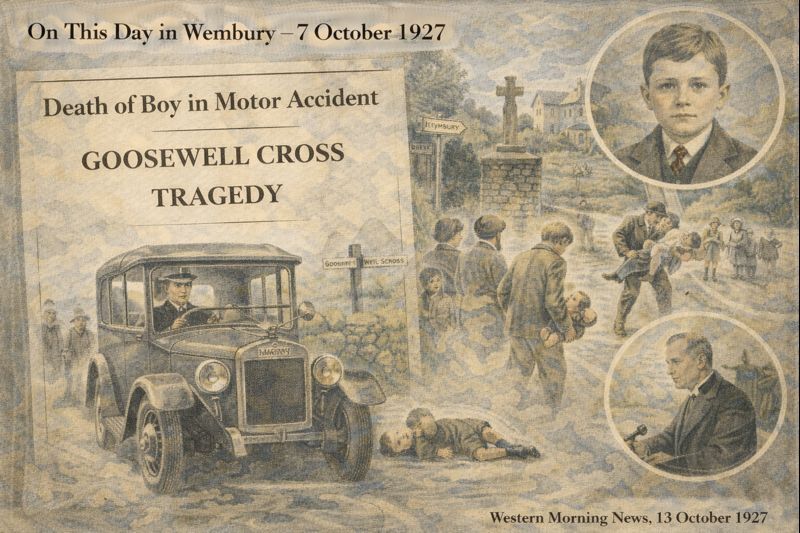
On This Day in Wembury — 7 October 1927
A motor accident at Goosewell Cross claimed the life of seven-year-old John Syms, of Deans Villas, Plymstock. He was struck by a car driven by Rev. Ernest Hughes, rector of Meavy, who was travelling from Wembury towards Meavy. Hughes told the inquest he had been driving at about six miles an hour, sounding his horn continuously, when a group of children ran into the road. One boy escaped but John was hit, carried home, and died the following day. The inquest on 13 October returned a verdict of accidental death, and the coroner urged schools to supervise children across dangerous roads.
Source: Western Morning News, 13 October 1927
The case highlights how quickly motor traffic was transforming rural life. Country lanes, once the preserve of walkers and horse carts, became hazardous as cars grew more common. Goosewell Cross was already a notorious blind corner, and John’s death pressed home the need for safety measures that today we take for granted.
Entries are summaries and interpretations of historical newspaper reports.