
On This Day in Wembury — 10 October 1903

Potholes, puddles and road repairs — some things never change

On 10 October 1903, the Western Morning News reported on a meeting of the Plympton Rural District Council, where the condition of roads around Wembury caused familiar-sounding complaints.

Dr. R.H. Clay complained about the state of the road from his lodge at Wembury, saying that no attempt had been made to keep it in order for six months and that water was running over the surface of the road instead of along the gutter.

The Surveyor told the council that he was attending to the problem.

The same meeting also heard a complaint about Knighton Road. The Surveyor estimated that putting it into anything like proper repair would cost £110, a very substantial sum at the time. The Clerk then pointed out that it was not a parish road, and therefore the council had nothing to do with it.

It is difficult to read the report today without smiling slightly. More than 120 years later, complaints about potholes, poor drainage and who exactly is responsible for fixing a road remain a regular part of local life.

There is even a direct modern parallel. Wembury Parish Council now runs a Road Warden scheme, with local volunteers filling some of the smaller potholes in the parish.

So although the vehicles have changed from horse-drawn carts to cars, the basic problem appears remarkably familiar: rain, damaged road surfaces, blocked drainage — and somebody trying to work out who is supposed to sort it out.

Source: Western Morning News, Saturday 10 October 1903.

10thoct1903.jpg


On This Day in Wembury — 10 October 1912

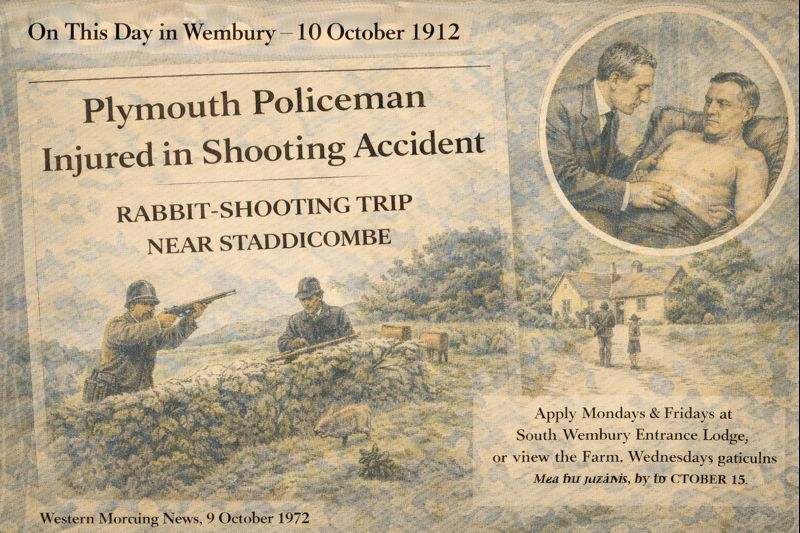
A rabbit-shooting trip near Staddiscombe, close to Wembury, ended in misfortune when a Plymouth policeman was accidentally injured. He had gone out with his brother, also a constable, and Mr. T. Hull of Plymouth. While they worked separately with a hedge between them, a shot appears to have struck a stone or other hard object, deflecting pellets into the lower right side of the officer’s abdomen and groin.

He was quickly attended to, conveyed back to Plymouth, and examined by a doctor. Fortunately, none of the pellets penetrated deeply, and although one or two might remain lodged, his condition was described as comfortable. A full recovery within days was expected.

Source: Western Daily Mercury, 12 October 1912

The episode shows the hazards of informal rabbiting parties in the early 20th century, when a day’s sport could turn dangerous in an instant. It also reminds us how close-knit the communities around Plymouth, Wembury, and Staddiscombe were — where policemen, farmers, and townsmen often joined forces in such rural pursuits.
10-10.jpg

Curated and written by Wembury Waves using material from the British Newspaper Archive.
Entries are summaries and interpretations of historical newspaper reports.