
Wembury On This Day — 18 October 1895
“The laissez-faire attitude of the Wembury Parish Council”
A wonderfully sharp little piece of late-Victorian local politics appeared in the Western Morning News on this day in 1895, when a meeting of Revelstoke Parish Council turned its attention to postal deliveries, the water supply — and, rather pointedly, the condition of a road in Wembury.
The meeting was chaired by Mr G. Lewis, and one of the first matters discussed was the post. The postal authorities were making enquiries following the council’s request for a second delivery of letters. The chairman thought this essential because the district already had a second outward post to Plymouth, and he also wanted the morning delivery brought forward.
The complaint gives a useful glimpse of just how important the postal service was to a rural community in 1895. Before telephones became commonplace, the post was not merely for birthday cards and bills. Letters carried business instructions, orders, legal correspondence, family news and appointments. A letter arriving several hours late could genuinely affect the working day.
The chairman recalled earlier arrangements when letters had apparently been brought via Ivybridge, and the newspaper says that the existing tardiness of the delivery had met with “general censure”.
But then the meeting moved closer to Wembury — and the language became considerably less diplomatic.
A reply had been received concerning “the state of the path at Passage-lane.” Revelstoke had apparently approached Wembury Parish Council over the matter, only to receive an answer saying, in effect, that the complainants were perfectly able to take the issue directly to the District Council themselves.
The Revelstoke chairman was not impressed.
He expressed surprise at what the newspaper described as the “curt tone of the Wembury Council letter”, pointing out that Revelstoke had not actually been obliged to involve Wembury at all before going to the District Council.
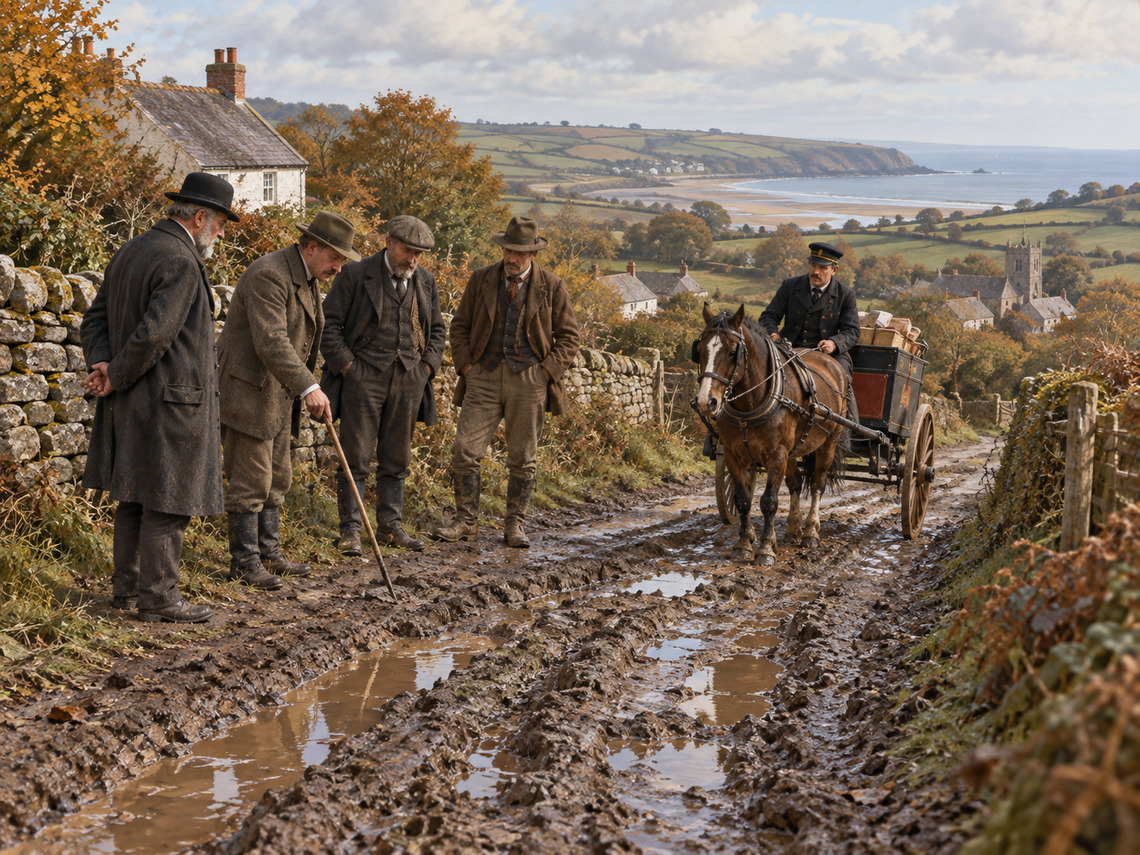
The condition of the route was not regarded as merely a Wembury matter. According to the report, it affected both Revelstoke and Newton Ferrers because it formed part of their main route towards Plymouth. The coastguards, although stationed within Wembury parish, were also said to use the road constantly.
Then came the line which makes the item particularly enjoyable 131 years later.
Mr Bunker, seconded by Mr Ellis, proposed that, owing to the:
“laissez faire attitude of the Wembury Parish Council”
Newton Ferrers Parish Council should be invited to join Revelstoke in making representations directly to the District Council.
The motion was carried nem. con. — nemine contradicente, meaning that nobody voted against it.
So, in October 1895, neighbouring councillors were effectively accusing Wembury Parish Council of shrugging its shoulders over the condition of the road.
Some things really do have a long history.
Passage Lane and the road to Plymouth
The reference to Passage Lane is particularly interesting because this corner of the parish had long been important for movement around the Yealm.
Wembury Local History Society’s history of the parish records another dispute associated with Passage Lane, involving an attempt by a landowner to obstruct people and farm traffic using the route to avoid a steep hill. A wall was erected across the end of the lane, litigation followed, and the episode even produced a plaque complaining about the “iniquities of lawyers”.
That does not necessarily mean the 1895 council complaint concerned exactly the same obstruction, but it demonstrates that access around Passage Lane was not a trivial matter. These lanes formed part of a working transport network at a time when journeys that today take a few minutes by car were made on foot, horseback or by horse-drawn vehicle.
The geography also explains why Revelstoke councillors were interested in something technically lying in Wembury. Revelstoke was then a separate civil parish incorporating Noss Mayo; it was not combined with Newton Ferrers to form the modern parish of Newton and Noss until 1935.
The coastal communities around the Yealm were therefore administratively divided even though their roads, ferries, postal services and markets inevitably linked them together.
More than just the road
The same council meeting dealt with another familiar rural concern: water.
The entire Revelstoke council was to form a committee and meet the medical officer and representatives of the District Council to discuss what the newspaper simply called “the water question.”
That brief phrase probably carried considerably more weight to a Victorian reader than it does today. Reliable drinking water and sanitation were major public-health concerns, especially in small communities dependent on wells, springs and local supplies. Revelstoke and Noss Mayo had experienced a devastating cholera outbreak earlier in the nineteenth century; accounts of local history record more than 200 people affected and at least 50 deaths.
The council also found time to criticise the School Committee because its accounts and report had not been displayed for public inspection for the period required by the Education Department.
So in one relatively short meeting we have complaints about postal delays, road maintenance, water supply and public accountability.
It feels surprisingly modern.
A little wider context
The Revelstoke of 1895 was also going through considerable social change.
Much of the surrounding landscape had been transformed during the previous two decades by Edward Baring, Lord Revelstoke, whose Membland Estate included the spectacular coastal carriageway now known as the Revelstoke Drive or Nine Mile Drive. The route was constructed during the 1880s and ran around the coast from the estate towards Noss Mayo; sections survive today as part of the coastal path.
Baring's financial fortunes had collapsed spectacularly in the crisis involving Barings Bank in 1890. Contemporary descriptions record that the lavish rebuilding of the estate and church belonged to the prosperous period immediately before that collapse.
So the councillors meeting in 1895 were living in a district containing the remnants of an extraordinarily wealthy Victorian estate while simultaneously worrying about much more mundane matters: whether the post arrived on time and whether ordinary people could get along a muddy road.
Reflection
It is tempting to read old parish-council reports expecting them to concern a completely different world.
Then along comes one like this.
A neighbouring authority complains about a bad road. Wembury apparently replies that it is somebody else's problem. The neighbouring council takes exception to the tone of the reply, describes Wembury's attitude as “laissez faire”, and decides to escalate the matter to the next tier of local government.
Strip away the horses, the Victorian postal service and the Latin terminology, and the exchange could almost have taken place yesterday.
But underneath the amusement is a useful piece of Wembury history. It shows how interconnected these supposedly isolated villages already were in 1895. A neglected lane in Wembury mattered to people in Revelstoke and Newton Ferrers; coastguards depended upon it; Plymouth was the destination beyond it; and several different authorities had some claim to responsibility for it.
Roads, water, postal services and arguments over which council ought to do something about them — apparently the essentials of parish life have not altered quite as much as we might imagine.
Source: Western Morning News, 18 October 1895.
Wembury On This Day — 18 October 1895
“The laissez-faire attitude of the Wembury Parish Council”
A wonderfully sharp little piece of late-Victorian local politics appeared in the Western Morning News on this day in 1895, when a meeting of Revelstoke Parish Council turned its attention to postal deliveries, the water supply — and, rather pointedly, the condition of a road in Wembury.
The meeting was chaired by Mr G. Lewis, and one of the first matters discussed was the post. The postal authorities were making enquiries following the council’s request for a second delivery of letters. The chairman thought this essential because the district already had a second outward post to Plymouth, and he also wanted the morning delivery brought forward.
The complaint gives a useful glimpse of just how important the postal service was to a rural community in 1895. Before telephones became commonplace, the post was not merely for birthday cards and bills. Letters carried business instructions, orders, legal correspondence, family news and appointments. A letter arriving several hours late could genuinely affect the working day.
The chairman recalled earlier arrangements when letters had apparently been brought via Ivybridge, and the newspaper says that the existing tardiness of the delivery had met with “general censure”.
But then the meeting moved closer to Wembury — and the language became considerably less diplomatic.
A reply had been received concerning “the state of the path at Passage-lane.” Revelstoke had apparently approached Wembury Parish Council over the matter, only to receive an answer saying, in effect, that the complainants were perfectly able to take the issue directly to the District Council themselves.
The Revelstoke chairman was not impressed.
He expressed surprise at what the newspaper described as the “curt tone of the Wembury Council letter”, pointing out that Revelstoke had not actually been obliged to involve Wembury at all before going to the District Council.
The condition of the route was not regarded as merely a Wembury matter. According to the report, it affected both Revelstoke and Newton Ferrers because it formed part of their main route towards Plymouth. The coastguards, although stationed within Wembury parish, were also said to use the road constantly.
Then came the line which makes the item particularly enjoyable 131 years later.
Mr Bunker, seconded by Mr Ellis, proposed that, owing to the:
“laissez faire attitude of the Wembury Parish Council”
Newton Ferrers Parish Council should be invited to join Revelstoke in making representations directly to the District Council.
The motion was carried nem. con. — nemine contradicente, meaning that nobody voted against it.
So, in October 1895, neighbouring councillors were effectively accusing Wembury Parish Council of shrugging its shoulders over the condition of the road.
Some things really do have a long history.
Passage Lane and the road to Plymouth
The reference to Passage Lane is particularly interesting because this corner of the parish had long been important for movement around the Yealm.
Wembury Local History Society’s history of the parish records another dispute associated with Passage Lane, involving an attempt by a landowner to obstruct people and farm traffic using the route to avoid a steep hill. A wall was erected across the end of the lane, litigation followed, and the episode even produced a plaque complaining about the “iniquities of lawyers”.
That does not necessarily mean the 1895 council complaint concerned exactly the same obstruction, but it demonstrates that access around Passage Lane was not a trivial matter. These lanes formed part of a working transport network at a time when journeys that today take a few minutes by car were made on foot, horseback or by horse-drawn vehicle.
The geography also explains why Revelstoke councillors were interested in something technically lying in Wembury. Revelstoke was then a separate civil parish incorporating Noss Mayo; it was not combined with Newton Ferrers to form the modern parish of Newton and Noss until 1935.
The coastal communities around the Yealm were therefore administratively divided even though their roads, ferries, postal services and markets inevitably linked them together.
More than just the road
The same council meeting dealt with another familiar rural concern: water.
The entire Revelstoke council was to form a committee and meet the medical officer and representatives of the District Council to discuss what the newspaper simply called “the water question.”
That brief phrase probably carried considerably more weight to a Victorian reader than it does today. Reliable drinking water and sanitation were major public-health concerns, especially in small communities dependent on wells, springs and local supplies. Revelstoke and Noss Mayo had experienced a devastating cholera outbreak earlier in the nineteenth century; accounts of local history record more than 200 people affected and at least 50 deaths.
The council also found time to criticise the School Committee because its accounts and report had not been displayed for public inspection for the period required by the Education Department.
So in one relatively short meeting we have complaints about postal delays, road maintenance, water supply and public accountability.
It feels surprisingly modern.
A little wider context :)
The Revelstoke of 1895 was also going through considerable social change.
Much of the surrounding landscape had been transformed during the previous two decades by Edward Baring, Lord Revelstoke, whose Membland Estate included the spectacular coastal carriageway now known as the Revelstoke Drive or Nine Mile Drive. The route was constructed during the 1880s and ran around the coast from the estate towards Noss Mayo; sections survive today as part of the coastal path.
Baring's financial fortunes had collapsed spectacularly in the crisis involving Barings Bank in 1890. Contemporary descriptions record that the lavish rebuilding of the estate and church belonged to the prosperous period immediately before that collapse.
So the councillors meeting in 1895 were living in a district containing the remnants of an extraordinarily wealthy Victorian estate while simultaneously worrying about much more mundane matters: whether the post arrived on time and whether ordinary people could get along a muddy road.
It is tempting to read old parish-council reports expecting them to concern a completely different world.
Then along comes one like this.
A neighbouring authority complains about a bad road. Wembury apparently replies that it is somebody else's problem. The neighbouring council takes exception to the tone of the reply, describes Wembury's attitude as “laissez faire”, and decides to escalate the matter to the next tier of local government.
Strip away the horses, the Victorian postal service and the Latin terminology, and the exchange could almost have taken place yesterday.
But underneath the amusement is a useful piece of Wembury history. It shows how interconnected these supposedly isolated villages already were in 1895. A neglected lane in Wembury mattered to people in Revelstoke and Newton Ferrers; coastguards depended upon it; Plymouth was the destination beyond it; and several different authorities had some claim to responsibility for it.
Roads, water, postal services and arguments over which council ought to do something about them — apparently the essentials of parish life have not altered quite as much as we might imagine.
Source: Western Morning News, 18 October 1895.
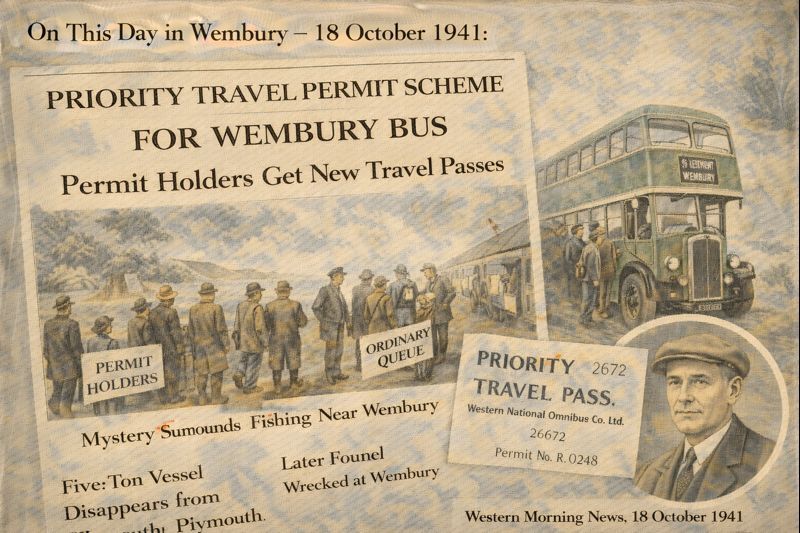
On This Day in Wembury — 18 October 1941:
Travel permit scheme introduced for Wembury bus
The Western National Omnibus Company announced the start of a new registration system for bus travel, giving priority at rush hours to holders of special travel permits. For the time being the scheme applied only to Services 95 and 95a (Plymouth—Dean Cross—Hooe), 96 (Plymouth—Wembury), and 96a (Plymouth—Elburton).
Permit holders, identified as engaged on essential war work, were to be given first consideration during peak hours, with queues at main stops divided into two lines. The company stressed that no passengers would be refused if accommodation was available, but wartime pressure on services made priority necessary. The scheme took effect from 20 October 1941.
Source: Western Morning News, 18 Oct 1941
Entries are summaries and interpretations of historical newspaper reports.