
- Home
- On this day in Wembury
- 10-19
ChatGPT said:
Wembury On This Day — 19 October 1923
The death of Henry Penrose Prance — and a Wembury family connection
The Western Morning News & Mercury carried a substantial obituary on this day in 1923 for Henry Penrose Prance, a prominent Plymouth solicitor whose life had been closely tied to the civic, professional and cultural affairs of the town.
The headline described him simply as “A worthy Plymothian”, and that seems to have been more than newspaper politeness. The article paints the picture of a man who spent decades in voluntary public service, particularly in Plymouth’s legal and intellectual life, before retiring only a few years before his death.
Prance had died on the evening of 17 October 1923 at his home, Whitchurch, Mannamead, Plymouth. He was a member of a well-known Plymouth legal family and had followed his father, William Henry Prance, into the profession. Contemporary directories list Henry Penrose Prance as a solicitor at 7 Athenaeum Terrace, Millbay Road, and the Rugby School register records that he entered Rugby aged 14 in 1864 and was admitted as a solicitor in 1873.
The obituary says that he became one of the town’s best-known figures and was especially associated with what it called Plymouth’s “intellectual thought.” That phrase is revealing. He was not simply a lawyer who happened to sit on committees; much of his public life centred on institutions intended to broaden access to education, books, lectures and debate.
One of the clearest examples was the Plymouth Proprietary Library. The newspaper records that Prance had been its honorary treasurer for many years and later served on its committee. The library was one of the town’s important nineteenth-century cultural institutions, providing books, periodicals and reading-room facilities at a time when such resources were far less readily available than today.
The obituary also emphasised his legal standing. Prance had twice served as President of the Plymouth Law Society, first in 1895 and again in 1914. The Society’s own historical list confirms both terms.
But the tone of the newspaper suggests that his reputation rested just as much on unpaid work as on his profession. Under the heading “Voluntary Service”, it described the various causes into which he had quietly put his time and energy. It specifically noted his long involvement with hospital work and other local organisations, presenting him as one of those Victorian and Edwardian civic figures who regarded public service almost as an obligation of position.
That sort of service mattered greatly before the development of the modern welfare state. Hospitals, libraries, schools, charitable institutions and professional bodies often depended upon local people prepared to give considerable amounts of unpaid time to committees, fundraising and administration.
The Wembury connection
For Wembury, however, the final paragraph is the important one.
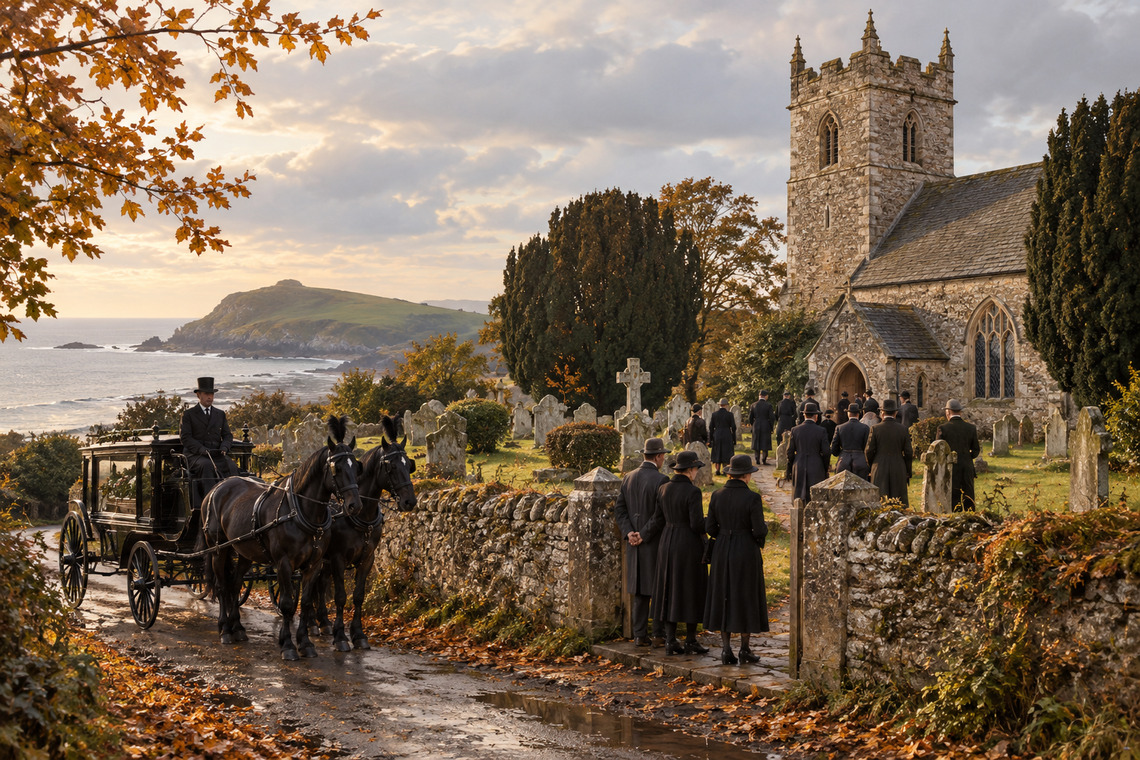
The obituary announced that Prance’s funeral would take place in the family vault at Wembury, followed by a service at St Andrew’s Church, Plymouth.
The Prance family had a long-established association with Wembury. The family history records that there is a Prance family vault in the churchyard at St Werburgh’s Church, together with memorial tablets inside the church.
And Henry Penrose Prance’s connection did not end with his burial.
In the same year, a gilded oak altar set — cross and candlesticks — was presented to Wembury Church in his memory. Wembury Local History Society’s own records note that the cross carries the inscription commemorating Henry Penrose Prance of Plymouth, 17 October 1923. The set was restored and re-dedicated in 2012, when two matching candlesticks were added.
That gives this newspaper obituary a particularly tangible link with Wembury. The man whose death was reported across several columns of the Plymouth press in October 1923 is still commemorated inside the parish church a century later.
A family rooted in Plymouth and Wembury
The wider Prance family was deeply embedded in Plymouth life. Members of the family became doctors, solicitors and businessmen, and the family history credits earlier generations with involvement in the founding of the Devon and Cornwall Banking Company and in Plymouth medical institutions.
Henry’s son Cyril Seymour Coode Prance continued that tradition of public service. He became a prominent Plymouth surgeon, later receiving the OBE, and was involved with hospital administration, St John Ambulance and local government.
There is therefore a strong sense of continuity here. Henry Penrose Prance belonged to a Victorian generation in which professional success and civic duty were closely linked, while later generations of the same family continued much the same pattern.
What makes this story worth including in Wembury’s history is that the village connection is easy to miss.
Henry Penrose Prance was primarily a Plymouth man. His career, professional life and most of his public service were centred there. Yet when he died, his final resting place was not in the city but in the family vault at Wembury.
And within St Werburgh’s Church there remains a physical memorial to him.
The newspaper obituary is therefore more than a record of the death of a respected solicitor. It is a reminder of the old social and family ties that linked Wembury with Plymouth long before modern commuting made the two seem naturally connected.
A century later, the gilded altar set and the family vault still preserve the name of a man whom the newspaper remembered for a “life of voluntary service to town.”
Source: Western Morning News & Mercury, 19 October 1923.
On This Day in Wembury — 19 October 1938
Bazaar in Aid of Medical Missions to India
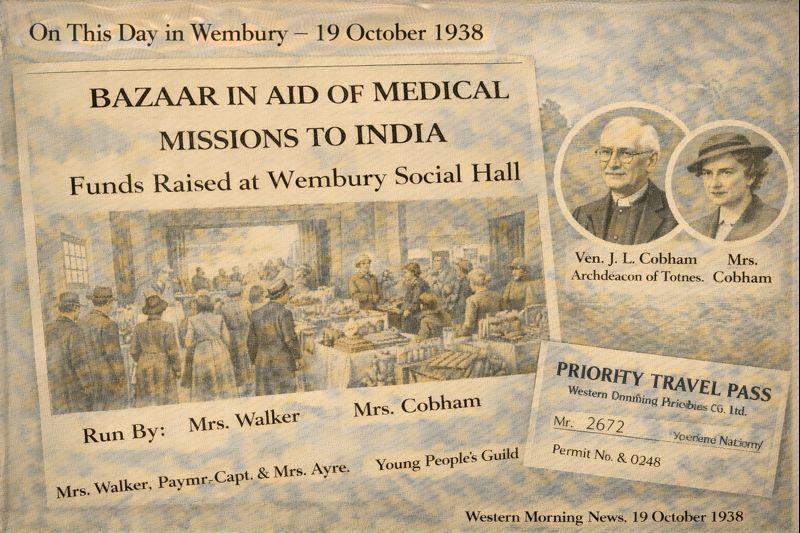
On this day, the Western Morning News reported on how the Social Hall in Wembury hosted a busy bazaar to raise funds for medical missions in India. The Archdeacon of Totnes, Ven. J. L. Cobham, gave a short address, stressing the importance of supporting this practical and humane work overseas. Mrs. Cobham formally opened the sale, praising the stallholders for the attractiveness and variety of their displays.
The Vicar, Rev. C. Young, chaired proceedings, while Paymaster-Capt. L. C. E. Ayre and Mrs. C. Walker offered thanks. Stalls were run by Mrs. Walker, Paymr.-Capt. and Mrs. Ayre, Mrs. E. D. W. Church, Mrs. Hardy, the Church Working Party, and the Young People’s Guild. Tea was served by Miss Henderson and helpers from Heybrook Bay, and the hall itself had been decorated by Mrs. Baston and her team.
This small village event sits within the wider story of Wembury’s long-standing links between parish life and global causes. While the village raised funds for its own Social Hall just a year earlier, here it turned outward, reflecting how even small communities in Devon saw themselves as part of worldwide humanitarian and church networks on the eve of the Second World War.
📖 Source: Western Morning News, 19 October 1938
Entries are summaries and interpretations of historical newspaper reports.