
Wembury On This Day, 24 October 1933
A stolen bicycle and a sailor on remand
A small but intriguing crime story with a Wembury connection appeared in the Western Morning News on this day in 1933.
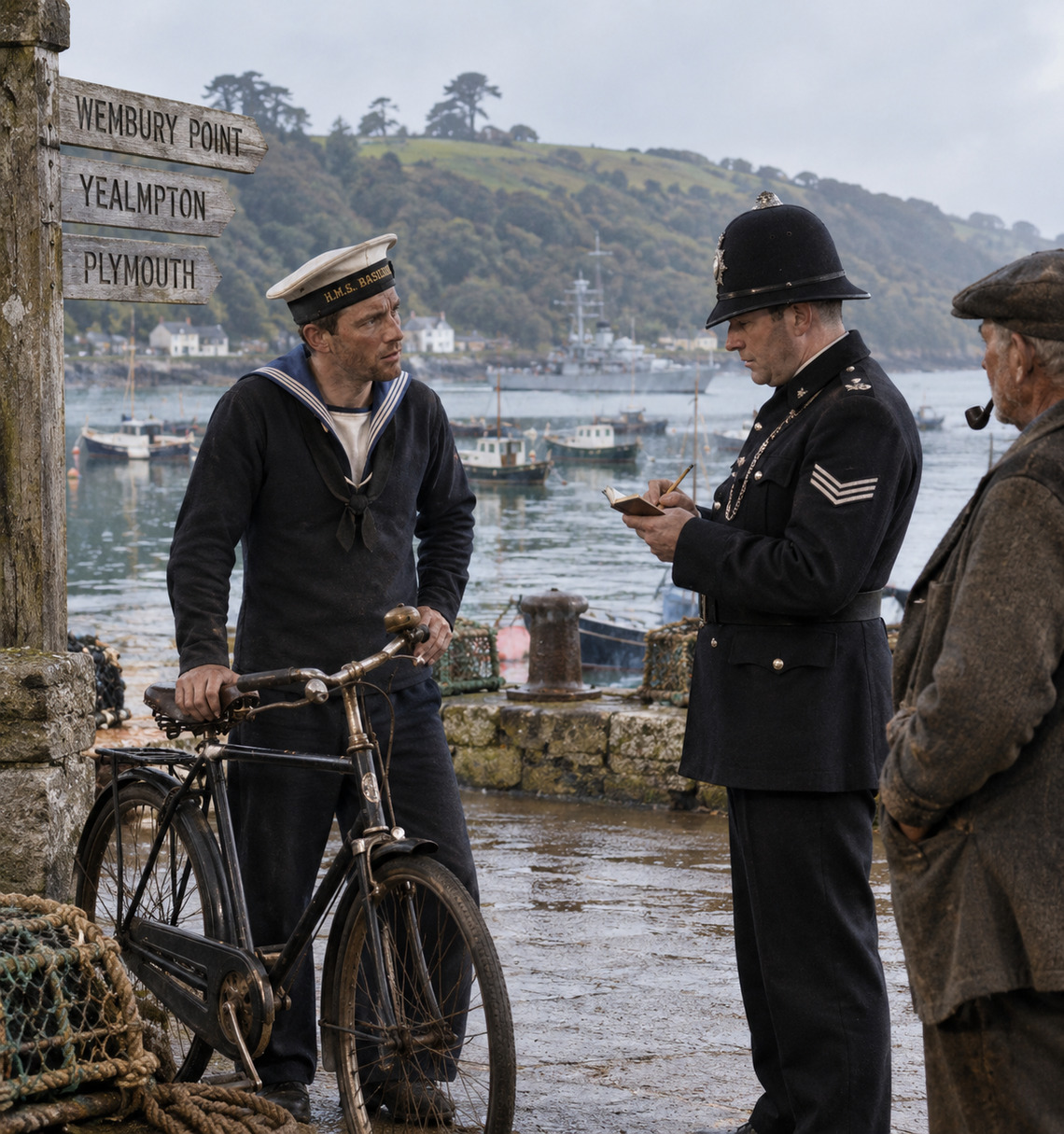
The paper reported that a sailor attached to HMS Basilisk at Devonport had been remanded at Torquay while police arranged an escort from Yealmpton.
The man was Wilfred Harbottle.
According to Superintendent A. E. Martin, Harbottle had been seen near Torquay Railway Station by Constable Bott. The constable questioned him about a pedal bicycle in his possession.
The enquiry soon took an unexpected turn.
Harbottle eventually admitted, according to the report, that he had stolen the bicycle from Wembury Point, near Plymouth.
Further enquiries were then made and police discovered that a bicycle matching the one in question had indeed been reported missing.
It is a very brief court report, but it catches several different strands of local life in a few lines.
Wembury Point in 1933 was not yet the later HMS Cambridge gunnery establishment familiar to generations of local residents. The military occupation of the Point came during the Second World War. In the early 1930s the area was still known for the holiday camp that had been established there during the interwar period, together with the open coastal landscape around it.
That makes the theft particularly interesting. A bicycle left at Wembury Point could have belonged to a local resident, holidaymaker, worker or visitor. In an era when bicycles were one of the most important forms of everyday transport, losing one was a serious inconvenience.
For many people a bicycle was not recreational equipment. It was the way they travelled to work, visited neighbouring villages, reached shops and railway stations, or simply got around a countryside where public transport could be limited.
Harbottle himself was serving at Devonport. HMS Basilisk was the name associated at different times with Royal Navy establishments and vessels, and in this context the newspaper identifies him simply as a sailor attached to Basilisk at Devonport.
The geography of his arrest is also striking.
The bicycle had apparently disappeared from Wembury Point, yet Harbottle was later encountered near Torquay railway station, roughly forty miles away by road. Whether he had ridden the whole distance, combined cycling with another form of transport, or intended to travel farther is not explained.
The fact that he was being held at Torquay pending an escort from Yealmpton shows how local policing and court administration worked across districts. Yealmpton was the relevant local centre for the Wembury area, so officers there would have had responsibility for taking the case forward.
It also gives the report a rather old fashioned flavour. Today we would probably think in terms of transferring a suspect between police stations. In 1933 the newspaper spoke quite literally of awaiting an escort.
The story is a reminder of how visible a stolen bicycle could be in a period before mass car ownership. A stranger moving through town with a cycle could attract attention, especially if a constable had reason to ask where it had come from.
And Harbottle's case appears to have unravelled very quickly.
The constable saw him near the station, asked about the bicycle, and before long the trail led back to Wembury Point.
There is also a nice contrast with the modern image of Wembury Point as a place of walkers, wildlife and coastal views. In 1933 it was part of a much more mobile interwar landscape, visited by holidaymakers, cyclists and people moving between the coast and Plymouth.
This little report survives not because the crime was especially serious, but because it is exactly the kind of ordinary event that brings a place to life.
A bicycle disappears from Wembury Point.
A sailor turns up with one near Torquay station.
A policeman asks a few questions.
And within a day or two the matter is in the newspaper.
Source: Western Morning News, 24 October 1933.
On This Day in Wembury
24 October 1987 — RNLI Craft Fair at Wembury Village Hall
On this day Wembury Village Hall hosted an RNLI Craft Fair from 10.30 a.m. to 4 p.m., as advertised in Plymouth Extra a few days earlier. Such events brought together local makers, bakers, and craftspeople to raise funds for the Royal National Lifeboat Institution.
Reflection: For a coastal parish like Wembury, the RNLI has always been more than a charity — it is a lifeline. Though Wembury itself has no lifeboat station, the community has long supported nearby crews at Plymouth and Salcombe. Craft fairs and similar events provided a social focus as well as vital fundraising, linking inland village life with the perils of the sea. The 1987 fair continues that tradition of local solidarity with those who save lives offshore.
Source: Plymouth Extra, 22 October 1987 (advertising event for 24 October).

Entries are summaries and interpretations of historical newspaper reports.