
Wembury On This Day, 27 October 1917
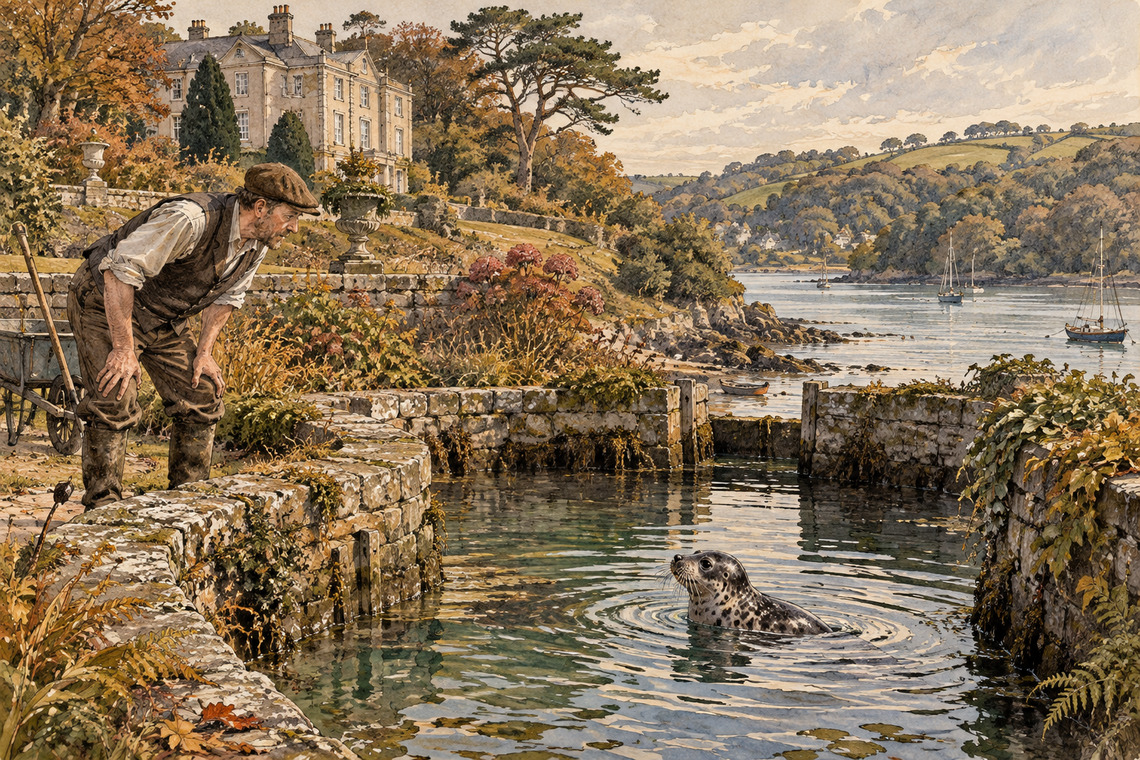
A seal shot in the old fishpond at South Wembury House
A short but striking report in the Cornish & Devon Post on this day in 1917 records an unusual visitor to South Wembury House, now known as Thorn House.
The newspaper reported that Mr F. Heard, gardener at South Wembury House, had noticed what he thought was an otter in the fishpond in the grounds, into which the tide flowed.
He fetched a gun and shot the animal.
Only afterwards was it discovered that the supposed otter was actually a young seal.
The paper described it as one of the common variety and gave its dimensions as 3 ft 9 ins long and 3 ft 2 ins across.
It is an extraordinary little story, partly because of the mistake itself, but also because it tells us something very specific about the setting of South Wembury House.
The newspaper’s reference to a fishpond into which the tide flowed is especially interesting, because this was almost certainly not just an ornamental garden pond. Historic mapping records an “Old Fish Pond” in Wembury Wood on the Yealm below South Wembury House. The wider Thorn estate has much older roots, associated with the historic Manor of South Wembury and with Plympton Priory. Its tidal connection with the Yealm would explain perfectly how a young seal could have found its way into it.
That makes the story rather more interesting than a simple case of an animal straying into a garden pond.
The seal had entered what appears to have been an old tidal fishpond forming part of a much older riverside landscape.
South Wembury House itself had developed from the property once known as Lockyer’s Cottage, becoming a substantial nineteenth century residence overlooking the River Yealm. The site later became known as Thorn House.
By 1917, the house and its grounds represented a very different social world from most of rural Wembury. A property of this size required gardeners, domestic staff and estate workers, and Mr Heard would have been one of the people responsible for maintaining those grounds.
The fact that he initially believed the animal was an otter is understandable in the context of the time.
Otters were often regarded as pests around fisheries and stocked ponds, particularly where landowners valued fish for food or sport. Attitudes towards wildlife were very different from those of today. There was no expectation that someone encountering a wild animal in a fishpond should contact a rescue organisation or conservation body.
A gardener responsible for protecting a stocked pond who believed an otter had entered it might simply have seen the animal as a threat to the fish.
So Mr Heard fetched a gun.
Only once the animal had been killed did the rather embarrassing truth become apparent.
It was not an otter at all.
It was a seal.
There is something almost comic in the sequence when read more than a century later. A gardener notices movement in the fishpond, assumes an otter has arrived among the fish, takes immediate action, and then discovers that a young seal has somehow travelled in from the Yealm.
But the story also gives us a lovely glimpse of the physical character of South Wembury at the time.
The River Yealm was not merely something visible from the windows of the house. Its tides reached into the estate itself. Fish, water and wildlife could move between the river and the old pond.
That relationship with the estuary had probably existed for centuries.
And for one unfortunate young seal in October 1917, the connection between river and estate proved rather too easy to navigate.
It is precisely the sort of tiny newspaper report that helps bring old Wembury back to life. Beneath the rather odd story of mistaken identity is evidence of an ancient riverside landscape, a working country estate, a tidal fishpond and the close relationship between South Wembury and the Yealm.
Source: Cornish & Devon Post, 27 October 1917.
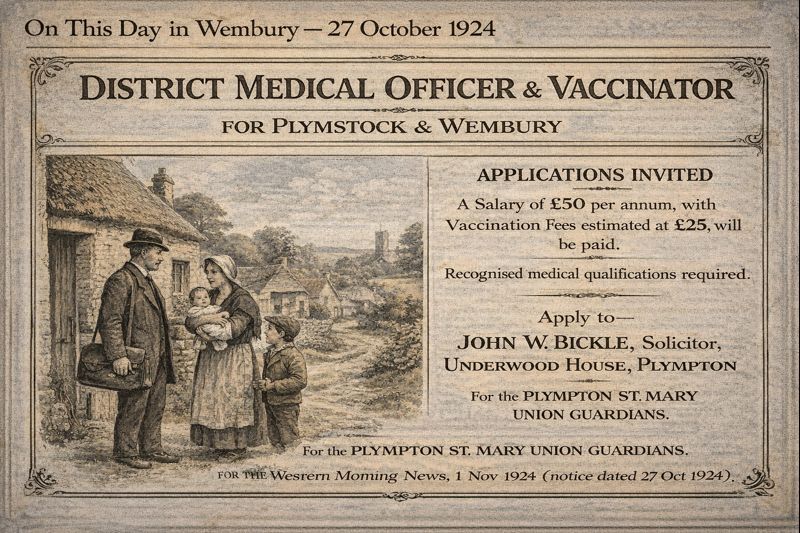
On This Day in Wembury — 27 October 1924: Medical officer and vaccinator post advertised
On this day the Plympton St Mary Union Guardians, through solicitor John W. Bickle of Underwood House, Plympton, issued a notice inviting applications for the post of District Medical Officer and Vaccinator for No. 3 District, covering the parishes of Plymstock and Wembury. The role carried a salary of £50 per year plus vaccination fees estimated at £25, for a district of about 5,930 acres and a population of 4,620. Applicants were required to hold recognised medical and surgical qualifications, with the appointment subject to the sanction of the Ministry of Health.
This illustrates how rural public health was organised in the inter-war period, still under the framework of Poor Law unions and their Guardians. Local medical officers were central to both everyday healthcare and compulsory vaccination duties, part of the gradual transition from Poor Law medicine to the more unified system that would arrive with the National Health Service in 1948.
Source: Western Morning News, 1 Nov 1924 (notice dated 27 Oct 1924)
Entries are summaries and interpretations of historical newspaper reports.