
On This Day in Wembury — 5 November 1945
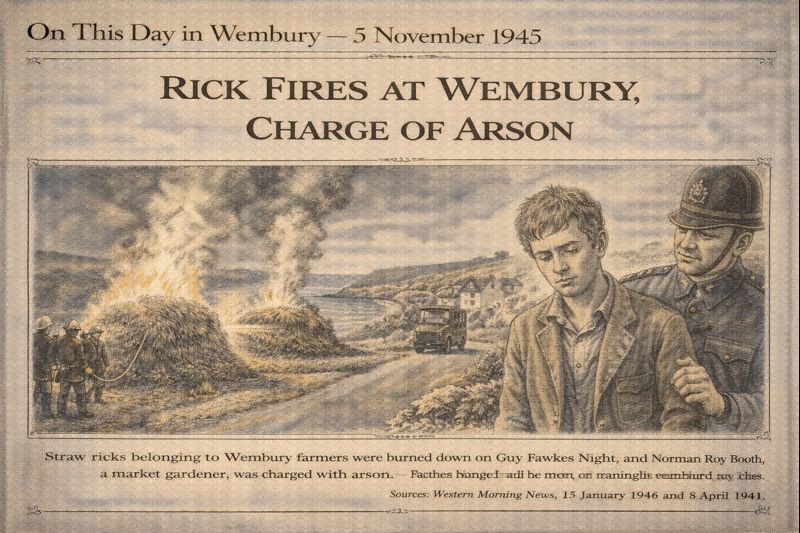
Rick Fires at Wembury, Charge of Arson. On Guy Fawkes Night two straw ricks were destroyed by fire at Train Farm and Folcham Field, Wembury. One, belonging to Mr F C Rowland of Train Farm, was about 12 tons of oaten straw worth £50. The other, belonging to Mr B R Clifton of Folcham, was three and a half tons of barley straw valued at £14. Fire crews could not save them because of lack of water. Norman Roy Booth, 23, market gardener of 1 Watergate Cottages, Wembury, was later charged with arson and allegedly confessed to setting the fires.
At the time rick burning was seen as a very serious crime. Straw and hay ricks were essential winter fodder, and destroying them could threaten livestock and cause heavy financial loss. The association with Guy Fawkes Night added to alarm as fire risk was already high. The damage, worth over £60, was a major blow in 1945 when farming was under tight control and shortages remained. Arson was treated as reckless endangerment since flames could spread to barns or cottages. The case was committed to the Devon Assizes, the senior criminal court, reflecting how grave the charge was.
At the Devon Assizes in April 1946 the outcome was recorded. Booth was described as having a mental age of ten. He was bound over for two years on condition that he abstained from drink and resided with his uncle as guardian. The court concluded he was a "mental defective" (sic) and required supervision rather than imprisonment.
Sources Western Morning News, 15 January 1946 and 4 April 1946
On This Day in Wembury — 5 November 1981
Swedes bring a Wembury lorry to a halt in Suffolk
On 5 November 1981, the Suffolk Free Press reported an unusual accident involving a Wembury man and his young son.
The headline was hard to resist:
“Swede bashers!”
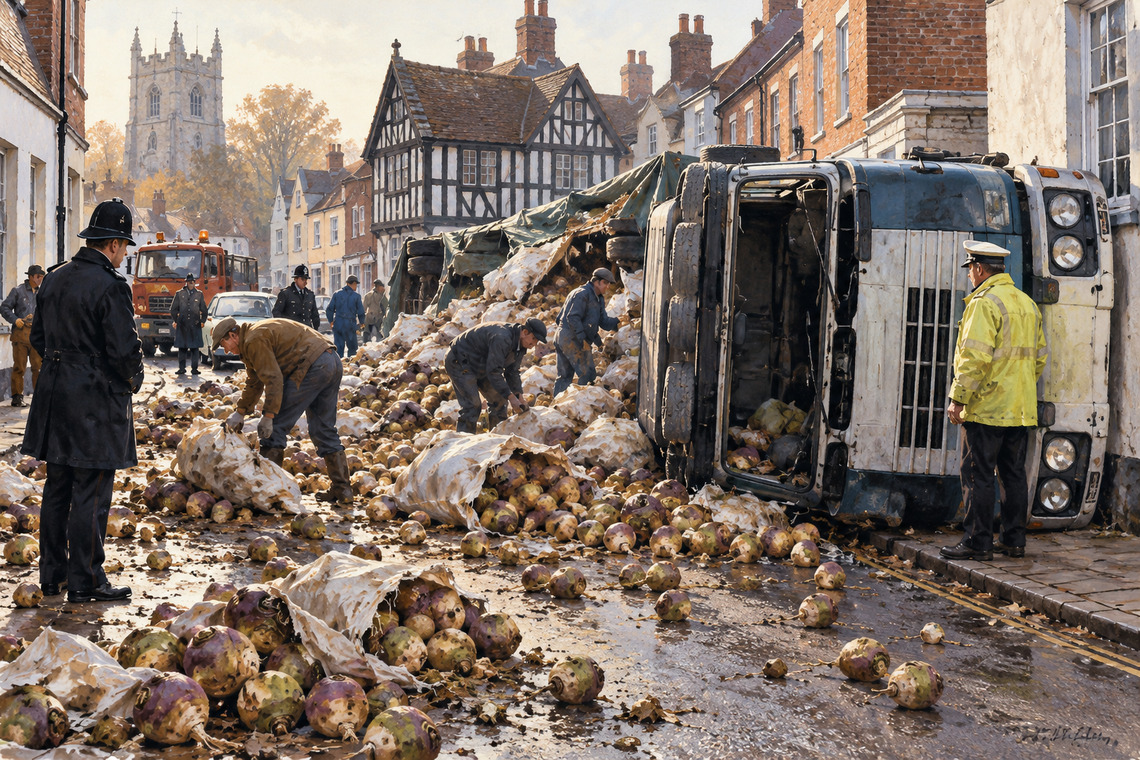
The previous Wednesday morning, at about 7 am, an articulated lorry carrying 18 tons of bagged swedes overturned in Gregory Street, Sudbury, Suffolk.
According to the report, the lorry had been negotiating the sharp bend from Gainsborough Street when it went over, spilling its load across the road and pavement near Kent Blaxill’s yard.
The newspaper said the pavement was completely buried beneath the swedes.
Fortunately, no pedestrian was caught underneath them.
The driver was Mr Graham Camp of Wembury, Plymouth, who had his eight-year-old son James with him. Both were taken to St Leonard’s Hospital suffering from shock but were released after treatment.
Traffic through Gregory Street was disrupted for several hours while the overturned vehicle and its remarkable cargo were cleared away.
The clipping provides one of those wonderfully ordinary but memorable links between Wembury and somewhere far beyond Devon. There was nothing particularly historic about a Wembury lorry driver travelling across the country in 1981, but the circumstances ensured that this particular journey made the local press hundreds of miles away.
Gregory Street itself is part of Sudbury’s historic centre. Several surviving buildings there are now Grade II listed, including Nos. 39, 41 and 43, illustrating just how tight and old-fashioned parts of the street layout still were when a large articulated lorry tried to negotiate the bend in 1981.
The location mentioned in the report also had a long commercial history. Kent Blaxill, whose yard stood nearby, had been trading since 1838 and had developed into a substantial East Anglian builders’ merchant.
The accident must have made quite a sight. Eighteen tons of bagged swedes spilling into a narrow town street would have taken some clearing, and it is perhaps surprising that the newspaper was able to report that nobody had been seriously hurt.
For Graham Camp and his son James, what began as an early morning haul through Suffolk became a hospital visit and a newspaper story.
For everyone else in Gregory Street, it became the morning when the traffic stopped and the pavement disappeared beneath a small mountain of swedes.
Source: Suffolk Free Press, Thursday 5 November 1981.
Entries are summaries and interpretations of historical newspaper reports.