
On This Day in Wembury – 15 November 1895
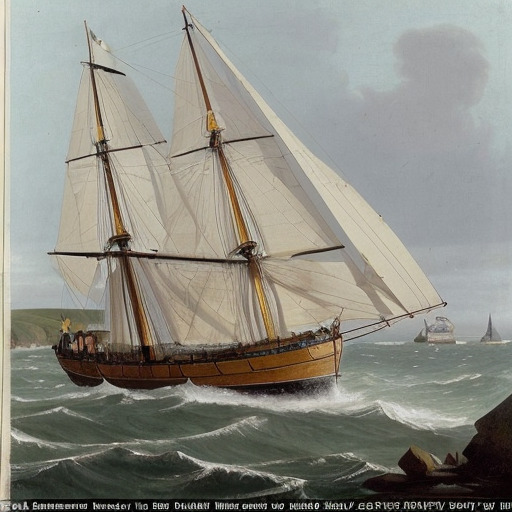
The Norwegian barque August Smith came to grief on the Church Ledge rocks in Wembury Bay during a violent south-west gale. In the thick weather her crew had mistaken the outline of the Mewstone for the distant Eddystone Lighthouse, a navigational error that proved fatal.
By mid-afternoon on Friday the vessel was seen drifting helplessly toward the shore in driving rain and heavy seas. Signals were sent from the Wembury coastguard, and the Plymouth lifeboat was taken under tow by the Government tug Ætna. In the darkness outside the breakwater, however, the lifeboat’s towing bollard gave way and the line parted. The two vessels lost sight of each other and returned separately, leaving the barque on her own.
From Plymouth, Staff-Captain Tomlin (the harbour-master) set out again in the Ætna with a picked crew, while Commander Gray rode on horseback through the storm to Wembury. At the same time a telegram was sent to Mount Batten ordering the rocket life-saving apparatus to be rushed by road to the scene. Early telegraph reports circulated nationwide that “a barque of unknown name” had struck at the west end of Wembury Bay and that her crew were “feared lost.”
In fact the outcome was far less grim. The eleven-man crew of the August Smith, having cut away the foremast to ease the strain and abandoned attempts to save their vessel, were able to climb down and walk ashore once the tide ebbed. Exhausted but alive, they were welcomed by the people of Wembury. The vicar, Rev. Burgess, and villagers gave them food and shelter in the Reading Room, where they spent the night before being taken onward.
The wreck itself lay in about six feet of water, pinned hard on the rocks, her timbers strained and her cargo lost to the sea. Salvage parties from Newton Ferrers and Noss Mayo arrived on the Saturday to recover what they could, but the August Smith was effectively a total loss.
The episode became part of Wembury’s long record of shipwrecks. It was remembered not just for the drama of the storm, but for the contrast between early national reports of disaster and the local reality — that all hands had survived thanks to the chance of the falling tide and the hospitality of the parish.
Sources: Western Daily Mercury, 18 Nov 1895; Fraserburgh Advertiser, 22 Nov 1895.
On This Day in Wembury — 15 November 1937
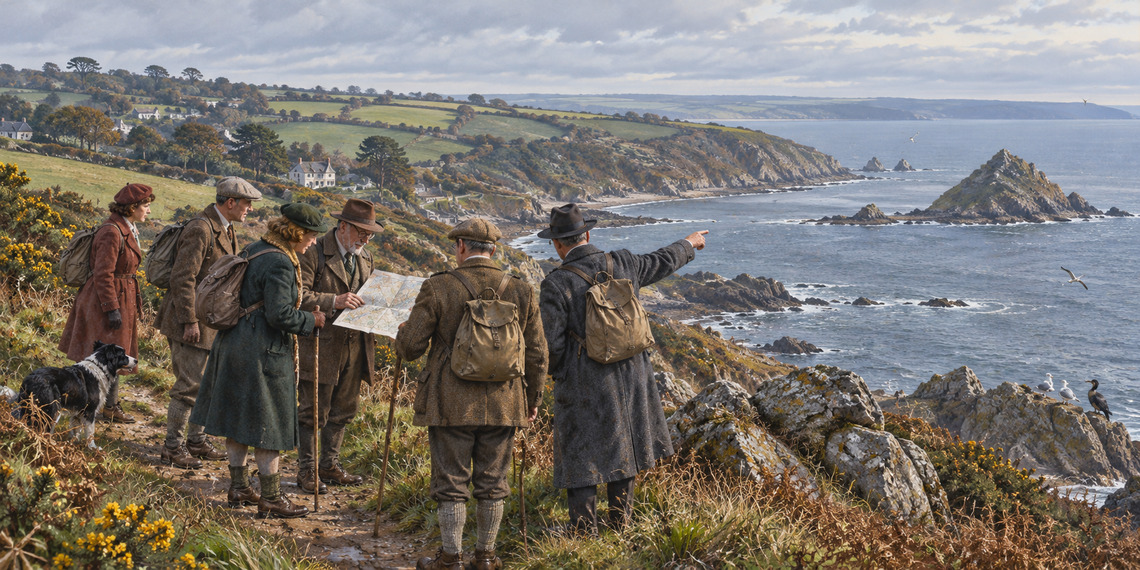
Plymouth ramblers follow the cliffs to Wembury
On 15 November 1937, the Western Morning News reported on the first Saturday ramble of the winter programme organised by the Plymouth Holiday Fellowship.
The walkers had the benefit of an official footpath map supplied by Wembury Parish Council, and their route followed a network of paths where rights of way were sometimes uncertain.
The party set out from Turnchapel and made their way along the cliffs, passing between there and Bovisand. Apart from the section by the golf course, the newspaper reported that they were entitled to walk along the cliff edge.
Their route then carried them through the Wembury Bird Sanctuary, where they enjoyed a particularly memorable view of the Mewstone.
Even in the 1930s, therefore, Wembury was already attracting walkers not just for the scenery but for its wildlife and coastal paths.
The use of an official parish footpath map is particularly interesting. It shows that questions of access, rights of way and established paths were already important locally long before the modern South West Coast Path was created.
Today, public rights of way are still formally mapped and protected, and Wembury remains one of the best-known stretches of walking country on the South Devon coast. The present-day coastal route from Wembury towards Bovisand and Staddiscombe still follows much the same dramatic landscape of cliffs, fields and sea views. Plymouth City Council
The wildlife interest has endured as well. The coast around Wembury is now recognised for its rich bird and marine life, while Wembury Point remains an important place for species including cirl buntings, lizards, adders and numerous coastal birds. National Trust
The newspaper said that the return journey was made by road through Staddiscombe, bringing the total distance to about twelve miles.
There is something pleasingly familiar about the whole outing. A group of walkers sets off with a map, follows the cliffs, stops to admire the Mewstone and spends a day exploring Wembury on foot.
Nearly ninety years later, that is still one of the best ways to experience the place.
Source: Western Morning News, Monday 15 November 1937.
Entries are summaries and interpretations of historical newspaper reports.