
On This Day in Wembury — 18 November 1823
A naval court martial and an urgent ride to Wembury
On 18 November 1823, the Sun in London carried a lengthy report of a Royal Navy court martial at Plymouth which contained an unexpected appearance by Wembury.
The officer on trial was Captain George Harris, commander of the 46-gun frigate HMS Hussar. Earlier that year Harris had been ordered to take Sir Edward Thornton, Britain’s envoy to Portugal, together with his family and entourage, from Plymouth to Lisbon.
The accusation against Harris concerned delays in carrying out those orders.
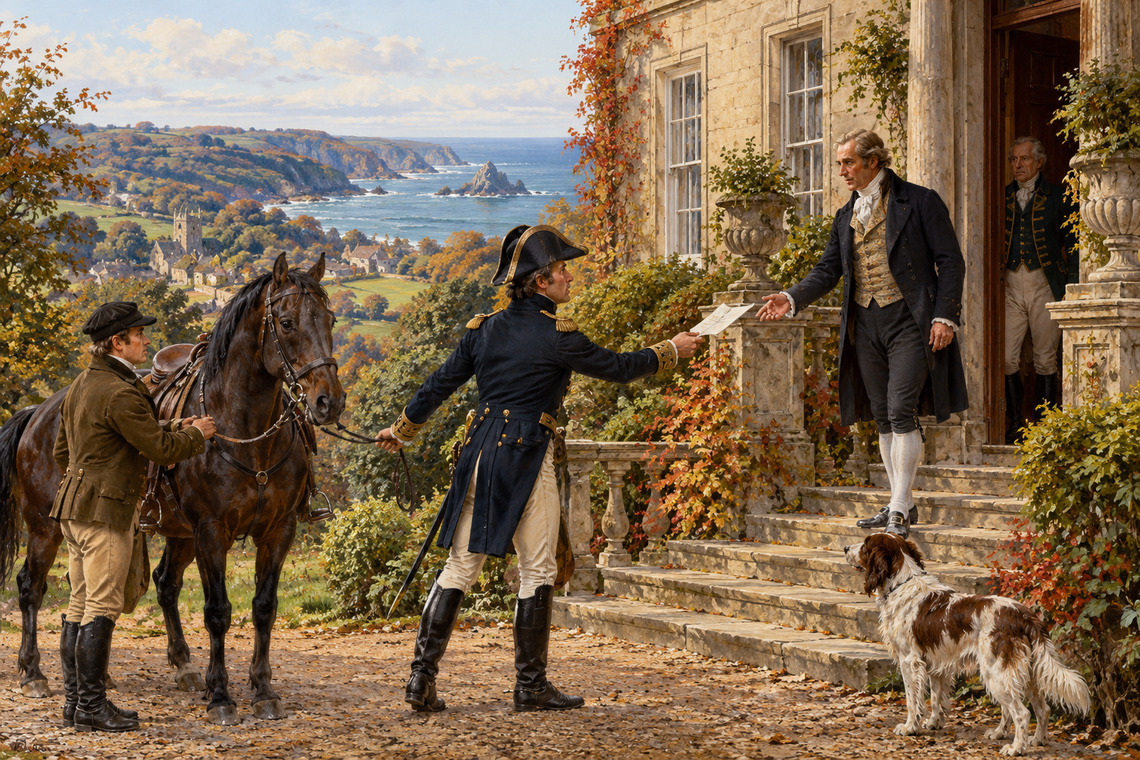
During his defence, Harris described the increasingly frustrating efforts he had made to discover exactly when Thornton intended to embark. At one stage, having received fresh instructions, the captain decided that sending another message was not enough.
He told the court that he:
“procured a horse, and rode to Wembury”
because he was anxious to communicate personally with Sir Edward Thornton.
Thornton was then associated with Wembury House, and the newspaper described Wembury as his seat. The episode therefore gives us a wonderfully specific picture of Wembury in the summer of 1823: a senior Royal Navy captain leaving Plymouth, obtaining a horse and riding out into the countryside in an attempt to find one of Britain’s leading diplomats.
Sir Edward Thornton was an experienced diplomat who had represented Britain in Sweden and Portugal and had played an important part in European diplomacy during and after the Napoleonic Wars. In August 1823 he was being sent back to Portugal as Envoy Extraordinary and Minister Plenipotentiary.
The journey was politically important, but getting the ambassador aboard the Hussar proved anything but straightforward.
Harris maintained that his ship had been ready to sail and that the delays arose because Thornton and his party were not ready to embark when expected. The evidence presented at the court martial included letters, orders, conversations with naval officers and Harris’s repeated attempts to establish precisely when his distinguished passenger intended to appear.
The case ultimately went strongly in Harris’s favour. Contemporary naval biography records that the court found the charges against him unproved and without foundation, concluding that HMS Hussar had been ready for sea and that Harris himself had acted with “zeal and promptitude”. He was honourably acquitted.
Thornton did reach Portugal and continued his diplomatic mission there. His connection with Wembury was to last for many years: later records place him at Wembury House, where he remained until his death in 1852. The Manors of Wembury
The story is an unusual reminder that Wembury was not always as remote from national affairs as its rural setting might suggest. In 1823, while diplomats and Admiralty officials exchanged increasingly urgent letters about a mission to Portugal, part of that drama spilled directly into the parish.
Somewhere on the road from Plymouth, Captain George Harris was riding towards Wembury, carrying news that could not wait for the post.
Two centuries later, that single sentence in his evidence turns a complicated naval court martial into something surprisingly local.
Source: Sun (London), Tuesday 18 November 1823.
On This Day in Wembury – 18 November 1940
WMN reports milk adulteration case at West Wembury Farm
On this day the Western Morning News reported the prosecution of John Henry Smallridge, farmer-dairyman of West Wembury Farm. He was fined 10 shillings and ordered to pay £1 1s. costs at Plympton for selling milk that fell below the legal standard. The public analyst found it contained only 2.52% milk fat, whereas regulations required at least 3%.
Source: Western Morning News, 19 November 1940.
This case sits alongside other glimpses of wartime rural Wembury, where even as the parish dealt with the presence of military defences and tragedies like the 1940 Wilfred Barrack shooting of a sunbather and the RSPCA’s prosecution for a lame horse at West Wembury Dairy, local farmers still faced scrutiny over the quality of basic food supplies.
Milk was a vital rationed commodity in 1940, and prosecutions for adulteration or sub-standard fat content reflected the pressure to maintain fair distribution in a time of scarcity. West Wembury, like Langdon and other historic farms in the parish, had long produced dairy for local communities, and cases like Smallridge’s underline how the everyday agricultural economy of Wembury was drawn into wartime regulation just as surely as its coastline was drawn into national defence.

Entries are summaries and interpretations of historical newspaper reports.